
Microsoft
Activision (Microsoft) · AI / ML · Filed Jul 16, 2026 · USPTO published Nov 12, 2026 · This week's release
Activision Files Patent to Train Game Characters on Players' Real Voice Chat Reactions
Activision's filing describes listening to the voice chat your squad already uses, spotting the shout that follows a big kill, and teaching computer-controlled characters to react the same way.
- Publication number
- US 2026/0355629 A1(US20260355629A1)
- Applicant
- Activision Publishing, Inc.
- Filed · Published
- Jul 16, 2026 · Nov 12, 2026
- Inventors
- Michael Sanders
- Status when we published
- Waiting for an examiner
- Document
- 20 claims
- US classification
- 463/42
- Parent application
- Continuation of 18/397,529 (filed Dec 27, 2023)(18397529)
What Activision's voice-chat NPC patent does
Imagine you land a long-shot kill in a shooter, and your friends on voice chat erupt. Now imagine a computer-controlled character in a later match letting out that same kind of triumphant whoop when something similar happens.
That is the idea in this Activision patent application. The game flags big moments, like a kill, a death or a sudden burst of gunfire, then grabs the voice chat from just before and after (the description gives 10 seconds each way as one example). It pairs each reaction with the moment that caused it, and uses those pairs to teach a neural network (software that learns from examples) what a believable reaction sounds like.
The system also keeps a profile of each player, so a character can pick reactions that fit you, such as ones in your language. Abusive or offensive chatter is meant to be filtered out first.
… capturing reactions of human players and correlating the captured reactions with one or more coinciding game events that have triggered those reactions.
Translation: Recording what players say and matching those remarks up with what just happened in the game.
How the game matches shouts to kills and deaths
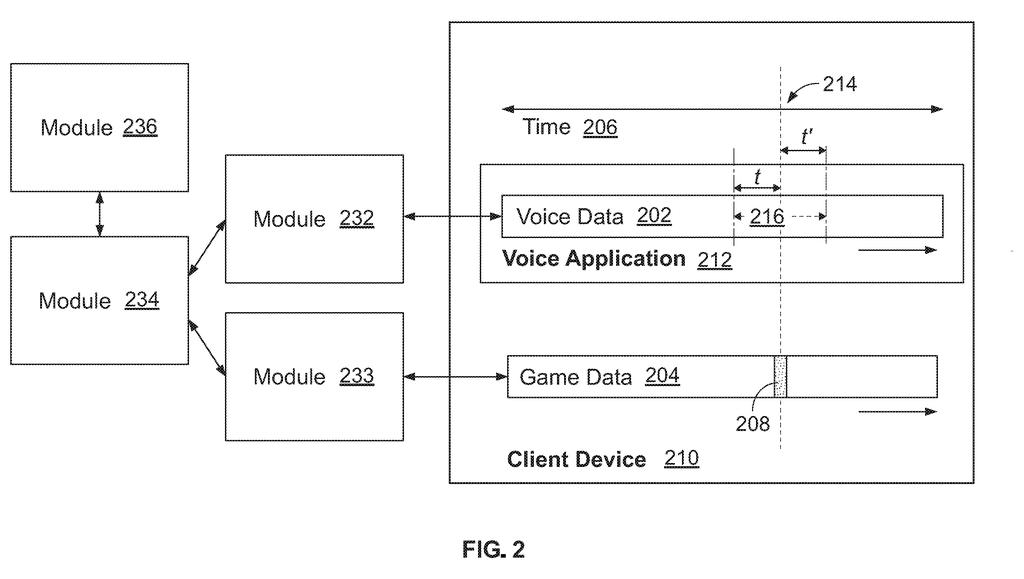
The claims describe a method where two programs run side by side on your device: the game itself, and a separate voice-chat app (the filing names Discord as one example). Normally those two never talk to each other, so the system lines them up using timestamps.
The steps:
- Watch the game for events that match criteria developers set ahead of time, such as a kill, being killed, a celebration or a loss.
- Note when the event happened and pull the voice chat from a stretch before and after it.
- Link that voice clip to the event that likely caused it.
- Keep a player profile that updates as you gain experience, and build a player-specific filter from it to choose which clips to use. The claims name language, location and engagement as profile inputs.
- Update the filter as the profile changes.
The description says a neural network (software that learns patterns from examples) does the learning, including detecting emotion in each voice. It may also use a large language model (the technology behind chatbots) with a layer tuned to a location, language or player.
When a second matching event happens, the game plays a generated reaction, usually from a non-player character (a computer-controlled one). Player feedback on those reactions can retrain the selection.
acquiring voice data from a first application executing at least partially in a client device during a gameplay session, wherein the first application is programmatically separate from, and executes independently from, an instance of a video game …
Translation: Recording what players say through a separate background program running alongside the game.
Why your squad's trash talk could end up in NPCs
If this works, computer-controlled characters in an online match could sound like the people you play with, with real surprise and real trash talk, instead of a handful of canned lines you hear every game. The description also mentions giving a voice to avatars of players who join without a microphone, or who choose to use generated voices.
The bigger question is where the raw material comes from. The reactions come from chat that happens in a separate app, such as Discord, which many players treat as a private space with friends. Anything built on that has to earn trust, and the claims do include a step to filter out abusive or offensive content before anything gets played back.
Microsoft's 21st filing in our Voice & speech AI coverage since May joins earlier work like an AI game recap and teaching chatbots social tone.
Source: US 2026/0355629 A1 at the USPTO (PDF). Full patent text and figures are in the official publication.
Get our take in your Top Stories
Liked this breakdown? Add Patentlyze as a preferred source on Google, and our plain-English take shows up more often in your Top Stories the next time Microsoft patent news breaks.
Add Patentlyze on Google
One click.
There are more where this came from
We read every patent application Big Tech publishes and send you the ones worth knowing. Plain English, free, every week.
The drawings · 4 sheets
4 drawing sheets from US 2026/0355629 A1 · click any drawing to enlarge


More from Microsoft
All 646 Microsoft patents →
More in AI / ML
All 2,637 AI / ML patents →
Sony
Sony Patents a Trick for Giving Game Characters Distinct Voices by Translating Twice
Adobe
Adobe Files Patent for an AI Writer That Copies a Brand's Voice
Google
Google Files Patent for a Voice Layer That Lets Its Text Chatbots Talk
Google
No comments yet