
Qualcomm
Qualcomm · Automotive · Filed Apr 28, 2026 · USPTO published Nov 12, 2026 · This week's release
Qualcomm Patents a Car Vision System That Reads Roads Without a Fixed Grid
Most self-driving software chops the road into a checkerboard and asks each square what it sees. Qualcomm's patent application throws out the checkerboard and lets a set of movable markers go find the pedestrians and lane lines instead.
- Publication number
- US 2026/0358805 A1(US20260358805A1)
- Applicant
- QUALCOMM Incorporated
- Filed · Published
- Apr 28, 2026 · Nov 12, 2026
- Inventors
- Andreas SJOEDIN HAELLSTRAND, Meysam SADEGHIGOOGHARI
- Status when we published
- Waiting for an examiner
- Document
- 20 claims
- US classification
- 701/300
- Parent application
- Claims priority from a provisional application 63801772 (filed May 7, 2025)
What Qualcomm's grid-free car vision actually does
A driver-assist system looks at the road and carves it into a checkerboard. Each square gets asked whether a pedestrian, a vehicle or a lane line is inside it. If two things land in the same square, one can get lost, and lane lines can jump, jitter or show up twice as they cross square edges.
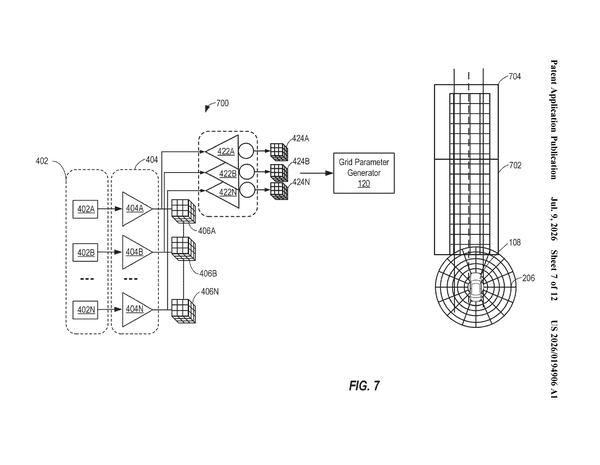
Qualcomm's patent application drops the checkerboard. Instead, the software makes a fixed number of guesses, such as 100, and each one starts from a marker point placed around the car. Each guess can then slide any distance from its marker to land on whatever it found: a person, a vehicle, a stretch of lane line.
For you, the hoped-for result is a car that tracks crowded scenes more smoothly, while its computer does less work to get there.
… process the BEV features using a machine-learning model to generate an output, wherein the output comprises a number of predictions, and wherein each prediction of the number of predictions comprises a respective anchor point and a respective offset relative to the respective anchor point; …
Translation: An AI model analyzes the overhead view to make specific point and distance predictions.
How anchor points slide to where objects are
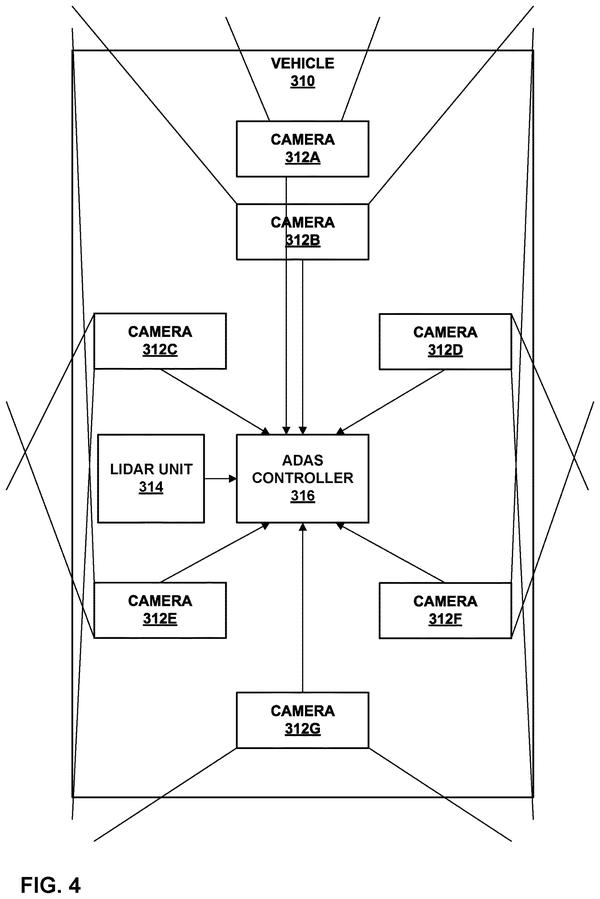
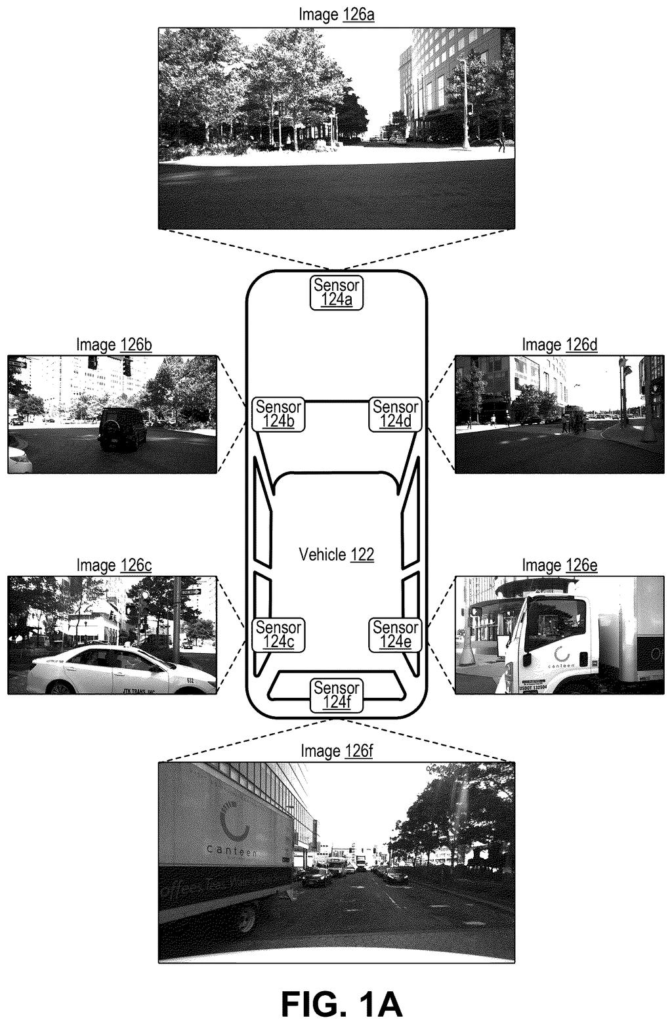
The claims describe a pipeline. Sensor data from cameras, radar (radio waves that measure distance), lidar (laser distance sensing), or any mix of them is turned into bird's-eye-view features, meaning a top-down picture of the car's surroundings. A machine-learning model then reads that picture and produces a list of predictions.
Every prediction has two parts: an anchor point (a fixed spot placed around the car ahead of time) and an offset (how far, and in which direction, the prediction has moved from that spot). Based on the output, the vehicle adjusts something like its path, steering, braking, a lane change, or what shows on its dashboard display.
The claims also cover a distance limit on how far each prediction may move, with that limit larger than the average gap between neighboring anchors, so their reach overlaps. Anchors can be spread evenly or unevenly depending on the task. The description gives the example of reaching 150 meters ahead but only 40 meters in other directions.
Each prediction can also carry extras such as a class (pedestrian, vehicle, lane line), height, width, direction and speed. In training, the model is taught that the nearest predictions are responsible for each real object, and the rest should report background. In the filing's example, a 256x256 grid shrinks to a 64x64 list of predictions.
Why a lighter output matters for driver assist
If your car has lane-keeping or other driver-assist features, the vision software behind them has to track many things at once without wasting computing power. The filing says grid-based methods struggle with crowds of pedestrians, closely spaced vehicles and parallel lane lines, and that its approach handles dense scenes without extra cost. It also says the output stays the same size when the detection range grows.
The filing also reports smoother lane detection, with fewer double detections and less jitter, and says the approach can work with cameras, radar or lidar. It adds that the same idea applies to robots and drones. Treat those results as the company's own claims, since the filing gives no test numbers.
Qualcomm's 57th filing we've tracked in our self-driving sensing race watchlist since July builds on earlier work like its parked-car vision patent and its gaze-based safety alerts patent.
Source: US 2026/0358805 A1 at the USPTO (PDF). Full patent text and figures are in the official publication.
Get our take in your Top Stories
Liked this breakdown? Add Patentlyze as a preferred source on Google, and our plain-English take shows up more often in your Top Stories the next time Qualcomm patent news breaks.
Add Patentlyze on Google
One click.
There are more where this came from
We read every patent application Big Tech publishes and send you the ones worth knowing. Plain English, free, every week.
The drawings · 23 sheets
23 drawing sheets from US 2026/0358805 A1 · click any drawing to enlarge


Show the other 15 sheets


More from Qualcomm
All 624 Qualcomm patents →
More in Automotive
All 360 Automotive patents →
Amazon
Amazon's Zoox Files Patent for Robotaxis That Warn You About Ice and Crowds
Amazon
Zoox Files Patent for Parking Spots That Tell a Robotaxi Where It Is
Waymo (Google)
Waymo Patents a Robotaxi That Won't Pick You Up on a Slick Spot
Nvidia
No comments yet