
Wing (Google)
Google · Chip · Filed May 8, 2025 · USPTO published Nov 12, 2026 · This week's release
Google Wins a Patent for a Solar-Powered AI Computer That Orbits Earth
Google has won a patent for a flat, solar-powered satellite that would run AI chips in orbit and cool them by radiating heat into space. The patent has already been granted.
- Publication number
- US 2026/0356504 A1(US20260356504A1)
- Applicant
- Google LLC
- Filed · Published
- May 8, 2025 · Nov 12, 2026
- Inventors
- Blaise Aguera-Arcas, Travis Roland Beals, Thomas Fischbacher
- Status when we published
- Granted
- Document
- 39 claims
- US classification
- 244/171.8
- Examiner
- O'HARA, BRIAN M (Art Unit 3642)
What Google's orbiting AI computer actually is
A data center sits on the ground, eating up land and electricity around the clock. As demand for AI computing grows, Google's patent says those two things, space and power, are getting harder to find on Earth.
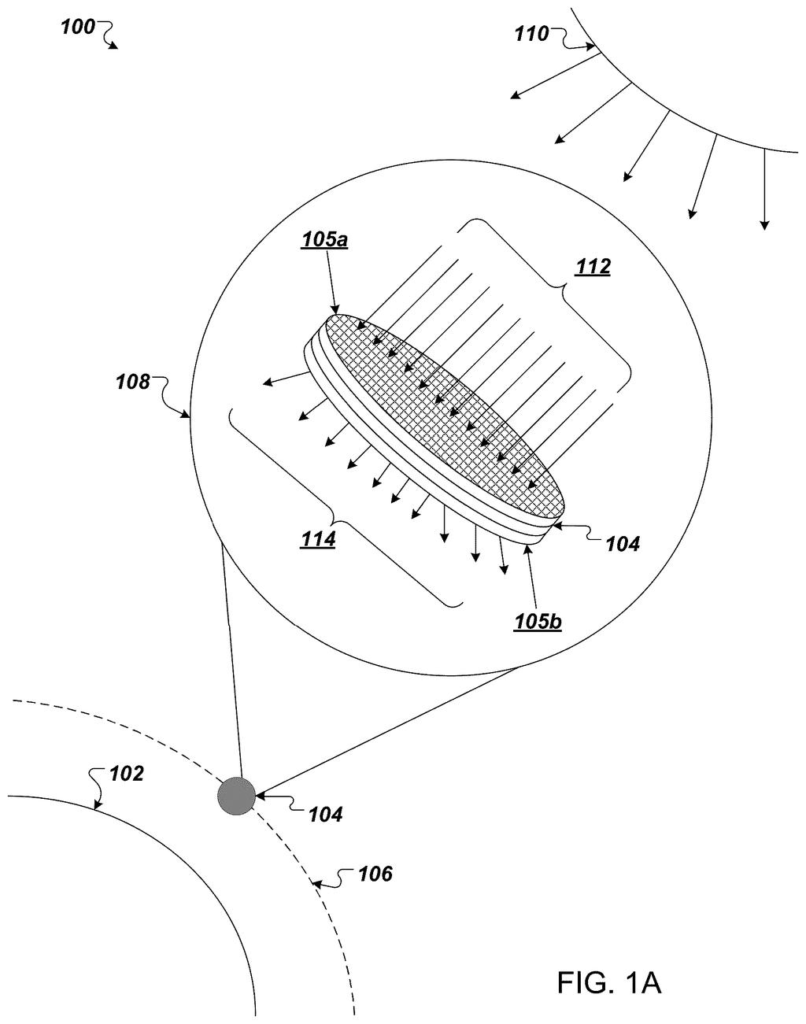
So the patent, which has already been granted, pictures moving some of that computing off the planet. You would have a flat, thin satellite, around 2 meters across in one example. One side is covered in solar cells facing the sun. Right behind them sit the AI chips, running on that power directly. On the far side, a cooling layer sends the chips' heat out into space.
In effect, it is a data center panel that orbits Earth, and the filing says many of them could link up to share the work.
… at least one machine-learning (“ML”) hardware accelerator adjacent the solar panel, the at least one ML hardware accelerator configured to implement a neural network ML model; and a heat dissipation layer configured to radiate heat generated when the at least one ML hardware accelerator is powered by the power signals …
Translation: The satellite packs AI chips right next to solar panels and uses special cooling layers to keep them from overheating.
How the sunlight, chips and heat pipes stack up
Claim 1 covers a flat satellite module built as a stack. One side of a solar panel holds the solar cells. The other side holds a power delivery network (a web of metal traces that carries the electricity to the other parts). Next to the panel sit one or more ML hardware accelerators (chips built for the heavy math behind AI models), which run a neural network for training or inference (answering questions with an already-trained model).
Behind the chips is a heat dissipation layer with heat pipes (sealed tubes where a fluid carries heat away by evaporating and condensing). They connect to the chips and spread the heat so it can radiate into space. In one worked example, about 950 watts lands on the panel and roughly 400 watts of that feeds the chips.
A second independent claim covers a full satellite, with the chips and cooling in a central body and foldable solar arrays that unfold after launch. The filing also describes:
- Tensor processing units (TPUs), a type of AI chip, as the accelerators.
- Copper shielding to protect the chips from radiation that can flip bits of data.
- Thrusters, spinning wheels and magnetic coils that turn the panel toward the sun.
- Optical links so several satellites can share one workload.
… a heat dissipation layer configured to radiate heat generated when the ML hardware accelerator is powered by the solar panel. The heat dissipation layer includes one or more heat pipes that: i) are coupled to the ML hardware accelerator, and ii) dissipate heat generated when the ML hardware accelerator executes a training or inference workload of the ML model.
Translation: Special heat pipes pull thermal energy away from the AI hardware while it runs machine learning workloads in space.
What a space-based AI computer could ease on Earth
The filing's argument is practical: demand for AI computing is growing faster than data centers can find room and electricity for it. A satellite addresses both, since orbit offers open space and sunlight, and the description says it would run on renewable solar power with little to no carbon emissions. It would also need fewer power parts, such as converters, inverters and batteries, because the panel feeds the chips directly.
None of this tells you when, or whether, Google would launch anything, and the filing gives no cost figures. It is also already a granted patent, though the final granted claims may read a little differently from the published application described here. For now it shows how far the company has thought about where AI computing could live.
Google's 26th filing in our Chip patent coverage since May follows a magnetic satellite steering idea and a wind-gripping drone stand among the 25 we've tracked before it.
Source: US 2026/0356504 A1 at the USPTO (PDF). Full patent text and figures are in the official publication.
Get our take in your Top Stories
Liked this breakdown? Add Patentlyze as a preferred source on Google, and our plain-English take shows up more often in your Top Stories the next time Google patent news breaks.
Add Patentlyze on Google
One click.
There are more where this came from
We read every patent application Big Tech publishes and send you the ones worth knowing. Plain English, free, every week.
The drawings · 13 sheets
13 drawing sheets from US 2026/0356504 A1 · click any drawing to enlarge


Show the other 5 sheets


More from Google
All 1,079 Google patents →
More in Chip
All 645 Chip patents →
AMD
ATI Technologies Patents an AI That Picks Its Own Waypoints for Game Characters

AMD
Xilinx Patents a Parallel Compression System That Switches Between Speed and File-Size Modes
Samsung
Samsung Patents a Taller-Stack Method for Building 3D Flash Memory Chips

Samsung
No comments yet