
Samsung Patents a Sync-Error-Correcting Sidelink Device Positioning Method
GPS doesn't work indoors, and cellular base stations aren't always close enough to pinpoint your location precisely. Samsung's new patent describes a way for 5G devices to locate each other using direct device-to-device radio signals — and, crucially, to correct the timing errors that make such measurements unreliable.
How Samsung locates devices without a GPS fix
Imagine you're in a warehouse, a parking garage, or somewhere with spotty cell coverage. Your phone can't get a clean GPS fix, and the nearest cell tower is too far away to pinpoint you accurately. Samsung's patent tackles this by having nearby devices act as location anchors — they ping each other with special radio signals and work together to figure out where you are.
The clever part is what happens when those anchor devices aren't perfectly in sync with each other. Even tiny timing differences between devices throw off distance calculations and make the location estimate wildly inaccurate. The patent describes a method where the device being located measures those timing differences, packages them into a correction value, and sends that correction up to a location server so it can be factored into the final calculation.
The result is a sidelink positioning system — device-to-device, no GPS required — that accounts for real-world clock drift between the phones or sensors acting as your location beacons.
How the time offset value corrects anchor sync drift
The patent centers on sidelink positioning, a 5G feature that lets devices (called UEs, or User Equipment) communicate directly with each other rather than routing everything through a base station. In this system, a target device is surrounded by several anchor UEs — devices whose locations are already known — and those anchors broadcast a special Sidelink Positioning Reference Signal (S-PRS).
The target device measures how long those signals take to arrive from each anchor, which in principle lets you triangulate its position. But there's a catch: the math only works if all the anchor devices share a common time reference. In practice, they don't — each device has its own internal clock with slight drift, creating synchronization errors.
Here's the fix the patent proposes:
- The first terminal (the one being located) measures the S-PRS signals from all anchor UEs.
- It derives a first time offset value — a number representing how far the anchors' clocks are out of sync with each other.
- It transmits that offset value to the Location Management Function (LMF), the network server responsible for computing the final position fix.
- The LMF folds the correction into its position calculation alongside the raw S-PRS measurements.
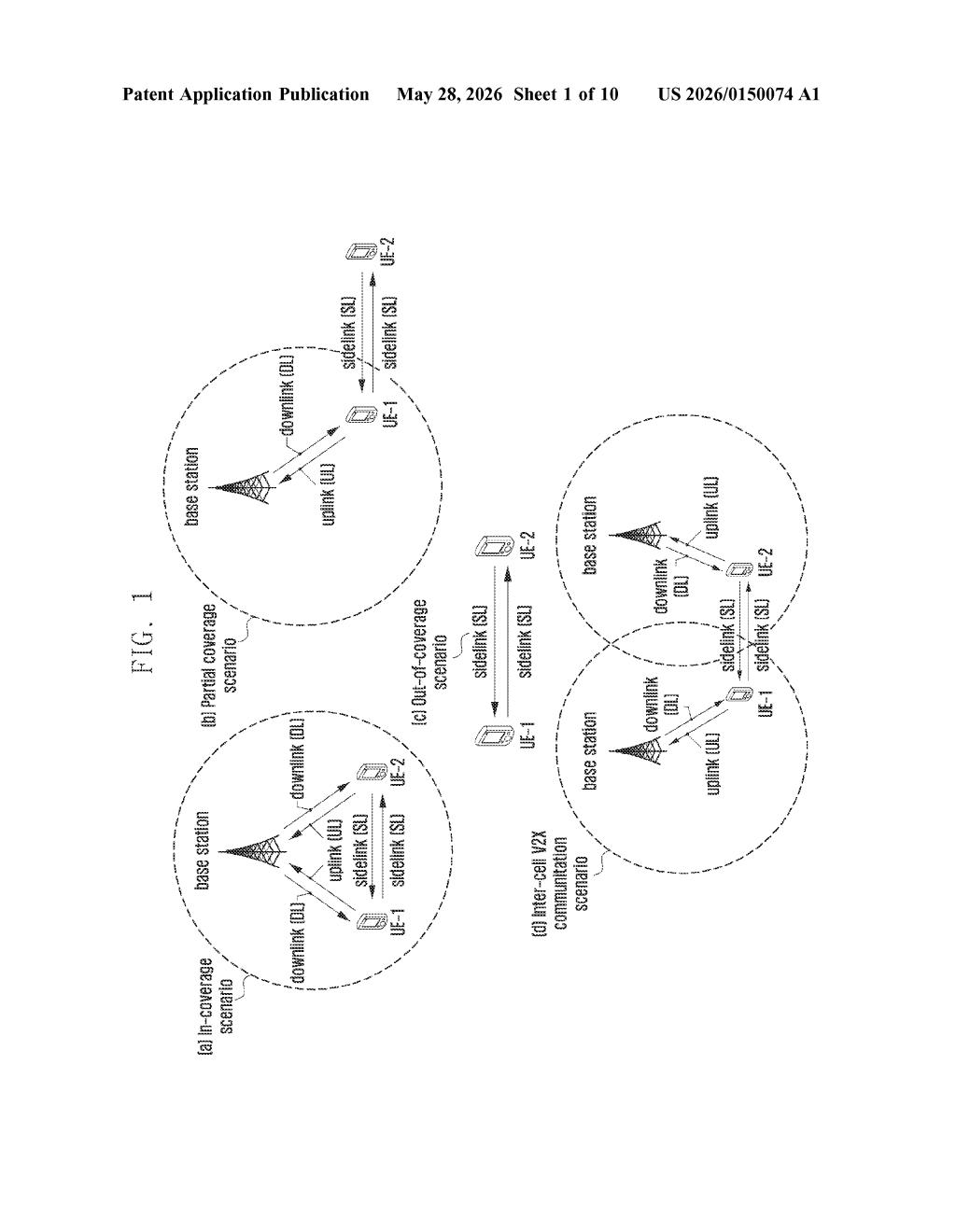
The patent covers both directions: the target device can receive S-PRS from anchors, or transmit S-PRS to them, making it flexible for different network configurations including partial-coverage and out-of-coverage scenarios.
What this means for 5G positioning in dead zones
For everyday users, this is about getting accurate location data in the places where GPS and traditional cell-tower positioning fall apart — think dense urban canyons, underground facilities, or factory floors. 5G sidelink is already positioned as a key technology for industrial IoT, vehicle-to-vehicle communication, and emergency services, and all of those use cases depend on reliable location data.
The synchronization-correction piece is what makes this practically useful rather than theoretically interesting. Without compensating for clock drift between anchor devices, sidelink positioning errors can be large enough to be meaningless. By surfacing the timing offset as an explicit, transmittable value, Samsung's approach gives the location server what it needs to produce a trustworthy fix even when the anchor devices aren't tightly synchronized — which is most of the time in real deployments.
This is solid, unglamorous standards-track work — exactly the kind of incremental fix that determines whether a promising 5G feature actually ships reliably or stays a spec-sheet bullet point. The synchronization-error correction is a real problem in sidelink positioning, and formalizing a method to measure and report it is a meaningful contribution. It's not a headline product feature, but the companies that win in industrial 5G will be the ones who got the boring parts right.
There are more where this came from
We read every patent application Big Tech publishes and send you the ones worth knowing. Plain English, free, every week.
Want this weekly breakdown for a company we don't cover? Patentlyze Pro →