Latest AI training & infrastructure patents, Page 18
The unglamorous machinery underneath: training methods, inference speedups, model compression, and the scheduling tricks that make AI affordable to run.
- in the Nov 19 release
- 8
- in November so far
- 22
- filings tracked
- 324
- last 90 days
- 123
Recent filings
Newest first · 324 total-
Qualcomm · Published Jul 9
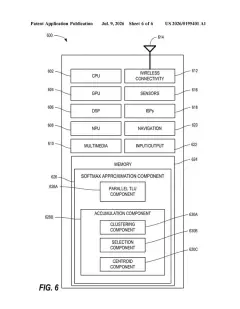
Qualcomm Patents a Faster Way to Run a Core AI Calculation on Chips
One of the most common calculations in AI, the softmax function, is also one of the most expensive to compute on small chips. Qualcomm thinks it has a faster path through the math.
-
IBM · Published Jul 9
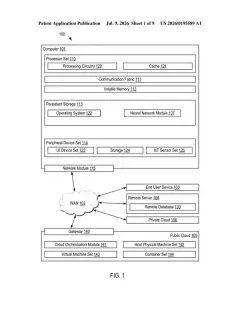
IBM Patents an AI Training System That Keeps Drilling on Its Own Mistakes
IBM wants to build AI systems that never stop practicing the problems they got wrong, stacking a chain of specialized models until the hardest cases are covered.
-
Google · Published Jul 9
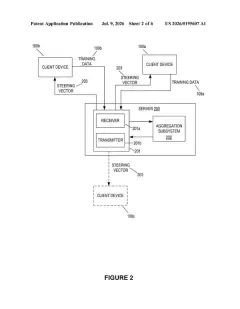
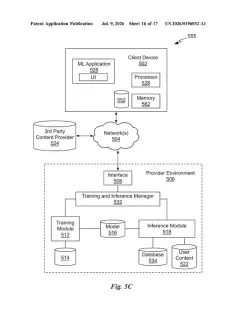
Google Patent: AI Learns From User Reactions While Keeping Data On-Device
Google is patenting a way to make its AI models learn from what you like and dislike, without ever shipping your actual inputs to a server. The trick: only a compressed mathematical fingerprint of the AI's internal state leaves your device.
-
IBM · Published Jul 9
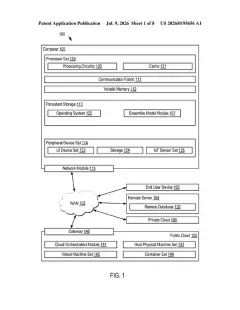
IBM Patents a Way to Put Its AI Models on an Energy Diet
AI models are power-hungry by default, but IBM is patenting a way to make them voluntarily slim down on command, swapping a full model for a stripped-down version whenever energy needs to be conserved.
-
IBM · Published Jul 9
IBM Patent: Federated AI Learns From Private Data Without Ever Exposing It
IBM has filed a patent for a way to train a machine learning model across multiple organizations' private databases without any single party ever seeing another's raw records. The trick is mathematical noise that hides individual data points while still letting the AI learn from them.
-
IBM · Published Jul 9
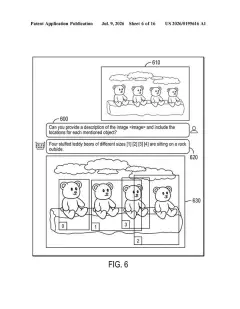
IBM Patents a Self-Checking Method to Train AI on Image Questions
IBM has filed a patent for a training pipeline that teaches an AI to answer questions about images by only feeding it practice questions it already knows the correct answer to. The twist: the system generates and verifies those questions automatically, without humans in the loop.
-
Nvidia · Published Jul 9
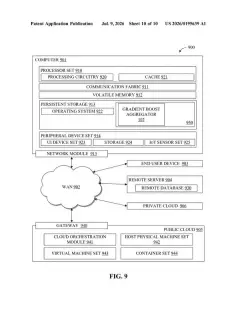
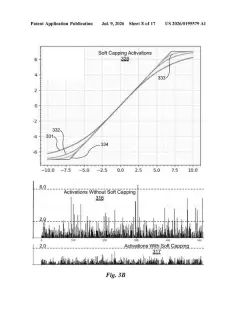
Nvidia's New Patent Removes a Hidden Cost That Slows Down AI Training
Training a large AI model is expensive and slow, and one of the standard techniques used to keep training stable turns out to be a surprisingly heavy piece of that cost. Nvidia has filed a patent to remove it entirely.
-
Microsoft · Published Jul 9
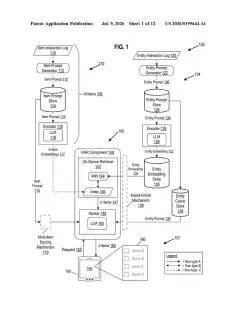
Microsoft's New Patent Makes AI Faster at Picking What You See in Your Feed
Every time an app decides what post, ad, or article to show you, a ranking system is making that call. Microsoft just filed a patent for a two-stage AI training process designed to make that decision faster and more accurate at the same time.
-
Nvidia · Published Jul 9
Nvidia's New Patent Teaches Robots by Showing Them AI Videos of Themselves
Training a robot normally means thousands of hours of real-world trial and error. Nvidia's new patent wants to skip most of that by having an AI imagine what the robot should do, then teaching the robot from those imagined videos.
-
Google · Published Jul 9
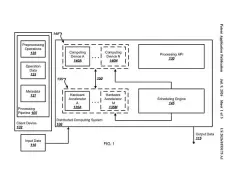
Google Patent Splits AI Workloads Across Preparation Steps and Accelerator Chips Simultaneously
AI chips are expensive and fast, but they often sit idle waiting for data to arrive. Google's new patent describes a system that keeps those chips constantly busy by offloading the preparation work to cheaper, general-purpose computers running in parallel.
-
Google · Published Jul 2
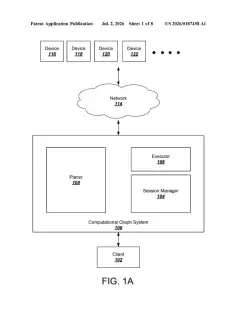
Google Patents a Way to Let AI Chips Talk to Each Other Without a Central Coordinator
When you're training a massive AI model, getting dozens of chips to cooperate without a traffic jam is one of the hardest engineering problems there is. Google's latest patent tackles that by letting the chips sort it out themselves.
-
Google · Published Jul 2
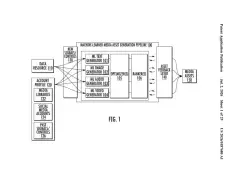
Google Patents an AI System That Builds New Ads From Your Existing Logos and Colors
Instead of asking advertisers to upload fresh creative for every new campaign, Google has patented a system that scans what you already have and generates a full batch of ads from scratch.