Latest AI training & infrastructure patents, Page 25
The unglamorous machinery underneath: training methods, inference speedups, model compression, and the scheduling tricks that make AI affordable to run.
- in the Nov 19 release
- 8
- in November so far
- 22
- filings tracked
- 324
- last 90 days
- 123
Recent filings
Newest first · 324 total-
Nvidia · Published May 28
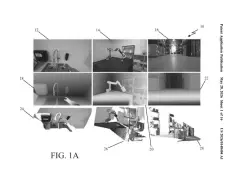
Nvidia Patents a Self-Curating Synthetic Data Loop for Stereo Vision Models
Training a depth-sensing AI normally requires mountains of carefully labeled real-world images — a slow, expensive process. Nvidia's new patent describes a system that generates its own training data, then uses the model it trained to throw out the bad examples automatically.
-
Nvidia · Published May 28
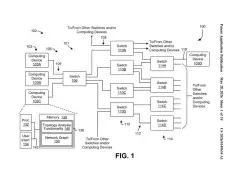
Nvidia Patents an Unsupervised AI That Finds Network Topology Anomalies
What if your network could spot its own wiring mistakes — without anyone telling it what a mistake looks like? That's the core idea behind Nvidia's latest networking patent, which uses a graph-based AI model trained on part of a network to predict what the rest of it *should* look like.
-
Amazon · Published May 28
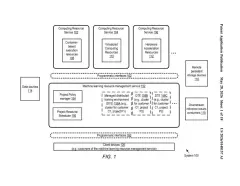
Amazon Patents a GPU Resource Sharing System for Multi-Project ML Workloads
Running three ML training jobs at once shouldn't mean one hogs the GPUs while the others wait. Amazon's new patent describes a system that watches GPU usage across all your projects in real time and automatically lends idle capacity to whoever needs it most — without breaking your predefined resource budgets.
-
Adobe · Published May 28
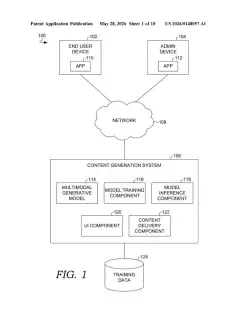
Adobe Patents a Generative AI That Designs Content Around Performance Data
Adobe is patenting an AI model that doesn't just generate creative content — it learns to link that content directly to real-world performance metrics, training both ideas in the same shared mathematical space.
-
Adobe · Published May 28
Adobe Patents a System for Auto-Generating Music-AI Training Data
Teaching an AI to connect music and language is only as good as the training data you feed it — and Adobe is patenting a way to manufacture that data at scale, automatically.
-
Salesforce · Published May 28
Salesforce Patents a Self-Verifying Reasoning Pipeline for Vision-Language AI
Salesforce is teaching AI models to show their work — and only keep the answers where the reasoning actually checks out. The result is a self-cleaning training pipeline for visual question-answering that filters bad logic before it can corrupt the model.
-
Samsung · Published May 21
Samsung Patents an ML Training Method for Fixing Blurry Handheld Photos
Taking sharp photos in low light is hard — your hands shake, frames blur, and stacking multiple shots makes the misalignment worse. Samsung's new patent describes a way to train AI models to fix exactly that, by teaching them on artificially degraded images before they ever see a real shaky shot.
-
IBM · Published May 21
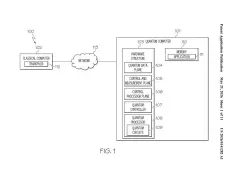
IBM Patents a Neural Network That Predicts Quantum Circuit Outputs
Running a quantum circuit is expensive and error-prone — so IBM is training a neural network to predict what a quantum computer would output, without always having to run the hardware itself.
-
Adobe · Published May 21
Adobe Patents a Parallel Approach to Causal Linear Attention in Neural Networks
Attention mechanisms are the engine inside modern AI — but they're also the bottleneck. Adobe's new patent describes a way to run a key part of that engine in parallel, potentially making AI inference meaningfully faster without sacrificing accuracy.
-
Salesforce · Published May 21
Salesforce Patents a User-Directed Pipeline for Building Multimodal AI Training Data
Teaching an AI to understand images is only as good as the training data you feed it — and most pipelines for generating that data are opaque black boxes. Salesforce is patenting a system that makes the whole process transparent and user-configurable.
-
Google · Published May 21
Google Patents a Progressive Regularization Method to Speed Up ML Model Training
Training a machine learning model is expensive and slow — and a big chunk of that cost comes from how you apply regularization. Google's new patent, from the duo behind EfficientNet, describes a training schedule that deliberately starts loose and tightens the rules as training progresses.
-
Google · Published May 21
Google Patents an Ordinal Regression Training Method for Ranked Recommendations
When a recommendation system suggests five things to you, the order matters — but most ML training routines don't enforce that order as rigorously as they should. Google's new patent tries to fix that at the loss-function level.