
Adobe Files Patent to Teach a Fast AI Image Maker by Copying a Slow One
Most AI image generators clean up random static over dozens of rounds before a picture appears. Adobe's filing describes training a model that finishes the job in one to four.
What Adobe's fast-student image model does
Most AI image generators start with a screen of random static and clean it up bit by bit, often 50 steps or more, until a picture matching your prompt appears. Every one of those steps costs time and computing power, which is why you often wait. Adobe's patent application is about making that wait much shorter.
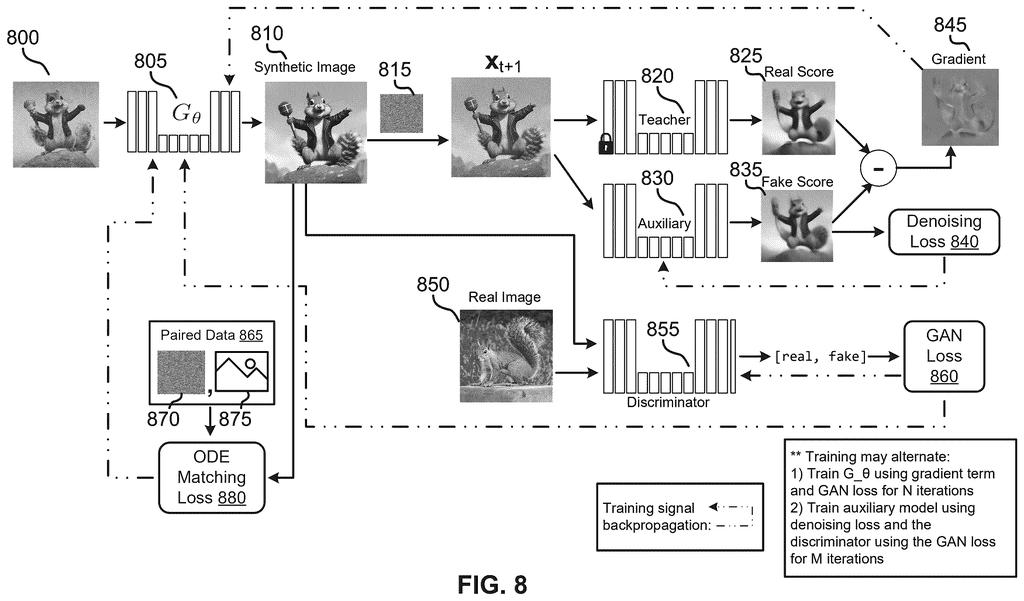
The idea is to use a big, slow, high-quality model as a teacher. A smaller student model learns to copy the teacher's results, but in only one to four steps. A second helper, a kind of fake-image detective, keeps pushing the student to look more real.
The filing says the student may even end up beating the teacher on quality, and that in some versions it could produce an image in under a second.
obtaining a teacher model trained to generate synthetic images; computing a distribution matching distillation (DMD) loss for an image generation model using the teacher model; …
Translation: The fast AI learns by comparing its work against a slower, highly trained original model.
How the slow model coaches the fast one
The core claim covers a training recipe with two ingredients. The first is a distribution matching distillation loss (a score that measures how far the student's range of possible pictures is from the teacher's). The second is a GAN loss from a discriminator, a model that tries to tell real images from the student's fakes.
In the matching step, the teacher's settings are frozen, and it judges a noisy version of the student's output. A second helper model, trained alongside the student, makes the same judgment. The gap between the two judgments (called score functions, which point toward more realistic images) becomes the push that updates the student. The filing also describes an optional ODE matching loss, a check that the student follows the same cleanup path as the teacher, using a small set of noise-and-image pairs made by the teacher.
Other claims cover hybrid sampling:
- The teacher runs the first few cleanup steps to lay out the rough picture.
- The trained student finishes the rest.
The student can be a U-Net diffusion transformer, a design that shrinks the image data in its middle layers so there is less to process. In the filing's example, the teacher uses 50 to 1,000 steps while the student uses 1 to 4.
… using a discriminator model, embodiments compute a generative adversarial network (GAN) loss for the image generation model. The discriminator model classifies an output of the image generation model.
Translation: A secondary checker model evaluates the newly generated images to help make them look more realistic.
Why faster image generation matters to you
If this works as described, the payoff is time. Waiting on every image makes you think twice about asking for another variation, while a picture in under a second invites you to keep tweaking. Fewer steps also means less computing power per picture, which matters to whoever pays the server bill.
The company also pitches steadier training. It says methods that rely only on adversarial training can be unstable and lose variety, and that methods that only match distributions needed costly paired data. Combining both signals is meant to cover each one's weak spots. The filing adds that the same approach could apply to video.
Adobe's 42nd entry in AI image & video we've tracked since May follows one suggesting photo fixes and an AI poster builder.
Slow image generation is a real annoyance. The waiting adds up when you make a dozen tries to get one usable picture, and every extra step costs the provider computing power at huge scale.
The approach fits the size of that problem. Cutting the work from as many as 1,000 steps to as few as four goes straight at the cost instead of nibbling around it. Teaching a small model from a big one is a familiar training idea, though, and the claims here cover one specific mix of training signals, so the novelty is narrow.
Our verdict: useful to anyone who generates images, but the filing shows no quality numbers, so the proof would have to come from testing.
Get our take in your Top Stories
Liked this breakdown? Add Patentlyze as a preferred source on Google, and our plain-English take shows up more often in your Top Stories the next time Adobe patent news breaks.
There are more where this came from
We read every patent application Big Tech publishes and send you the ones worth knowing. Plain English, free, every week.
The drawings
13 drawing sheets from US 2026/0330704 A1 · click any drawing to enlarge


Show the other 5 sheets


Want this weekly breakdown for a company we don't cover? Patentlyze Pro →
Be the first to weigh in