
Google Files Patent for Reusing AI-Made Ads Instead of Generating New Ones
AI image and video tools can take seconds or even minutes to produce one result, but an ad slot on a web page gets a fraction of a second. A new Google patent application tries to close that gap by reusing what the AI already made.
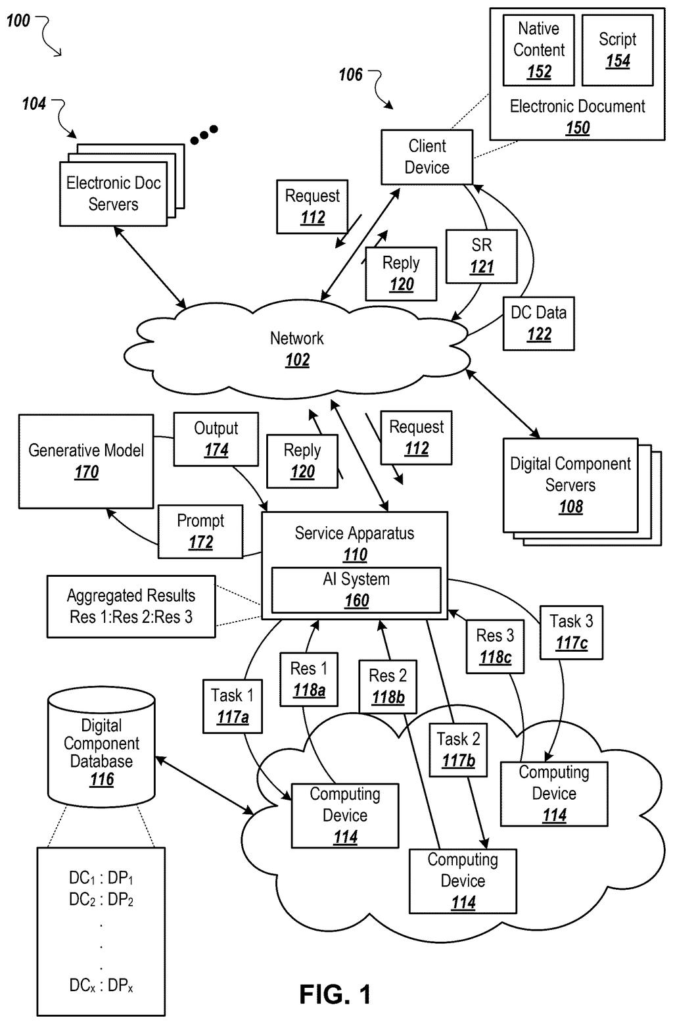
What Google's reuse-first AI ad system does
Ever asked an AI to draw something and then stared at a spinner for what felt like forever? Now consider a web page that has to show you an ad almost instantly, long before any AI could finish painting a fresh one.
Google's answer in this patent application is to stop starting from scratch every time. It keeps a stash of AI-made ads and images, each linked to a numeric fingerprint of the request that created it. When a new request arrives, the system checks whether it is close enough to an old one. If it is, you get the ready-made result right away.
If nothing matches, the system makes something new and saves it for next time. The filing says it can also show a default item first and finish the new one in the background. Items that nobody asks for get cleared out to save space.
maintaining, by an artificial intelligence system, a data structure that stores a set of pre-generated digital components and, for each pre-generated digital component, a stored embedding the represents a prompt used to generate the pre-generated digital component …
Translation: The system keeps a database of previously created ads alongside data representing the instructions used to make them.
How Google matches your prompt to old results
The system keeps a cache (a fast storage area for things it expects to need again) of content an AI already generated, such as images, video clips, text or ads. Next to each item sits an embedding, a list of numbers (the filing mentions 32 or 64 of them) that captures the meaning of the prompt that produced it.
When a new prompt arrives, the system turns it into its own embedding and scores it against every stored one. One example measure is cosine similarity, which gauges how closely two lists of numbers point the same way. Then:
- If a stored item scores above a set threshold, it is sent back. If several qualify, the best scorers are picked.
- If none qualify, a generative model (an AI that creates images, text or video) makes new content, which is sent and also saved for future matches.
- If a provider has opted in to customization, the system can generate fresh content even when a match exists, adding that company's details to the prompt.
The filing also covers housekeeping. Stored items that have not matched any request within a time limit get deleted. The cache can be pre-filled using prompts written by people or by a language model. The system can also generate recommended ads for a provider without being asked.
The AI system determines, for each pre-generated digital component, a similarity metric that represents a measure of similarity between the stored embedding used to generate the digital component and the first input embedding.
Translation: The software compares new ad requests against past prompts to see if an old ad matches what the user wants.
Why Google wants AI ads to load in milliseconds
If AI-made ads and images are going to appear on web pages and in chat answers, they have to show up before you scroll away. The filing says some models take seconds or even minutes to make a new image or video, while an ad slot needs an answer in milliseconds. Reusing earlier results is how you could get a tailored-looking ad without the wait. It also trims the computing bill, since running generative models is expensive.
The filing is aimed at advertisers and publishers more than at you directly, though you would be the one seeing the results. It describes a patent application, and the examiner's first review rejected the claims as filed, which is routine at this stage and usually followed by amendments. No specific product is named.
Google's 40th filing in our AI image & video coverage since May adds to a run that includes a panoramic video from one sweep application and a typed descriptions into stickers application.
Reusing old answers costs freshness. The whole design bets that two prompts with similar numbers deserve the same result, so a near match can hand someone an ad built for a slightly different request. The threshold setting decides how often that happens, and the filing leaves its value open.
The fix is an opt-out: providers who want everything freshly made can say so. That shrinks the savings for the customers who care most about control. Cleanup has its own cost too, since an item deleted for going quiet has to be rebuilt later if its audience comes back.
Even so, the trade reads as worth it. Generating on every request is slow and expensive, and a stored set of results with an adjustable cutoff is a sensible, if unexciting, answer. Most people will never notice it working, which is how plumbing should behave.
Get our take in your Top Stories
Liked this breakdown? Add Patentlyze as a preferred source on Google, and our plain-English take shows up more often in your Top Stories the next time Google patent news breaks.
There are more where this came from
We read every patent application Big Tech publishes and send you the ones worth knowing. Plain English, free, every week.
The drawings
5 drawing sheets from US 2026/0320094 A1 · click any drawing to enlarge


Want this weekly breakdown for a company we don't cover? Patentlyze Pro →
Be the first to weigh in