
Apple
Apple · Cell phone · Filed Apr 30, 2026 · USPTO published Nov 19, 2026 · This week's release
Apple Files Patent for Letting Your Item Tracker Rest While You're Home
Your phone checks on your item tracker every second, even while you sit on the couch at home. Apple's patent describes letting that check go once you've settled in.
- Publication number
- US 2026/0371432 A1(US20260371432A1)
- Applicant
- Apple Inc.
- Filed · Published
- Apr 30, 2026 · Nov 19, 2026
- Inventors
- Benjamin A. Werner, Tunc Ertan, Michele Bavaro, Pranati Kuppa, Anup Dhital, Benjamin A. Detwiler, Brent M. Ledvina, Todd Wheeler
- Status when we published
- Waiting for an examiner
- Document
- 20 claims
- US classification
- 455/500
- Parent application
- Claims priority from a provisional application 63808485 (filed May 19, 2025)
What Apple's tracker-leash patent actually does
A little item tracker sits in your bag by the front door all evening, and your phone checks on it once every second, even though neither of them has moved. Add earbuds, a watch and a few other gadgets, and a lot of tiny batteries are doing busy work.
Apple's patent describes a fix. Your phone keeps track of where you are and how long you've been there. Once you've stayed put past a set time, it drops the constant connection and only checks in now and then. When you start moving again, it brings the connection back.
The constant connection exists so your phone can tell where you last were if something gets left behind. If you've been sitting at home for an hour, that answer is already obvious.
… terminating, by the user device, a network connection with an accessory device, the accessory device present at the location with the user device, the network connection comprising a persistent wireless network connection characterized by periodic communications between the user device and the accessory device …
Translation: Your phone cuts off its constant check-ins with your tracker once you have stayed in one place long enough.
How your phone decides when to let go
The patent covers what it calls a leash: a persistent Bluetooth connection between a phone and an accessory such as a finder tag, earbuds or a watch. While leashed, the phone sends a signal about every second and gets a reply. If the replies stop, the phone knows the accessory was left behind and uses its own last known location as the accessory's last known spot.
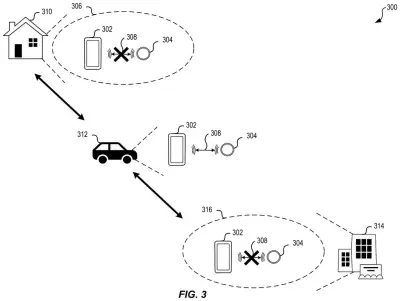
The new part is knowing when to let go. The phone's location app logs when you arrive somewhere, and dwell time (how long you've stayed in one place) is counted from that arrival. Once it passes a threshold, the phone ends the leash. The filing gives examples of roughly 1 minute at home and 10 minutes at a café. It also describes keeping the leash at unfamiliar places, like a hotel on vacation, where tracking matters more than saving power.
After the leash drops, the phone still checks for nearby accessories on a slow schedule, such as every 15 minutes. When it sees you've left, it restores the leash. The filing lays out four timing policies:
- Drop and restore the leash only at the slow check-ins.
- Drop it right away, but restore it at the next check-in.
- Drop it at a check-in, but restore it the moment you leave.
- Drop it and restore it immediately.
A separate claim covers a handoff: if your phone leaves, a paired smartwatch can take over the leashes to the other accessories.
Techniques are disclosed for managing network connections between a user device and an accessory device. A user device can determine a dwell time at a location. The user device can determine whether the dwell time exceeds a threshold time.
Translation: The system tracks how long your phone stays in a single spot to decide when to give your gadget a break.
What this means for your tags and earbuds
If you carry a tracker tag, earbuds and a watch, each one spends battery on connection checks. In the filing's example, an accessory that is leashed and also broadcasting uses about 40 microwatts, while one that only broadcasts uses about 20. Those small devices run on batteries meant to be replaced rarely, so cutting that draw in half in that example could mean a much longer life between swaps.
The savings also leave room for features that cost more energy, like the ultrawideband radios that pinpoint a lost item, without needing bigger batteries. Your phone saves a little too, since it stops talking to the accessory every second. This is a patent application, so it describes an approach and says nothing about what Apple will ship.
That makes this Apple's 57th filing we've tracked in our cell phone coverage since May, a series that includes applications like a camera hidden under the screen and charging that detects nearby metal objects.
Source: US 2026/0371432 A1 at the USPTO (PDF). Full patent text and figures are in the official publication.
Get our take in your Top Stories
Liked this breakdown? Add Patentlyze as a preferred source on Google, and our plain-English take shows up more often in your Top Stories the next time Apple patent news breaks.
Add Patentlyze on Google
One click.
There are more where this came from
We read every patent application Big Tech publishes and send you the ones worth knowing. Plain English, free, every week.
The drawings · 11 sheets
11 drawing sheets from US 2026/0371432 A1 · click any drawing to enlarge


Show the other 3 sheets


More from Apple
All 748 Apple patents →
More in Cell phone
All 494 Cell phone patents →
Google
A New Google Patent Cuts the Battery Drain From Your Digital Car Key
Sony
Sony Patents a Tiny Laser Whose Light Waves All Line Up the Same Way
Microsoft
Microsoft Patents a Phone Screen That Hides Its Antenna in the Glass
Samsung
No comments yet