
Google
Google · Cell phone · Filed Dec 5, 2025 · USPTO published Nov 12, 2026 · This week's release
A New Google Patent Cuts the Battery Drain From Your Digital Car Key
When your phone is your car key, the car keeps pinging it to ask if you're still nearby, and each ping can wake the whole phone. Google's patent application has a small security chip answer or ignore those pings so the main processor can keep sleeping.
- Publication number
- US 2026/0359495 A1(US20260359495A1)
- Applicant
- Google LLC
- Filed · Published
- Dec 5, 2025 · Nov 12, 2026
- Inventors
- Adam M. Bar-Niv, Shiv Rajora, Baktash Boghrati
- Status when we published
- Waiting for an examiner
- Document
- 20 claims
- US classification
- 726/34
- Parent application
- National Stage Entry of PCT/US2023/026742 (filed Jun 30, 2023)(PCTUS2023026742)
What Google's battery-saving car key does
Today, if your phone is your car key, the car keeps sending it little messages asking whether you're still nearby. Each message can wake the phone's main processor, which lights up parts of the phone and uses battery, even when the message doesn't need you at all.
Google's patent application describes a gatekeeper for those messages. Your phone already has a small, separate security chip that holds the digital key. Under this filing, that chip reads each message first. Routine ones, like "are you still here?", get ignored while the rest of the phone stays asleep. Messages that matter, like the car being unlocked, wake the phone so it can tell you.
You'd get a say, too. Settings could decide which messages get through, such as dropping most of them when your battery is low or your screen is facing down on a table.
… determining, by the secure element, whether the secure element can process the command while an application processor of the computing device is operating in a low-power state based on at least one of a transaction type or a transaction configuration of the secure element; …
Translation: The phone decides if it can handle car messages without waking up the main processor.
How the phone's security chip filters car pings
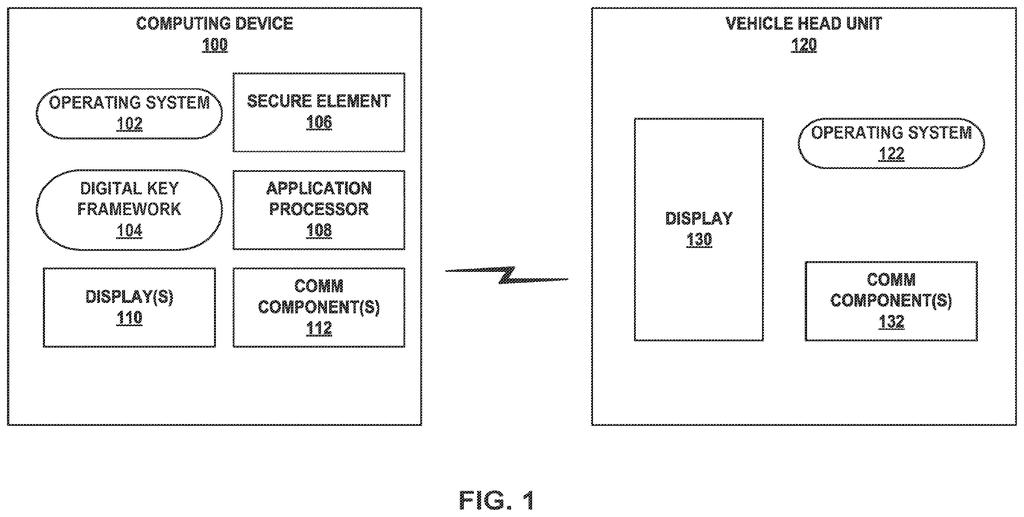
The claims cover a method in which a secure element (a small, isolated chip built to guard things like cryptographic keys) receives a command from a vehicle. Before anything else, it decides whether it can handle that command itself while the application processor (the phone's main, power-hungry chip that runs the operating system, apps and screen) stays in a low-power state.
That decision rests on at least one of two things:
- Transaction type: a label on each command, such as unlock the doors, lock the doors, or confirm the phone is still near the vehicle. Some are one-time events and some recur.
- Transaction configuration: user-adjustable settings. The filing mentions the phone's mode (silent, battery saver, do not disturb), its orientation (screen facing down), and its status.
If the secure element can deal with the command, for example by discarding it, it does so and the main chip keeps sleeping. The description also lists other options, such as filtering the command or replying to the car directly. If it can't, it wakes the main chip into a high-power state and passes along at least an indication of the command, which the main chip can then show on screen.
The description's example: as you walk up to your car, the "vehicle is nearby" ping is dropped. Unlocking and starting the engine wake the phone to display a notice. While you drive, all presence checks are discarded.
Why a quieter car key matters for your battery
If your phone doubles as your car key, it has to stay reachable all day, and a chatty car can nibble at your battery. Letting a small chip handle the chatter means the screen and main processor stay asleep for messages you'd never look at anyway. The settings angle matters too: you could choose to see alerts for unlocks but skip routine check-ins, which cuts a few distractions as well.
The filing describes changes only on the phone's side of the conversation. It gives no figures for how much power this would save, and a patent application is not a product announcement. Still, digital car keys depend on phones that last a full day, so small savings like this can add up.
Google's 39th filing we've tracked in our cell phone patents since May follows a camera that throttles before overheating and a magnet-based foldable hinge.
Source: US 2026/0359495 A1 at the USPTO (PDF). Full patent text and figures are in the official publication.
Get our take in your Top Stories
Liked this breakdown? Add Patentlyze as a preferred source on Google, and our plain-English take shows up more often in your Top Stories the next time Google patent news breaks.
Add Patentlyze on Google
One click.
There are more where this came from
We read every patent application Big Tech publishes and send you the ones worth knowing. Plain English, free, every week.
The drawings · 3 sheets
3 drawing sheets from US 2026/0359495 A1 · click any drawing to enlarge


More from Google
All 1,079 Google patents →
More in Cell phone
All 485 Cell phone patents →
Samsung
Samsung Files Patent for a Foldable Phone That Rests Its Cover Screen on the Battery

Samsung
Samsung Patents an AI System That Reads Battery Health From the Inside
Samsung
Samsung Files Patent for a Camera Fix That Saves Battery Without Adding Photo Noise
Samsung
No comments yet