
Apple
Apple · Energy · Filed Jul 23, 2026 · USPTO published Nov 19, 2026 · This week's release
Apple Patents Earbuds That Trade Audio Speed for Battery Savings in Noisy Rooms
Your ears forgive more audio delay in a noisy room, and this Apple patent turns that quirk into a way for earbuds to save battery and wireless bandwidth. The louder your surroundings, the more slack the system gives itself.
- Publication number
- US 2026/0369289 A1(US20260369289A1)
- Applicant
- Apple Inc.
- Filed · Published
- Jul 23, 2026 · Nov 19, 2026
- Inventors
- Shai Messingher LANG, Emily A. WIGLEY, Hui-Jung KUO, Ronald J. GUGLIELMONE JR.
- Status when we published
- Waiting for an examiner
- Document
- 20 claims
- US classification
- 704/226
- Parent application
- Continuation of 18/244,883 (filed Sep 11, 2023)(18244883)
What Apple's noise-aware earbud audio does
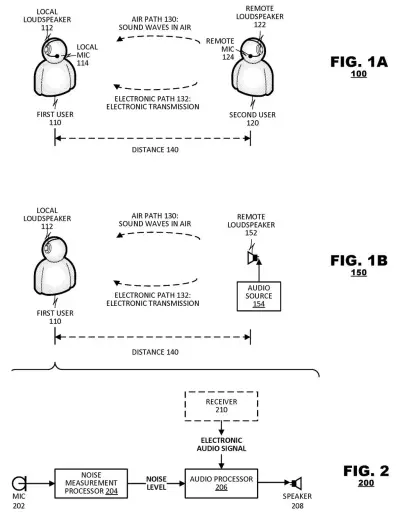
You're standing a few feet from a friend in a quiet room, and your earbuds are amplifying their voice. You hear them twice: once through the air, once through the earbuds. If the two copies land a hair apart, it sounds like an echo.
Apple's patent builds on a finding it says came from experiments: how much of that gap you notice depends on how loud the room is. At about one meter in a very quiet room, roughly 20 milliseconds is the most you'd tolerate. In a noisier room, the same listener puts up with much more.
So the device listens to the room first, then picks how to process the incoming audio. A quiet room gets the fastest route. A loud room lets the device use slower processing that saves power or squeezes the audio into less data.
… determining, based on the ambient noise level, an acceptable latency associated with presentation of the electronic audio signal to the user …
Translation: The earbuds figure out how much audio delay you can tolerate based on room noise.
How the earbuds pick a codec by room noise
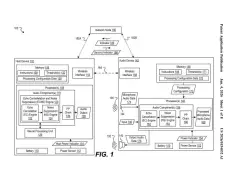
The core idea is a loop between room noise and audio processing. A device (the filing names earbuds, headsets, hearing aids and smart glasses) uses its microphone to measure background noise. It then works out how much latency, meaning the delay between a sound being captured and played back, the listener can put up with.
Next it picks from a menu of processing modes that have different delays. The filing's main example has three tiers:
- Quiet room: no audio compression at all, the lowest-delay option.
- Moderately noisy room: a first codec (a method for squeezing audio into less data) with low delay and mild compression.
- Loudest room: a second codec with higher delay and heavy compression, which needs less wireless bandwidth.
The filing also describes other tools. The device can raise the noise floor (the faint background hiss in the audio) by adding artificial noise, mixing in captured room noise, or easing off noise cancellation. That makes a timing gap harder to notice. Longer processing buffers can also improve speech enhancement, such as language translation or adjustments for a listener's hearing. If several steps are stacked, their combined delay has to stay within what the listener can tolerate.
The claims cover three angles: choosing a mode from ambient noise, choosing a mode from latency tolerance and bandwidth, and choosing a setup from the estimated distance between you and the audio source. The distance can come from wireless ranging between two devices.
In some implementations, the selection may further be based on signal-to-noise ratio, estimated distance to an audio source, communication bandwidth, or power-consumption considerations.
Translation: The system also factors in battery life, distance, and signal strength to pick the mode.
Why this matters for earbuds and hearing aids
If you wear earbuds or hearing aids that amplify a nearby voice, a TV, or a table microphone, you've probably run into that odd doubled sound. The filing's examples include two people watching a movie, where one wears amplifying earbuds and the other hears only the TV speakers. A device that adapts to the room could avoid the echo when it is most obvious and save resources when it is not.
The savings are practical. Slower processing can use less power, and heavier compression can ease the load on a crowded wireless link. That could mean longer listening time in a loud place. The patent names no product, so how any of this would show up for you is unknown.
This is the 698th Apple filing in our Apple coverage since May, adding to recent applications like live music translation earbuds and room-quieting translation earbuds.
Source: US 2026/0369289 A1 at the USPTO (PDF). Full patent text and figures are in the official publication.
Get our take in your Top Stories
Liked this breakdown? Add Patentlyze as a preferred source on Google, and our plain-English take shows up more often in your Top Stories the next time Apple patent news breaks.
Add Patentlyze on Google
One click.
There are more where this came from
We read every patent application Big Tech publishes and send you the ones worth knowing. Plain English, free, every week.
The drawings · 3 sheets
3 drawing sheets from US 2026/0369289 A1 · click any drawing to enlarge


More from Apple
All 748 Apple patents →
More in Energy
All 140 Energy patents →
Qualcomm
Qualcomm Patents a Way for Wireless Earbuds to Dodge Crowded Radio Traffic
AMD
AMD Files Patent for Laptop Cameras That Cut Video Quality as the Battery Drains
Samsung
Samsung Patents an AI System That Turns Off Spare Antennas to Save Battery
Qualcomm
No comments yet