
Apple
Apple · Wearable · Filed Apr 7, 2026 · USPTO published Nov 19, 2026 · This week's release
Apple Files Patent for Earbuds That Quiet the Room While They Translate
If your earbuds translate a foreign speaker into your language, the room's background noise can bury the translation. Apple's patent has the earbuds quiet the room at exactly the moment the translated voice speaks.
- Publication number
- US 2026/0369290 A1(US20260369290A1)
- Applicant
- Apple Inc.
- Filed · Published
- Apr 7, 2026 · Nov 19, 2026
- Inventors
- Yang LU, Ashok MASILAMANI, Hanchi CHEN, Mitchell R. LERNER, Vladan BAJIC
- Status when we published
- Waiting for an examiner
- Document
- 22 claims
- US classification
- 381/71.1
- Parent application
- Claims priority from a provisional application 63806599 (filed May 15, 2025)
What Apple's translating earbuds do to noise
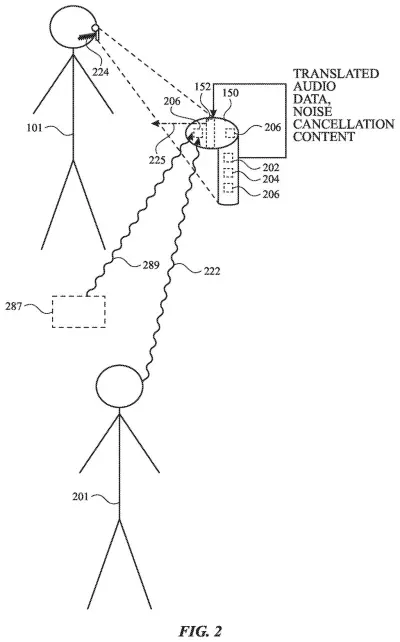
A tourist stands at a busy market stall in Madrid, earbuds in, while the vendor talks fast. A computer-generated voice whispers the English translation into the tourist's ear. Behind it, scooters, chatter and clattering plates keep coming.
Apple's filing says the usual earbud habit of letting outside sound in so you can hear the person talking backfires here. You aren't listening to the vendor's voice anymore. You're listening to the translation, and the outside noise gets in the way.
So the earbuds turn up their noise cancellation just while the translated voice plays, then ease off afterward. They mostly muffle the higher sounds and let deep rumbles through, which blurs the background without making your ears feel pressure. When you talk, they relax so you hear your own voice normally.
… modifying, while outputting the computer-generated translated audio signal, the noise cancellation operation to cancel a second amount, greater than the first amount, of the ambient noise.
Translation: The earbuds automatically turn up the noise canceling right as the translation starts playing.
How the earbuds blur noise but keep the bass
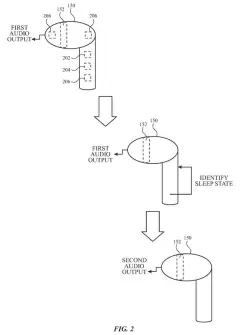
The claims cover earbuds or headphones that run noise cancellation at one level, then raise it while a computer-generated translated voice plays through the speaker. When the translation ends, the device can drop back to the earlier level. While you speak, it can set a third level, which the description says lets you hear your own voice naturally.
The boost can depend on frequency (how high or low a sound is). A frequency-dependent gain (a volume adjustment that treats pitches differently) acts like a low-pass filter, which means deep sounds pass through while mid and high sounds are suppressed. The filing says this blurs the ambient noise and reduces the ear-pressure sensation that sudden full-strength cancellation can cause.
The filing describes a few ways to do it:
- Raise the gain on the anti-noise signal (sound made to cancel other sound).
- Change the mixing value, the blend of anti-noise and pass-through sound, which normally follows the ambient sound level. The translation mode can offset that value.
- Adjust the filter settings directly.
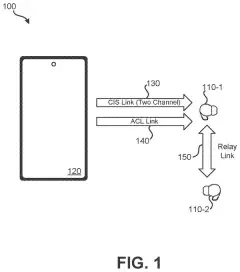
A paired phone can trigger the change and send a start time, so the earbuds ramp up before the translated voice begins. Dependent claims also remove the original speaker's voice from the pass-through sound and play back only a blurred copy of it.
The increase in the noise cancellation may be a frequency-dependent increase. The frequency-dependent increase effectively blur the ambient noise that reaches the ears of the user, while enhancing the ability of the user to hear and understand the computer-generated translated voice.
Translation: Targeted noise cancellation muffles background sounds so you can clearly hear the translated speech.
Why live translation needs quieter earbuds
Live translation through earbuds only works if you can understand the translated voice. In a loud restaurant, train station or street, the translation can sit below the noise. This filing treats the noise cancellation as part of the translation feature, not a separate setting you fiddle with.
The description also covers translating performances such as an opera, play, concert or movie, where the music and effects stay unmuffled while only the performer's voice is swapped for the translation. It is a patent application, not a product, but it shows a practical problem for anyone using translation earbuds abroad.
That makes this Apple's 17th filing we've tracked in our Wearable patents coverage since May, a group that includes ideas like curved watch glass and a self-hiding case handle.
Source: US 2026/0369290 A1 at the USPTO (PDF). Full patent text and figures are in the official publication.
Get our take in your Top Stories
Liked this breakdown? Add Patentlyze as a preferred source on Google, and our plain-English take shows up more often in your Top Stories the next time Apple patent news breaks.
Add Patentlyze on Google
One click.
There are more where this came from
We read every patent application Big Tech publishes and send you the ones worth knowing. Plain English, free, every week.
The drawings · 20 sheets
20 drawing sheets from US 2026/0369290 A1 · click any drawing to enlarge


Show the other 12 sheets


More from Apple
All 748 Apple patents →
More in Hardware
All 2,355 Hardware patents →
Qualcomm
Qualcomm Files Patent to Switch Off Earbud Microphones in Quiet Rooms
Samsung
Samsung Patents a Faster Way for Both Earbuds to Connect to Your Phone
Samsung
Samsung Patents Earbuds That Work Out What You're Doing From Sound and Movement
Google
No comments yet