
Apple
Apple · Energy · Filed Apr 10, 2026 · USPTO published Aug 27, 2026 · Aug 27 release
Apple Patents a Sliding Cover That Hides a Device's Charging Port
Apple is working on a way to hide charging ports behind a slim sliding cover that snaps into place and keeps out dust, and the mechanism is built thin enough to fit inside very small gadgets.
- Publication number
- US 2026/0254156 A1(US20260254156A1)
- Applicant
- Apple Inc.
- Filed · Published
- Apr 10, 2026 · Aug 27, 2026
- Inventors
- Mahmoud R. Amini, James M. Jeon, Ayoub Yari Boroujeni, Jack B. Rector III, Caleb J. Flori, Colin J. Abraham, Youqun Dong, Brandon Y. Leung, Kevin Bui
- Status when we published
- Waiting for an examiner
- Document
- 20 claims
- US classification
- 439/135
- Parent application
- Division of 18/380,613 (filed Oct 16, 2023)(18380613)
What Apple's hidden sliding port cover actually does
A charging port sits open on the edge of your device all day, collecting lint, dust, and debris every time it goes in a pocket or a bag. That small opening is a weak point, and on a very thin or very small device, there is barely room to add a protective door.
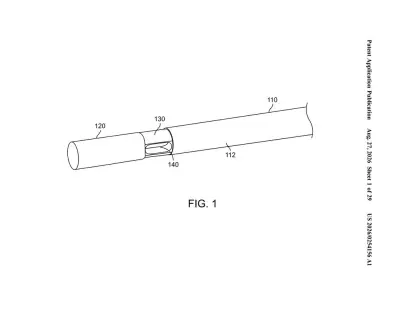
Apple's patent describes a sliding cover that moves over the port when you are not using it. Push it one way and the port is exposed so you can plug in a cable. Push it back and it clicks shut, hiding and protecting the port underneath. The cover is designed to be shallow, so it works even on compact gadgets where internal space is tight.
What makes this more than a simple flap is the way it locks. The cover has two stable resting positions, open and closed, and you get a small physical click when it settles into either one. That tactile feedback tells you the cover is fully seated without having to look at it.
a circumferential groove in the first surface; a canted-coil spring in the circumferential groove in the first surface; a first circumferential notch in the second surface to define the open position of the cover; and a second circumferential notch in the second surface to define the closed position of the cover.
Translation: The sliding cover uses a spring and specific grooves to lock the port cover firmly into either an open or closed position.
How the spring and notch system locks the cover in place
The patent describes an electronic device where the port is covered by a sleeve-style cover that slides along the outside of the device body. When you slide it open, it exposes a connector receptacle (the socket where a cable plugs in). When you slide it closed, it seals over that socket.
The mechanism that holds the cover in either position uses a canted-coil spring (a coiled metal spring set at an angle inside a groove that runs around the circumference of the cover interface). As the cover moves, that spring rides along the inner surface of the cover until it drops into one of two matching notches, one for the open position and one for the closed position. This is what creates the click and holds the cover in place rather than letting it drift.
The design is described as bistable, meaning the cover has exactly two stable states: fully open or fully closed. It does not rest comfortably anywhere in between. That matters because a cover that can sit halfway open offers little dust protection and can catch on things.
The patent also stresses that the receptacle is shallow depth, meaning the socket does not extend far into the body of the device. That is an engineering requirement for fitting this kind of covered port into a thin or compact product without sacrificing too much internal space for batteries or chips.
The cover can hide the connector receptacle and protect it from debris. The connector receptacle can also have a shallow depth making it suitable for use in small devices. Various cover mechanisms can be used. These cover mechanisms can be bistable, that is they can have a stable open position and a stable closed position.
Translation: The cover keeps dirt out of the charging port and uses a mechanism that stays securely open or closed when you move it.
What this means for dust-proofing small Apple devices
For everyday users, a port cover like this mostly matters in one specific situation: when your device fails because debris worked its way into the charging socket. That is not a dramatic failure but it is a frustrating and often expensive one. A cover that reliably snaps shut and stays shut until you deliberately open it could meaningfully extend the working life of a small device, especially one that lives in a dusty work environment, a gym bag, or an outdoor setting.
The shallow-depth requirement in this patent signals that Apple is thinking about very compact form factors, potentially hearing aids, health sensors, or accessories where a standard deep port simply will not fit. Apple's connector design choices have always been a signal of where hardware is heading, and this filing joins the latest Big Tech patents mapping out how wearable and health-adjacent devices will handle physical connections as those products get smaller.
Apple's 17th battery and power filing we've tracked since May builds on earlier applications like performance tied to behavior and charge rates tied to usage.
Source: US 2026/0254156 A1 at the USPTO (PDF). Full patent text and figures are in the official publication.
Get our take in your Top Stories
Liked this breakdown? Add Patentlyze as a preferred source on Google, and our plain-English take shows up more often in your Top Stories the next time Apple patent news breaks.
Add Patentlyze on Google
One click.
There are more where this came from
We read the new patents from Big Tech, carmakers and more and send you the ones worth knowing. Plain English, free, every week.
The drawings · 29 sheets
29 drawing sheets from US 2026/0254156 A1 · click any drawing to enlarge


Show the other 21 sheets


More from Apple
All 748 Apple patents →
More in Energy
All 148 Energy patents →
Qualcomm
Qualcomm Patents a Way to Save Your Phone's State When the Battery Is Pulled
Sony
Sony Patents a Light-Based Sensor That Reads Data Through Walls and Skin
Samsung
Samsung Patents a Battery System That Decides When a Cell Is Truly Dead
Intel