
Apple
Apple · AR / VR · Filed Jul 23, 2026 · USPTO published Nov 19, 2026 · This week's release
Apple Patents a Pinch-and-Drag Gesture That Gathers Floating Objects Into a Group
Apple describes a way to clear up a cluttered mixed-reality space with one hand: pinch an object, drag it past others, and everything it comes near tags along.
- Publication number
- US 2026/0369006 A1(US20260369006A1)
- Applicant
- Apple Inc.
- Filed · Published
- Jul 23, 2026 · Nov 19, 2026
- Inventors
- Jordan A. Cazamias, Aaron M. Burns, David M. Schattel, Jonathan Perron, Jonathan Ravasz, Shih-Sang Chiu
- Status when we published
- Waiting for an examiner
- Document
- 20 claims
- US classification
- 345/419
- Parent application
- Continuation of 18/123,841 (filed Mar 20, 2023)(18123841)
What Apple's pinch-and-sweep grouping does
Every time you tidy a crowded screen, you do the same chore: drag one item over, then another, then another. In a headset, where each drag means moving your arm through the air, that gets tiring fast. That is the problem Apple's filing goes after.
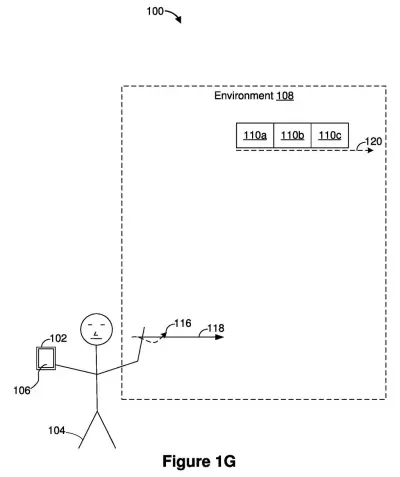
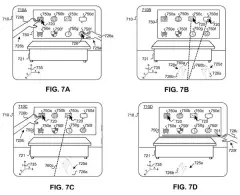
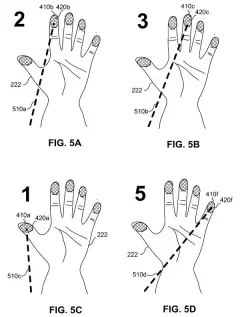
Apple's patent application describes a shortcut. You pinch one object, then drag it near others. Anything it passes close to, even without touching, joins it, like a snowball picking up snow. You keep moving the whole bunch, then spread your fingers to let go and drop everything where you want it.
Apple says the device can confirm a pinch or a new pickup with a shimmer, a sound, or a buzz. The finished bunch can also fold into a single folder-like object.
… while receiving the first drag gesture, in response to detecting the first virtual object within a threshold distance of the second virtual object, generating a group of virtual objects including the first virtual object and the second virtual object …
Translation: Dragging an item close enough to another automatically bundles them together into a single group.
How the drag picks up objects it passes near
The claims describe a specific sequence. First, the device detects a pinch gesture aimed at one virtual object, meaning a 3D item or window shown in a headset, phone, or tablet view. A camera usually spots the pinch through image analysis, which is software that picks out your hand's shape in video frames.
From there, the steps run in order:
- You drag the pinched object toward a second object.
- When the first object comes within a set distance of the second, the device creates a group containing both.
- A second drag, in a different direction, moves the whole group.
- A spread gesture (opening your fingers) ends the move.
The trigger distance can be greater than zero, so objects join the group without touching and keep some space between them. The device checks this by comparing stored coordinates (each object's position in the scene). Drag the group near a third object and it joins too, and this can repeat.
Spreading your fingers drops the group where your hand is, or along a path if you sweep in a line or arc. The filing also describes swapping the group for a single folder-like object that reveals its contents when you interact with it. Shimmer, sound, or vibration can confirm each step.
… a concurrent movement of the first virtual object and the second virtual object is displayed in the environment based on the first gesture …
Translation: Once grouped, both items move together across the screen in response to your single hand movement.
Why this matters for headset and tablet users
Anyone who arranges things in a headset knows that every drag is a physical movement. Apple's filing argues that grouping items one by one takes large gestures and extra effort, and that fewer inputs means less processing, power, and heat. If you tidy a virtual workspace, sort a set of 3D items, or clear windows out of the way, one sweep could replace a lot of arm-waving.
The filing says the idea fits devices from headsets to phones, tablets, and laptops, so the same pinch-and-collect move could reach more than one screen. It is a patent application, so nothing here says when or whether it ships. As a design idea, it points to hand controls that ask less of your arms.
This is the 53rd Apple filing we've tracked since May in our eye and hand controls watchlist, building on the head-tilt mute patent and the gaze-zoom display.
Source: US 2026/0369006 A1 at the USPTO (PDF). Full patent text and figures are in the official publication.
Get our take in your Top Stories
Liked this breakdown? Add Patentlyze as a preferred source on Google, and our plain-English take shows up more often in your Top Stories the next time Apple patent news breaks.
Add Patentlyze on Google
One click.
There are more where this came from
We read every patent application Big Tech publishes and send you the ones worth knowing. Plain English, free, every week.
The drawings · 14 sheets
14 drawing sheets from US 2026/0369006 A1 · click any drawing to enlarge


Show the other 6 sheets


More from Apple
All 748 Apple patents →
More in AR / VR
All 713 AR / VR patents →
Apple
Apple Patents a Way for Devices to Figure Out Exactly Which Object You're Pointing At
Apple
Apple Files Patent for a Headset That Stops Talking When You Tilt Your Head
Apple
Apple Files Patent for a See-Through Display That Zooms In Where You Look
Apple
No comments yet