
Apple
Apple · AR / VR · Filed Apr 8, 2026 · USPTO published Nov 19, 2026 · This week's release
Apple Files Patent for Pulling a Private Copy Out of a Shared Headset Screen
If the best view of a floating shared movie isn't from where you're sitting, this Apple patent lets you drag out a private copy of the screen. The catch: while you watch it, your headset treats you as sitting out of the group.
- Publication number
- US 2026/0367772 A1(US20260367772A1)
- Applicant
- Apple Inc.
- Filed · Published
- Apr 8, 2026 · Nov 19, 2026
- Inventors
- Gabrielle ECANOW, Alexander Burling RODRIGUEZ, Anish KANNAN, Jacob A. PICCOLO
- Status when we published
- Waiting for an examiner
- Document
- 24 claims
- US classification
- 715/755
- Parent application
- Claims priority from a provisional application 63808525 (filed May 19, 2025)
What Apple's private copy of a shared window does
Ever ended up on the worst seat on the couch, watching the TV from a sharp angle? The same thing can happen with headsets: a shared video window floats in the room for everyone, and from your spot it faces away from you.
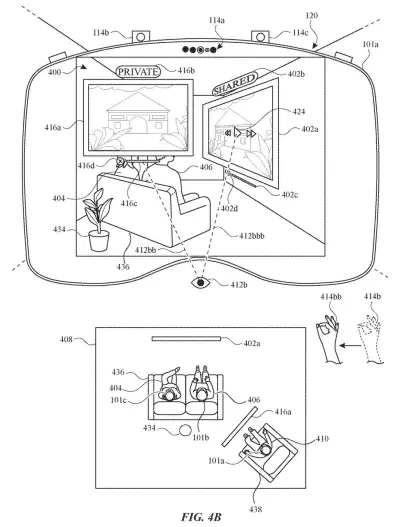
Apple's patent describes a fix. You pinch and drag the shared window, and instead of moving it for everyone, your headset pulls out a private copy that you can park wherever you like. The copy stays in sync, so if someone else hits pause, yours pauses too. The other people in the room can't see what's on it.
There is a trade-off. While you hold the private copy, the headset treats you as sitting out. Your taps on the shared window do nothing, and a message tells you why. Drag the copy back to the original and it snaps into place, and you're back in the group.
while in a multi-user communication session with the second electronic device and while presenting, via the one or more displays, a first user interface corresponding to a shared user interface at a first location within a three-dimensional environment, detecting, via the one or more input devices, an input directed to the first user interface; …
Translation: While sharing a view with another person, the device notices you trying to interact with something on the screen.
How a headset user gets detached, then rejoins
The setup is a multi-user communication session (a shared virtual space that several headsets join at once) where the people are collocated, meaning physically in the same room. A shared window, such as a media player, is docked (fixed in place) where the group can see it.
When you pinch and drag it, your headset undocks a virtual instance (a linked clone) and places it where you move it. The clone has to stay within a set distance of the original, so you stay aware of the group. Content stays synced, including play and pause, annotations, zoom and light or dark mode.
Once the clone exists, you become an inactive participant:
- Your taps on the shared window are ignored, and a notification says interactions are disabled. Its grabber bar and close button turn grey.
- When the shared window needs repositioning (say, a fourth person joins), your viewpoint is left out of the calculation.
- A notification offers to rejoin or stay out.
- Dragging the clone into a zone near the original snaps it back and restores your controls.
On the other headsets, looking toward you brings up a note that you're sitting out, plus a blurred 'phantom' copy of your window that moves as yours does. They can't see its contents.
Some examples of the disclosure are directed to systems and methods for presenting user interfaces and limiting participation in a multi-user communication session.
Translation: The patent covers technology for controlling who can see and participate in shared virtual spaces.
Why your seat in the room matters to Apple's headsets
If headsets become something groups use in the same living room, shared screens will have to work for people sitting in different spots. This patent gives each person a way to fix their own view without dragging everyone else's screen around. The price, losing control of the shared window, keeps the group's controls from getting tangled.
For you, it could mean watching a shared movie or reading a shared document from a comfortable angle while friends in the room keep the original. It could matter for Apple Vision Pro or a future Apple headset used for movie nights or meetings, though the filing itself only describes head-mounted displays.
This is the 137th Apple patent we've tracked since May in our Apple AR glasses work, joining earlier applications like a floating 3D voice assistant and rotating headset labels.
Source: US 2026/0367772 A1 at the USPTO (PDF). Full patent text and figures are in the official publication.
Get our take in your Top Stories
Liked this breakdown? Add Patentlyze as a preferred source on Google, and our plain-English take shows up more often in your Top Stories the next time Apple patent news breaks.
Add Patentlyze on Google
One click.
There are more where this came from
We read every patent application Big Tech publishes and send you the ones worth knowing. Plain English, free, every week.
The drawings · 19 sheets
19 drawing sheets from US 2026/0367772 A1 · click any drawing to enlarge


Show the other 11 sheets


More from Apple
All 748 Apple patents →
More in AR / VR
All 713 AR / VR patents →
Apple
Apple Files Patent for a Headset Window That Shows You the Room Next Door
Apple
Apple Files Patent for a Headset That Notices When You're Upset and Suggests a Break
Apple
Apple Patents a Headset Setup That Floats Your Video Above Your Laptop Screen
Apple
No comments yet