
Apple
Apple · AR / VR · Filed Oct 9, 2025 · USPTO published Nov 19, 2026 · This week's release
Apple Files Patent for Headset Labels That Turn to Face You as You Walk
In a headset, a floating label that spins away from you is hard to read. Apple's filing lets the operating system keep labels facing you, so the app never has to know where you are standing.
- Publication number
- US 2026/0369019 A1(US20260369019A1)
- Applicant
- Apple Inc.
- Filed · Published
- Oct 9, 2025 · Nov 19, 2026
- Inventors
- Hongpeng LIN, Banafsheh JALALI, Christian SCHNORR
- Status when we published
- Waiting for an examiner
- Document
- 19 claims
- US classification
- 345/419
- Parent application
- Claims priority from a provisional application 63808546 (filed May 19, 2025)
What Apple's turn-to-face label patent does
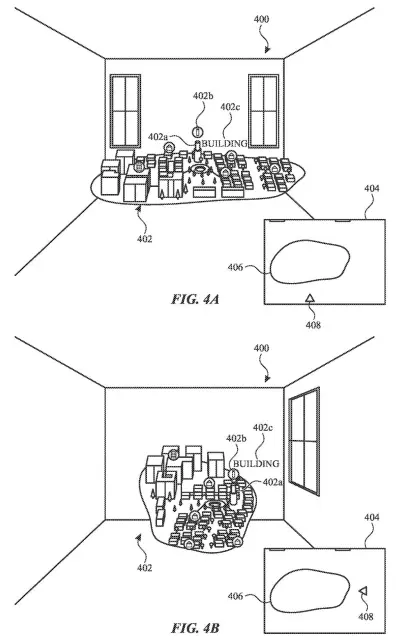
Imagine you're wearing a headset and a 3D map of a city hovers in front of you. A small label floats beside one building. As you walk around the map, the building turns to show you its other sides, but the label keeps its text pointed right at your eyes.
Apple's patent hands that job to the headset's operating system instead of the app. The map app simply says, "keep this label attached to this building, and keep it facing the viewer." From there, the system tracks your movement and redraws the scene on its own.
There's a privacy angle too. The filing describes the app never being told where you are. It asks for the behavior, gets back your taps and voice commands, and never sees your position. The filing also describes a related trick for making labels show in front of objects that would otherwise block them.
… detecting, via the one or more input devices, a change in the current location of the subject; and in response to detecting the change in the current location of the subject, re-rendering, based on the change in the current location of the subject, the second object while maintaining an orientation of the first object with respect to the subject.
Translation: The system redraws items when you move so things stay pointed right at you.
How the headset keeps labels facing you
The independent claims cover a system process (a background program that belongs to the operating system) that receives an instruction from an app. The instruction says to align a first object, such as a text label, with a subject, such as the user. The label is anchored to a second object, such as a 3D building, and all three are separate things.
The system then detects the subject's location using the device's input devices (cameras and other sensors) and draws both objects. When the user moves, the system re-draws the anchored 3D object from the new angle while keeping the label's orientation toward the user. It does this without any new instructions from the app, and the app is not given the user's location.
The filing and its dependent claims add several refinements:
- The app can name a primary axis (the main direction the label should face the user), and optionally a secondary one.
- A rotation limit caps how far a label turns to follow you.
- If a label would grow or shrink past a size threshold, it stops being displayed.
- The label can inherit visual traits, such as scale or color, from the object it is attached to.
The description also covers an occlusion variation (when one object blocks another). In an astronomy example, a label tied to the moon is drawn in front of the Earth, and the part of the Earth that would hide it is not drawn.
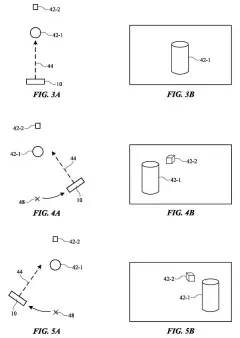
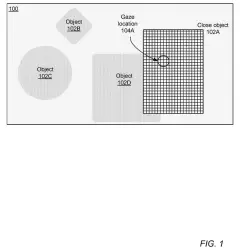
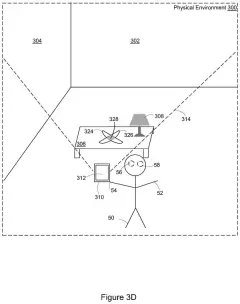
Some techniques are for aligning content based on location of user in accordance with some embodiments.
Translation: The patent describes methods for positioning virtual items relative to where a user is standing.
Why apps never need to know where you stand
If you've used a 3D view where text slides sideways or turns away as you move, you know the annoyance. This approach keeps labels readable, and it could apply to maps, 3D models, or educational apps in a headset, where captions and pop-ups need to stay legible as you move around.
It also changes who does the work. Developers can ask the system for this behavior instead of writing code to track you and update every label themselves. And because the app is not told where you are, an app can offer a position-aware experience while learning less about you, which is a point Apple tends to emphasize.
That makes this Apple's 135th filing we've tracked since May in our Apple AR glasses watchlist, joining earlier applications like one on finding lost items and one on live event audio.
Source: US 2026/0369019 A1 at the USPTO (PDF). Full patent text and figures are in the official publication.
Get our take in your Top Stories
Liked this breakdown? Add Patentlyze as a preferred source on Google, and our plain-English take shows up more often in your Top Stories the next time Apple patent news breaks.
Add Patentlyze on Google
One click.
There are more where this came from
We read every patent application Big Tech publishes and send you the ones worth knowing. Plain English, free, every week.
The drawings · 17 sheets
17 drawing sheets from US 2026/0369019 A1 · click any drawing to enlarge


Show the other 9 sheets


More from Apple
All 748 Apple patents →
More in AR / VR
All 713 AR / VR patents →
Apple
Apple Patents a Fix for Virtual Hands That Jump Between Headset Cameras
Apple
Apple Files Patent for Headset Graphics That Sharpen Only Where Both Eyes Look
Apple
Apple Files Patent to Brighten Headset Displays With Two Overlapping Patterns in the Lens
Apple
No comments yet