
Apple
Apple · Networking · Filed May 14, 2025 · USPTO published Nov 19, 2026 · This week's release
Apple Files Patent for Satellite Texting That Borrows Your Phone's Number
Take your watch hiking with no cell signal, and this Apple patent application would let it text people anyway, using the number from the phone you left behind as a go-between.
- Publication number
- US 2026/0370318 A1(US20260370318A1)
- Applicant
- Apple Inc.
- Filed · Published
- May 14, 2025 · Nov 19, 2026
- Inventors
- Gregory R Nelson, Abhishek Walia, Aditya Chaturvedi, Jialin Song
- Status when we published
- Waiting for an examiner
- Document
- 20 claims
- US classification
- 370/329
What Apple's satellite relay does for texts
Every time you leave your phone in the car and set off down a trail with only your watch, your messages go silent. No cell tower nearby means no texting. Apple's patent application describes a way around that.
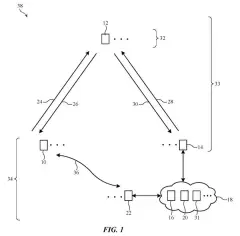
Your watch would connect to a group of satellites and send the text up to them. The text lands on servers on the ground, which hand it to your phone, still online somewhere with cell service. Your phone then sends it on as an ordinary text using its own SIM (the chip that links a device to your phone plan). The person you're messaging sees a message from your usual number.
Replies run the same route in reverse. Your phone catches the text and passes it up to the watch by satellite. The point is that your watch never needs a phone plan of its own.
… transmitting a message to a second UE device via the constellation, the core network, and relay by a third UE device that is associated with the first UE device, wherein the message comprises a handle associated with a subscriber identity module (SIM) of the third UE device …
Translation: Your satellite device sends a text using your other phone's cellular identity.
How your phone passes satellite texts along
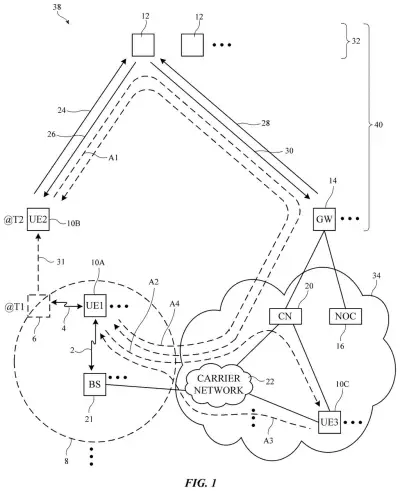
The setup involves three devices. The first (a watch or other small wearable, in the filing's main example) is off-grid, meaning out of reach of cell towers. The second is your phone, still online and holding the SIM (subscriber identity module, the chip that proves your account to a carrier). The third belongs to whoever you're texting.
To send a message, the first device compresses and encrypts the text, then sends it through a constellation (a group of satellites working together) to a ground-based core network (the satellite service's servers). The message carries a short handle for your phone's SIM, placed in both the 'to' and 'from' handle fields, which tells the servers to forward it to your phone. Your phone unpacks the text, converts it into a standard SMS, and sends it from your number.
The filing also describes several extras:
- A relay confirmation goes back to the off-grid device so you see that the text was passed on.
- A trusted contacts list can limit who is allowed to message you over satellite.
- A service summary can tell the device how many messages are waiting when it connects.
Because satellite links carry little data, the satellite messages use a compact format, and the phone converts them back to ordinary texts.
When the first UE moves off-grid, the first UE may connect to the CN via a constellation of satellites. The first UE may convey messages with the third UE via the constellation, the CN, and relay by the second UE using the SIM of the second UE.
Translation: When you lose cell service, your device routes messages through satellites using your normal phone number.
Why this skips a second phone plan
The practical payoff is simple: you could stay reachable on a swim, surf, or hike with only a small device, without buying and managing a second plan or SIM for it. The people you text would see your normal number and would not need to know a satellite was involved.
It also shows a design choice. Instead of giving every gadget its own cellular identity, the filing treats your phone as the home base for your account and lets other devices borrow it. That keeps billing simple and puts the control (a relay setting, a list of approved contacts) in your hands.
This is the 690th Apple filing in our Apple coverage since May, adding to a run that includes video call recording and phones sharing AI data with towers.
Source: US 2026/0370318 A1 at the USPTO (PDF). Full patent text and figures are in the official publication.
Get our take in your Top Stories
Liked this breakdown? Add Patentlyze as a preferred source on Google, and our plain-English take shows up more often in your Top Stories the next time Apple patent news breaks.
Add Patentlyze on Google
One click.
There are more where this came from
We read every patent application Big Tech publishes and send you the ones worth knowing. Plain English, free, every week.
The drawings · 8 sheets
8 drawing sheets from US 2026/0370318 A1 · click any drawing to enlarge


More from Apple
All 748 Apple patents →
More in Networking
All 516 Networking patents →
Samsung
Samsung Files Patent for Phones That Learn When a Satellite Can Actually Hear Them
Intel
Intel Patents a Fix for the Dropped Connections That Plague Satellite Phone Calls
Samsung
Samsung Patents Satellite-Aware Handover System for 5G and 6G NTN
Samsung
No comments yet