
Apple
Apple · Networking · Filed Jul 14, 2025 · USPTO published Nov 19, 2026 · This week's release
Apple Files Patent for Phones and Cell Towers That Swap AI Training Data
Before your phone hands a cell tower a pile of AI data, Apple's patent has it show a short description first, like a menu. The network only asks for the full thing if it looks worth the airtime.
- Publication number
- US 2026/0370569 A1(US20260370569A1)
- Applicant
- APPLE INC.
- Filed · Published
- Jul 14, 2025 · Nov 19, 2026
- Inventors
- Peng Cheng, Fangli Xu, Ralf Rossbach, Ping-Heng Kuo, Yuqin Chen, Haijing Hu, Sethuraman Gurumoorthy, Zhibin Wu
- Status when we published
- Examiner raised objections; the company can respond
- Document
- 20 claims
- US classification
- 709/223
- Examiner
- OSMAN, RAMY M (Art Unit 2457)
- Parent application
- National Stage Entry of PCT/CN2023/076444 (filed Feb 16, 2023)(PCTCN2023076444)
What Apple's AI dataset handshake actually does
A phone spends the day recording how strong its signal is in different places. A cell network could learn a lot from those records, but sending every file would eat up the same airwaves your calls and videos need.
Apple's patent describes a polite handshake to avoid that. First the phone sends a short description of what it has: what kind of data, how much, how recent, how reliable. The network reads it and asks for the full set only if it looks worth the trip.
The handshake also works in reverse, with the network offering data to your phone. The filing even describes asking for your consent before any sharing starts. Either way, the goal is to skip pointless transfers and leave airtime for what you are actually doing.
transmit, to a second communication device, a dataset notification including meta info of a dataset for an Artificial Intelligence (AI) model …
Translation: A device sends a notice about available AI training data to another device.
How a phone and tower decide what data to send
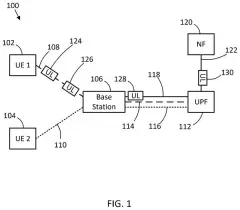
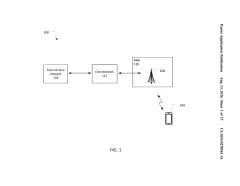
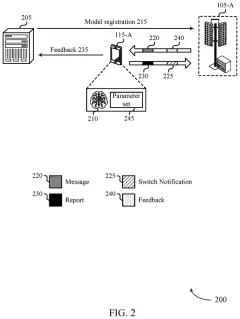
The filing covers two sides of one exchange: a first device (in the examples, a phone, which the patent calls user equipment) and a second device (in the examples, a base station, the cell tower hardware). The exchange has three steps:
- Notification: one side announces it holds a dataset for an AI model, plus metadata (a description of the data) such as data type, intended use, sample count, size, last update time and the conditions it was collected in.
- Request: the other side decides the data is worth having and asks for it.
- Report: the first side sends the dataset itself.
The notification can also carry quality scores: accuracy, variance, integrity and latency (how stale the data is). Notices can go out on a schedule, when a quality threshold is crossed, or in reply to an inquiry. A timer can stop requests from being sent too often.
The dataset can travel as a control message (RRC, the basic signaling between phone and tower) that holds the data or a download address, as a core-network message (NAS), or as ordinary data traffic. The filing says control messages are fastest but handle big files poorly, while the other routes carry more data with more delay.
Before any sharing, the two devices swap AI capabilities, check consent, and register which AI models each one has using model IDs.
… receive, from the second communication device, a dataset request to request obtaining the dataset …
Translation: The device gets a request asking to download the specific dataset.
Why Apple's phone-to-network data swap matters
Cellular networks are starting to use AI for jobs like picking the best signal beam and pinning down your location. Those models need data, and phones and towers each hold some of it. A cheap way to check what is available before moving it could keep that extra traffic from crowding out your calls and streaming.
The patent is about plumbing, so you will never see it as a feature. It also depends on the other side of the connection understanding the same messages. The examiner's first review rejected the claims as filed, which is routine at this stage and usually followed by amendments.
That makes this Apple's 20th filing we've tracked since July in our on-device AI privacy push watchlist, building on work like fake-mask face recognition and limiting what app servers see.
Source: US 2026/0370569 A1 at the USPTO (PDF). Full patent text and figures are in the official publication.
Get our take in your Top Stories
Liked this breakdown? Add Patentlyze as a preferred source on Google, and our plain-English take shows up more often in your Top Stories the next time Apple patent news breaks.
Add Patentlyze on Google
One click.
There are more where this came from
We read every patent application Big Tech publishes and send you the ones worth knowing. Plain English, free, every week.
The drawings · 9 sheets
9 drawing sheets from US 2026/0370569 A1 · click any drawing to enlarge


Show the other 1 sheets

More from Apple
All 748 Apple patents →
More in Networking
All 516 Networking patents →
Samsung
Samsung Patent Splits Federated AI Model Training Between Phones and Towers
Google
Google Patent Reveals Nearby Phones Jointly Training a Shared AI Model
Qualcomm
Qualcomm Files Patent to Catch Garbled Data When Phones Teach an AI Together
Qualcomm
No comments yet