
Apple
Apple · Software · Filed Nov 6, 2025 · USPTO published Nov 19, 2026 · This week's release
Apple Patents a Search Bar That Guesses What You Need Before You Type
Before you type a single letter, Apple's patent application has your phone's search bar guessing which app, web page or action you are about to need. It bases the guess on the time, your calendar, your location and what you did last week.
- Publication number
- US 2026/0368136 A1(US20260368136A1)
- Applicant
- Apple Inc.
- Filed · Published
- Nov 6, 2025 · Nov 19, 2026
- Inventors
- Erik M. BERGET, Alexandre R. MOHA, Amir ALAVI, Brendan B. ARONOFF, Chirag M. SHAH, Justin S. TITI, Kenneth S. WHITE, Rose G. MONTOYA, Kateryna KONONENKO, Daniel S. HSU, Andres H. PINEDA, Michal A. KALUZNY, Michael A. ROJAS
- Status when we published
- Examiner raised objections; the company can respond
- Document
- 20 claims
- US classification
- 707/722
- Examiner
- VU, BAI DUC (Art Unit 2163)
- Parent application
- Claims priority from a provisional application 63808615 (filed May 19, 2025)
What Apple's context-aware search bar actually does
A woman walks out of the office at 4:55 PM, with a calendar event starting at 5:00. She taps her phone's search bar and types just two letters, SM. In Apple's example, the phone already knows what she is likely to do next: text “leaving in five” to the person she usually messages about plans like this.
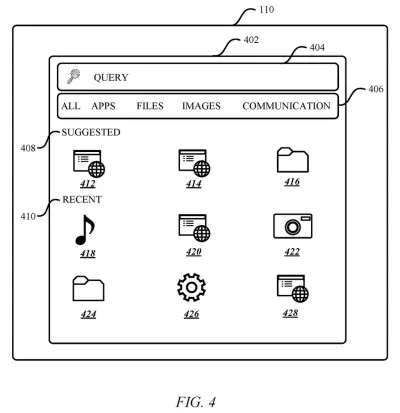
That is the idea behind this patent application. Your phone's built-in search would watch the time, your location, your calendar and your habits, then guess which apps, web pages, files and actions you want. It can even do this before you type anything, the moment you open the search screen.
Type a few letters like “artificial intel” and it can offer the Wikipedia page you read last week, ranked by how likely you are to want it right now. Tap it, and your browser opens straight to that page.
… determining that the at least the portion of the query corresponds to one or more application resources of an application previously interacted with by a user of the user device …
Translation: The system matches your partial typing to things you previously did inside your apps.
How Apple ranks apps and pages by likelihood
The filing covers two related ideas. The first kicks in once you start typing. A system process (a background service built into the operating system, separate from any app) checks whether your partial query matches something you did before in an app, like a page in your browser history.
A machine learning model (software trained to spot patterns in past behavior) then scores each match for relevance, using time of day, location, open apps, and how often and recently you used the item. Results are listed from highest score to lowest, and the description gives 0.60 on a 0 to 1 scale as an example cutoff. Tapping one opens the app straight to that page or item.
The second idea works before you type. When the search screen opens, the model scores your apps against your context and shows the top ones. The description also covers menu items inside an app and typed shortcuts like “SM” that ask the messaging app what it needs, then prefill a likely message and recipient.
Underneath, the device sorts streams of app activity into a database using predefined schemas (templates for which details to record). Apps need authorization to query it, and the description says the processing stays on the device.
The system identifies a set of potentially relevant applications prior to receiving any user input using machine learning model that leverages current user context to assign likelihood scores to candidate applications.
Translation: Your device guesses what you want before you even type anything by looking at your current situation.
What this means for searching on your iPhone
If this ever ships, your search bar stops being a box you type into and starts anticipating you. That could mean fewer taps to reopen the page you read last week, the document you work on every Monday, or the text you send every Friday at 5. The description also covers searching inside a site, so a query like “Reddit best bagel in town” could jump straight to a search on Reddit.
Privacy is built into the pitch: the description says the contextual processing happens on your device and apps need explicit permission to read your activity records. That matters because the system learns from a lot of personal habits. The examiner's first review rejected the claims as filed, which is routine at this stage and usually followed by amendments.
This is the 13th Apple filing we've tracked since June in our AI assistants that remember you watchlist, building on remembering where you left things and predicting your next destination.
Source: US 2026/0368136 A1 at the USPTO (PDF). Full patent text and figures are in the official publication.
Get our take in your Top Stories
Liked this breakdown? Add Patentlyze as a preferred source on Google, and our plain-English take shows up more often in your Top Stories the next time Apple patent news breaks.
Add Patentlyze on Google
One click.
There are more where this came from
We read every patent application Big Tech publishes and send you the ones worth knowing. Plain English, free, every week.
The drawings · 11 sheets
11 drawing sheets from US 2026/0368136 A1 · click any drawing to enlarge


Show the other 3 sheets


More from Apple
All 748 Apple patents →
More in Software
All 814 Software patents →
Google
New Google Patent Uses Your Browsing History to Answer Search Queries
Samsung
Samsung Files Patent for a Phone Search Box That Suggests What to Look For
Google
Google Files Patent to Delay Assistant Updates Until You Finish Editing Settings
Microsoft
No comments yet