
Apple
Apple · AR / VR · Filed Feb 20, 2026 · USPTO published Nov 19, 2026 · This week's release
Apple Files Patent for Live Event Broadcasts Where Sound Follows the Camera You Pick
When you flip between camera angles at a live event in a headset, the sound should flip with you. Apple's patent describes a way to make that happen automatically.
- Publication number
- US 2026/0371030 A1(US20260371030A1)
- Applicant
- Apple Inc.
- Filed · Published
- Feb 20, 2026 · Nov 19, 2026
- Inventors
- Jared King
- Status when we published
- Waiting for an examiner
- Document
- 20 claims
- US classification
- 381/303
- Parent application
- Claims priority from a provisional application 63806408 (filed May 15, 2025)
What Apple's camera-matched audio actually does
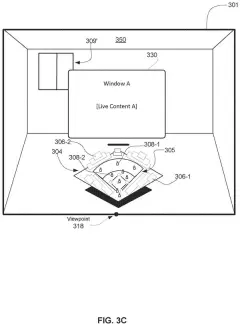
Imagine you're wearing a headset watching a live basketball game, switching between a camera courtside and one high above the arena. When you switch, the crowd, the squeaking shoes and the announcer should all seem to come from the right directions for that camera. Today, getting that right takes a lot of manual work.
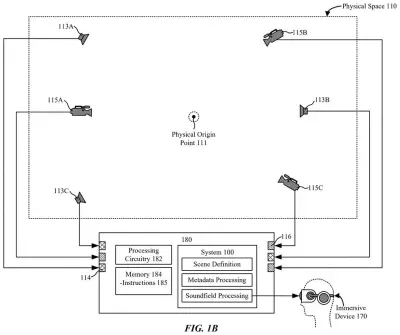
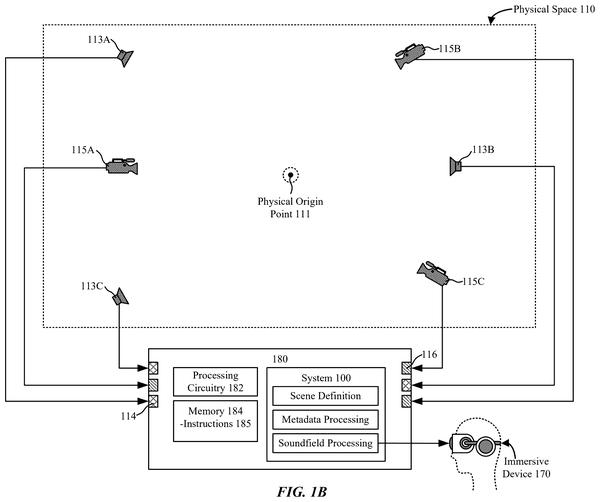
Apple's patent describes a single system that handles it automatically. It tracks where every camera and every sound source sits in the venue, builds a shared digital map of the space, and, when you pick a camera, recalculates where each sound should seem to come from relative to that camera.
The filing says this could replace the usual setup where every camera needs its own audio mixer. It also says the approach could cut setup time and reduce the amount of audio data sent to viewers.
… determining audio object presentation locations for each of the audio objects in the virtual space based on a selected capture node from the plurality of capture nodes, wherein the audio object presentation locations are measured from the capture node location of the selected capture node …
Translation: Calculating where sounds should seem to come from based on which camera angle you are currently watching.
How sounds get re-measured from each camera
The system takes in video from several cameras (the patent calls them capture nodes) and audio from several microphones, all placed in the same physical space. From the video it works out where each camera is. From the audio it works out where each sound source is, packaging each one as an audio object (a sound plus data about where it is located).
Next it maps both onto a shared virtual space, a digital copy of the venue that uses the same coordinate system as the real one. Everything is first measured from a single origin point, such as the center circle of a basketball court.
When a camera is selected, the system re-measures every sound from that camera's position instead of the venue's center. In the filing's example, a sound at (250, 50, 1000) from the origin becomes (1010, 850, 510) from the chosen camera. It then builds the spatial audio, optionally as a higher order ambisonics soundfield (a format that describes sound as a 3D bubble around the listener), and rotates it by the camera's heading so that "front" matches where the camera points. In the example, that rotation is 34 degrees.
The filing says these calculations can be run ahead of time for every camera, and that a human director or a machine learning system could pick the camera. The audio is synced with that camera's video and sent to a headset. The claims also cover the headset side: a device that receives and plays the synced audio and video.
… where the spatial audio and the video data from the selected capture node may be synchronized and transmitted to an immersive device …
Translation: Sending the matched video and 3D sound directly to a headset or device.
Why live headset broadcasts could be easier to mix
If you ever watch a concert or game through a headset, this is the difference between sound that matches your view and sound that feels pasted on. Each camera angle would get audio that fits its position, and the filing describes this happening in real time.
Behind the scenes, the patent points to a more practical payoff. The filing says one processing device could do the job that currently takes a separate audio mixer per camera, and that a camera moved mid-broadcast would not force the mix to be rebuilt from scratch. It also says setup time, audio routing complexity and the bandwidth needed to send audio to viewers would all drop. Those savings matter most to broadcasters, who decide whether live immersive events are worth producing.
This is the 133rd Apple filing we've tracked on our Apple AR glasses watchlist since May, following applications like one fixing jumpy virtual hands and virtual TVs casting wall light.
Source: US 2026/0371030 A1 at the USPTO (PDF). Full patent text and figures are in the official publication.
Get our take in your Top Stories
Liked this breakdown? Add Patentlyze as a preferred source on Google, and our plain-English take shows up more often in your Top Stories the next time Apple patent news breaks.
Add Patentlyze on Google
One click.
There are more where this came from
We read every patent application Big Tech publishes and send you the ones worth knowing. Plain English, free, every week.
The drawings · 6 sheets
6 drawing sheets from US 2026/0371030 A1 · click any drawing to enlarge


More from Apple
All 748 Apple patents →
More in AR / VR
All 713 AR / VR patents →
Apple
Apple Patents Eye Calibration So Headset Cameras Keep Nearby Objects Sharp
Apple
Apple Patents a Fix for Warped Hands in Headset Camera Views
Apple
Apple Files Patent to Tuck Eye-Tracking Cameras Into the Nose Bridge of Smart Glasses
Apple
No comments yet