
Apple
Apple · Hardware · Filed Aug 19, 2025 · USPTO published Nov 19, 2026 · This week's release
Apple Files Patent for Cutting Interference When Your Phone Talks to Its Charger
Every time your phone tells its wireless charger how much power it needs, the signal creates a burst of electrical static. Apple's patent times that signal so most of the static cancels out.
- Publication number
- US 2026/0370260 A1(US20260370260A1)
- Applicant
- Apple Inc.
- Filed · Published
- Aug 19, 2025 · Nov 19, 2026
- Inventors
- Sriram Narayanan, Stephen C. Terry, Arash Mehrabi, Alireza Safaee
- Status when we published
- Waiting for an examiner
- Document
- 20 claims
- US classification
- 375/130
- Examiner
- TADESE, BERHANU (Art Unit 2632)
- Parent application
- Claims priority from a provisional application 63806905 (filed May 16, 2025)
What Apple's charger chat patent actually does
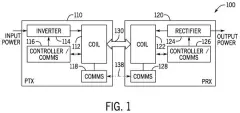
You set your phone on a wireless charger and walk away. Behind the scenes, the two are constantly trading tiny messages, such as how much power the phone wants. The phone sends its side by briefly changing how much power it draws, and the charger notices those changes and reads them as data.
The catch is that this signaling can create electrical interference that bleeds into other circuits. Apple's patent changes when the phone makes those tiny changes, timing them for a moment when most of the interference cancels out.
The filing also describes spelling out each 1 or 0 as a longer pattern of highs and lows, which makes the message easier for the charger to pick out, and filling the gaps between messages with a repeating filler pattern. The result is a cleaner signal with fewer electrical spikes.
… control circuitry that operates the rectifier to selectively short circuit the wireless power transfer coil to communicate with the wireless power transmitter using amplitude shift keying communication …
Translation: The phone talks to the charger by briefly and repeatedly shorting out its own charging coil.
How the phone times its coil shorts to cut noise
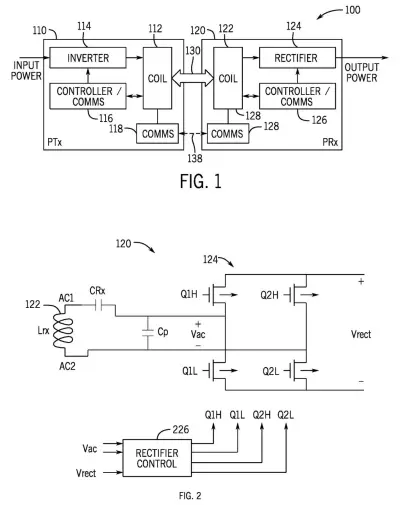
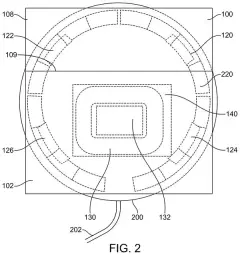
A wireless charger sends power to your device through a coil. A part called a rectifier (a circuit that turns the back-and-forth AC power from the coil into the one-way DC power a battery needs) sits on the device side. The patent uses that same rectifier to talk back to the charger.
The device does this with amplitude shift keying, which means it briefly shorts its coil, a change in load the charger can detect and decode. Shorting at the wrong moment creates sharp common mode noise (electrical spikes that can interfere with other circuits). The claims cover shorting the coil when the voltage is at half the rectifier's output voltage. In practice, that means shorting for two cycles of the power wave, then skipping two. The filing says this nearly eliminates the spikes and leaves a nearly constant common mode voltage.
The claims and description add several supporting details:
- Spread spectrum signaling: each 1 or 0 is replaced by a longer pattern of highs and lows called chips (the filing gives eight as an example), and each chip is a rising or falling transition.
- An idle pattern: a run of 1 bits fills the gaps between message packets.
- Full bridge rectifier: the shorting happens by closing the two low side switches.
The description also covers a low-power listener on the charger side that wakes the full decoder only when real data arrives.
… wherein the rectifier selectively short circuits the wireless power transfer coil at one half the rectifier’s DC output voltage to reduce common mode noise caused by communication with the wireless power transmitter …
Translation: Doing this at half the normal output voltage cuts down on unwanted electrical interference.
Why cleaner charger chatter matters for your gear
If you charge a phone, watch, or pair of earbuds wirelessly, this is the invisible conversation that keeps charging working. The filing names phones, tablets, laptops, headphones, and styluses as likely users. Electrical noise from that conversation can interfere with other circuits in the device, so a cleaner signal gives designers fewer problems to work around.
The description also says that constant signaling steadies the rectifier's output voltage and reduces audible noise, though it makes the charger do more listening work. That trade-off explains the always-on listener described in the filing. The claims cover the receiver side, and the filing ties its signaling to the Qi wireless charging standard.
That makes this Apple's 691st filing in our Apple coverage since May, adding to work like satellite texting and split video call recording.
Source: US 2026/0370260 A1 at the USPTO (PDF). Full patent text and figures are in the official publication.
Get our take in your Top Stories
Liked this breakdown? Add Patentlyze as a preferred source on Google, and our plain-English take shows up more often in your Top Stories the next time Apple patent news breaks.
Add Patentlyze on Google
One click.
There are more where this came from
We read every patent application Big Tech publishes and send you the ones worth knowing. Plain English, free, every week.
The drawings · 5 sheets
5 drawing sheets from US 2026/0370260 A1 · click any drawing to enlarge


More from Apple
All 748 Apple patents →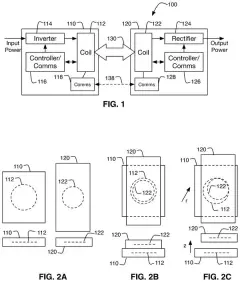
More in Hardware
All 2,355 Hardware patents →
Microsoft
Microsoft Files Patent for AI Chips That Multiply Numbers With Light
Intel
Intel Files Patent for Graphics Chips That Split Into Custom-Sized Slices for Different Users
Sony
Sony Patents a Folded Graphite Strip to Cool a Camera Sensor That Moves
Intel
No comments yet