
Hilti
Hilti · Gear · Filed May 7, 2025 · USPTO published Nov 19, 2026 · This week's release
Hilti Files Patent for a Lighter Piston Inside Its Hammer Drills
Inside a hammer drill, a small piston shuttles back and forth to power every blow. Hilti's filing shows how to make that piston lighter by building the bearing surfaces right into the part.
- Publication number
- US 2026/0364762 A1(US20260364762A1)
- Applicant
- Hilti Aktiengesellschaft
- Filed · Published
- May 7, 2025 · Nov 19, 2026
- Inventors
- Maximilian KNYRIM, Daniel SELTMANN, Aaron WIEDNER
- Status when we published
- Examiner raised objections; the company can respond
- Document
- 19 claims
- US classification
- 173/90
- Examiner
- JALLOW, EYAMINDAE CHOSSAN (Art Unit 3731)
- Parent application
- National Stage Entry of PCT/EP2023/080556 (filed Nov 2, 2023)(PCTEP2023080556)
What Hilti's two-part hammer piston does
A hammer drill breaks up concrete by pounding its bit again and again. Inside the tool, a small piston shoves air back and forth to throw each blow, and that piston has to be flung forward and yanked back on every single stroke. The heavier it is, the more energy the tool burns and the more it shakes in your hands.
Hilti's filing goes after that weight. Older designs used separate inserts to cushion the joint where the connecting rod meets the piston, which means extra parts and extra material. Hilti instead shapes the curved cradle surfaces directly into the piston's two halves, so material sits only where the load actually lands. The filing also says the parts can be molded from plastic.
On paper, the payoff is a lighter piston, less vibration and less wear on the drive. Hilti adds a few extras too, like a thin steel liner and a groove that holds grease.
a crank mechanism for converting a rotational drive movement of an electric motor via a connecting rod driven by a crank disk into a translationally alternating movement of an exciter piston for axially applying impact energy to a tool …
Translation: The system turns the motor's spinning motion into the back and forth hits of the drill piston.
How the bearing is built into the piston
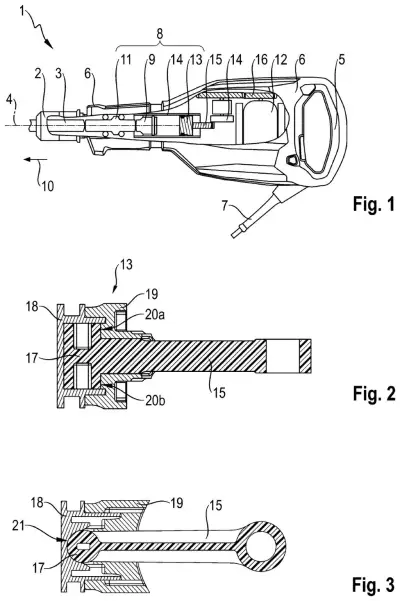
The patent covers the piston end of a hammer mechanism, the part that turns a motor's spinning into the back-and-forth push that drives the tool. A crank disk (a spinning wheel with an off-center arm) moves a connecting rod, which pushes an exciter piston (the piston that pumps air to fire the hammer blows). The tool is struck through an air cushion, not by the piston touching the bit directly.
The connecting rod ends in a bearing pin section, a rounded end molded as part of the rod. The piston is built in two pieces: a crown on top and a skirt, the sleeve-shaped body below it. A concave (hollow, cradle-like) surface is molded into the inside of the crown, and curved surfaces are molded into the inside of the skirt. Together they wrap around the rod's rounded end and form a plain bearing (a simple sliding joint with no rolling balls).
The filing describes several add-ons:
- Casting the rod and piston from plastic, ideally by injection molding.
- Small recesses in the rod's end to remove weight.
- A half-shell steel sheet, 0.2 to 2 mm thick, between the rod and the crown to cut heat and wear.
- A single lubricant groove in the most heavily loaded bearing surface.
- Grooves beside welded or glued seams to catch leftover weld or adhesive, plus small centering lugs that line up the two halves during assembly.
The crown surface handles the forward stroke, which carries the heaviest load, and two skirt surfaces handle the return stroke.
… which exciter piston is composed at least of a piston crown part and a piston skirt part, wherein a concave bearing shell section associated with the bearing pin section of the connecting rod is integrally formed on the inside of the piston crown part …
Translation: The piston is built from two separate parts with a built-in pocket to hold the connecting rod.
Why a lighter piston matters to tool users
For anyone who runs a chisel hammer or hammer drill all day, a lighter moving part means less shaking and less energy wasted moving the piston itself. Hilti says the lower mass also reduces wear on the crank drive, which could help tools last longer on a job site. The molded-in bearing design also means fewer loose parts to make and assemble.
This is a mechanical refinement, not a new kind of tool. The examiner's first review rejected the claims as filed, which is routine at this stage and usually followed by amendments. Nothing here says when, or whether, the design will appear in a Hilti product.
Hilti's third filing in the Power tools & outdoor patents we've tracked since November follows earlier applications on a self-locating surveying laser and a laser finding its position.
Source: US 2026/0364762 A1 at the USPTO (PDF). Full patent text and figures are in the official publication.
Get our take in your Top Stories
Liked this breakdown? Add Patentlyze as a preferred source on Google, and our plain-English take shows up more often in your Top Stories the next time Hilti patent news breaks.
Add Patentlyze on Google
One click.
There are more where this came from
We read the new patents from Big Tech, carmakers and more and send you the ones worth knowing. Plain English, free, every week.
The drawings · 4 sheets
4 drawing sheets from US 2026/0364762 A1 · click any drawing to enlarge


More from Hilti
All 4 Hilti patents →
More in Gear
All 26 Gear patents →
Makita
Makita Files Patent for a Demolition Hammer With Handles That Absorb Vibration
Greenworks
Greenworks Patents a Riding Mower With Motors Built Into Each Wheel and a Battery Mounted Below the Seat
Milwaukee
Milwaukee Tool Files Patent for Pipe Cameras That Label Rust, Cracks and Clogs
Milwaukee
No comments yet