
Samsung Patents a Coordinate-Aware Noise Prediction Model for Image Generation
Most AI image denoisers treat every pixel the same regardless of where it sits in the frame. Samsung's new patent tells the noise model exactly where each feature lives — and that positional context could make a real difference in output sharpness.
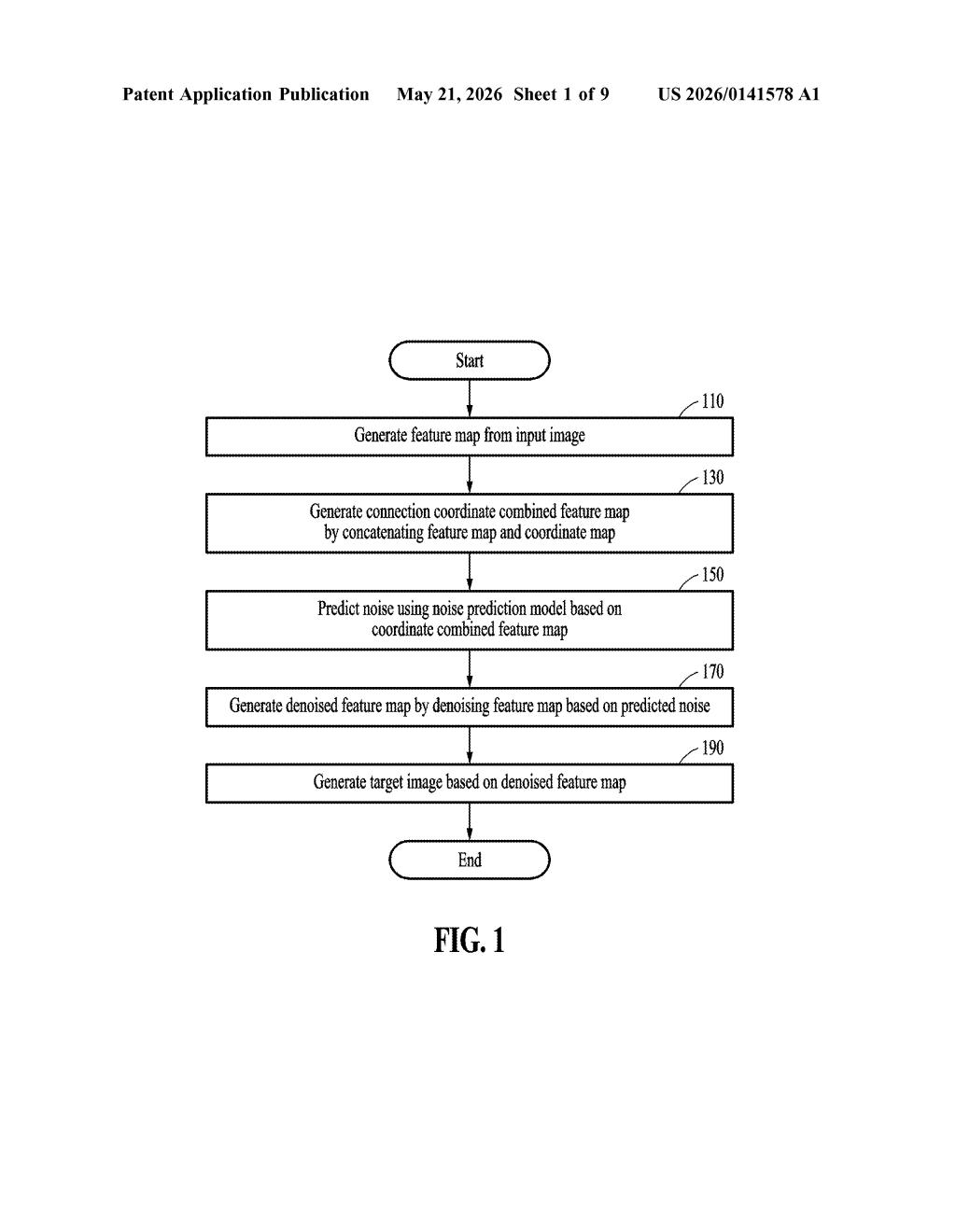
What Samsung's coordinate-map denoising actually does
Imagine your phone's camera tries to clean up a blurry or noisy photo using AI. The AI has to figure out which blurry patches are real detail and which are just noise — but without knowing where in the image each patch lives, it can sometimes smooth out edges that should stay sharp or miss noise in corners.
Samsung's patent adds a second layer of information called a coordinate map — essentially a grid that tells the AI model the exact position of every feature it's analyzing. That spatial context gets baked in before the model ever tries to predict what's noise and what isn't.
The result is a denoising pipeline that's spatially self-aware. Instead of treating the center of your photo and the edge the same way, the model can make smarter, location-informed decisions about what to clean up and what to preserve.
How the coordinate map guides Samsung's noise predictor
The patent describes a multi-step image processing pipeline built around a diffusion-style denoising approach (the same family of techniques behind AI image generators like Stable Diffusion). Here's how the stages connect:
- Feature map generation: The input image is first converted into a feature map — a compressed, abstract representation of the image's visual content extracted by a neural network encoder.
- Coordinate concatenation: A coordinate map — a tensor encoding the (x, y) spatial position of each feature point — is concatenated (joined channel-by-channel) with the feature map, producing a coordinate combined feature map.
- Noise prediction: This combined map is fed into a noise prediction model, which estimates the noise component present in the feature map. Because the model now sees positional data alongside visual features, it can tailor noise estimates to specific spatial regions.
- Denoising and output: The predicted noise is subtracted from the feature map to produce a denoised feature map, which is then decoded into the final target image.
The core insight is that by making spatial location a first-class input to the noise predictor — rather than something the model has to infer implicitly — the system can produce cleaner, more spatially consistent reconstructions.
What this means for on-device image generation quality
Diffusion-based image generation and enhancement are computationally expensive, and one of the known failure modes is spatial inconsistency — where the model applies uniform denoising logic to regions that should behave differently (think: a subject's face versus a blurred background). By explicitly injecting coordinate data, Samsung's approach targets that weakness directly.
For Samsung Galaxy devices, which already ship on-device AI photo processing features, this kind of architectural improvement could translate into sharper low-light shots or higher-quality AI-generated content produced entirely on the phone — without needing server-side processing.
This is a focused, incremental improvement to diffusion-based image pipelines rather than a wholesale new architecture. The idea of appending positional encodings to feature maps is well-established in transformer research, so Samsung is essentially applying a known technique to the denoising step specifically. It's not a splashy filing, but it's exactly the kind of careful optimization work that compounds into noticeably better camera output over time.
Get our take in your Top Stories
Liked this breakdown? Add Patentlyze as a preferred source on Google, and our plain-English take shows up more often in your Top Stories the next time Samsung patent news breaks.
There are more where this came from
We read every patent application Big Tech publishes and send you the ones worth knowing. Plain English, free, every week.
Want this weekly breakdown for a company we don't cover? Patentlyze Pro →