
Qualcomm
Qualcomm · AI / ML · Filed Nov 15, 2024 · USPTO published May 21, 2026 · May 21 release
Qualcomm Patents a Dual-Resolution Adapter System for On-Device AI Image Generation
Qualcomm is filing patents around running AI image generators more efficiently on-device — and this one proposes a clever split: let the big generative model handle one resolution, and offload part of the work to a smaller, purpose-built adapter running at a different resolution.
- Publication number
- US 2026/0141571 A1(US20260141571A1)
- Applicant
- QUALCOMM Incorporated
- Filed · Published
- Nov 15, 2024 · May 21, 2026
- Inventors
- Noor Fathima Khanum MOHAMED GHOUSE, Amir GHODRATI, Amirhossein HABIBIAN, Denis KORZHENKOV
- Status when we published
- Waiting for an examiner
- Document
- 20 claims
- US classification
- 382/156
What Qualcomm's generative model adapter actually does
Imagine asking your phone to generate or enhance an image using an AI model — the kind of thing that usually requires a cloud server because it's so computationally heavy. Qualcomm is working on ways to make that happen locally, on the device itself.
This patent describes a system where a generative model (think of it like a powerful AI artist) and a smaller helper called an adapter team up to produce output image frames. The twist: the main model and the adapter each work at different resolutions during the same generation pass. That lets the system divide the computational load more efficiently rather than running everything at the same scale throughout.
Each time the AI takes a "step" toward building the final image (a process called sampling), parts of that step are handled by the big model and other parts by the adapter. The result is an output image assembled from both contributions — potentially faster or cheaper in terms of compute than running one monolithic model the whole way through.
How the adapter and generative model split the work
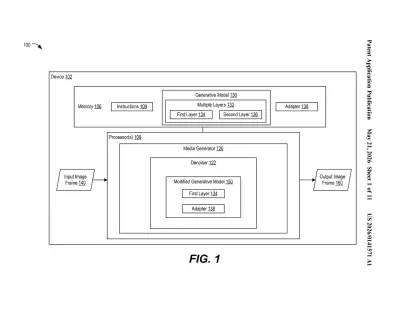
The patent centers on a media generator that combines a generative model — a multi-layer neural network similar to those used in diffusion-based image synthesis — with a separate, smaller module called an adapter.
During image generation, the system runs through multiple sampling operations (each sampling step progressively refines a noisy image toward a clean output, the core loop in diffusion models). Within each sampling operation, the work is split:
- A first portion is processed by a selected set of layers inside the main generative model, operating at a first resolution.
- A second portion is processed by the adapter, which operates at a second, different resolution.
Running parts of the pipeline at a lower resolution than others is a known technique for cutting compute costs — doing heavy feature extraction at a coarser scale before upsampling. The adapter here seems designed to complement the main model rather than replace any part of it wholesale, acting more like a resolution-specialized co-processor baked into the inference graph.
The patent also references a denoiser component and a modified generative model structure, suggesting the adapter may actually be grafted into the model's layer stack rather than sitting entirely outside it.
What this means for AI image generation on mobile chips
For Qualcomm, whose Snapdragon chips power a huge slice of the Android ecosystem, getting AI image generation to run well on-device — without needing to ping a cloud server — is a core business objective. A system that intelligently splits generative model work across different resolutions could meaningfully reduce memory bandwidth and latency on constrained mobile hardware.
For you as a user, this kind of architecture is what eventually makes real-time AI photo editing or on-device image generation feel snappy rather than sluggish. It's less about any single flashy feature and more about the plumbing that makes future camera and creative AI apps practical on a phone you already own.
Source: US 2026/0141571 A1 at the USPTO (PDF). Full patent text and figures are in the official publication.
Get our take in your Top Stories
Liked this breakdown? Add Patentlyze as a preferred source on Google, and our plain-English take shows up more often in your Top Stories the next time Qualcomm patent news breaks.
Add Patentlyze on Google
One click.
There are more where this came from
We read the new patents from Big Tech, carmakers and more and send you the ones worth knowing. Plain English, free, every week.
More from Qualcomm
All 637 Qualcomm patents →
More in AI image & video
All 226 AI image & video patents →
Microsoft
Microsoft Patents an Image Generator That Searches the Web Before It Draws
Nvidia
Nvidia Patents AI That Copies Image Quality in a Single Generation Step
Google
Google Patent Reveals Masked Token Prediction for Faster Text-to-Image AI
Adobe