
Ford
Ford · Automotive · Filed Apr 30, 2026 · USPTO published Nov 19, 2026 · This week's release
Ford Files Patent for Calmer Steering When You Take Back the Wheel
The scariest second of any semi-autonomous drive may be the one when you grab the wheel. Ford's patent filing tries to make that moment forgiving by temporarily making the steering less twitchy.
- Publication number
- US 2026/0365237 A1(US20260365237A1)
- Applicant
- Ford Global Technologies, LLC
- Filed · Published
- Apr 30, 2026 · Nov 19, 2026
- Inventors
- Sergio Codonesu, Oliver Nehls, David Michael Russell, Alexander Ein Waldt
- Status when we published
- Waiting for an examiner
- Document
- 20 claims
- US classification
- 701/41
What Ford's steering handoff patent actually does
A driver sits with hands off the wheel while the car holds its lane on a highway. Then something goes wrong, a warning sounds, and the driver grabs the wheel and yanks it hard. Going from watching to steering is a jolt, and big, sudden inputs are common.
Ford's patent describes a way to cushion that moment. When the car detects that you are taking over, it changes how the steering responds for a short while. Your turn of the wheel moves the tires less than usual, or the wheel pushes back harder against your hands, or both. Overcorrections then do less damage, and the car wanders less from its path.
Once things settle down, the steering slides back to its normal feel, so you aren't left with a strange-feeling car.
determine an occurrence of a change of driving mode in which control of a steering wheel is to be transferred between a driving control device and driver input …
Translation: It figures out when the car is switching between computer and human steering.
How the wheel dulls itself, then returns to normal
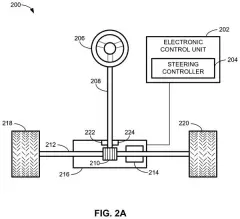
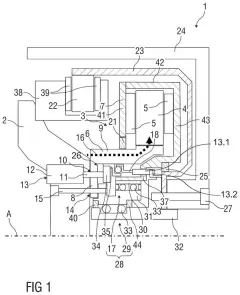
The claims cover a steering controller that first works out when control of the steering wheel is moving between the car's driving system and the person. That can be spotted when your hands touch the wheel, when you press a button on the screen, or when the software infers it from other sensors. The filing's main example is a steer-by-wire setup, where the wheel and the road wheels are linked by motors and software instead of a solid shaft. It also names other electric systems.
When a handoff happens and you turn the wheel, the controller sends a changed signal to one or both of two motors:
- The road wheel motor: the tires turn by a smaller angle than they normally would for the same wheel movement.
- The steering wheel motor: the wheel pushes back harder (called feedback torque, the resistance you feel through your hands).
The filing lists ways to adjust this: a less direct steering ratio (how far the tires turn per degree of wheel), a small time delay smoothed by a low-pass filter (a filter that rounds off sudden jerks), and extra damping that makes the wheel harder to spin. The adjustments can depend on vehicle speed, road surface such as sand or gravel, and a driver's personal settings.
A second phase eases things back. Because the dulled ratio leaves the wheel and tires slightly out of step, the system measures that gap and gradually closes it. It starts this after a set time passes or the car is stable, meaning a low steering angle, a low steering speed and little spin about its vertical axis (yaw).
… provide, based on the change of driving mode, a control signal that is adapted relative to a normal operating mode of the steering system to at least one of (i) a road wheel actuator to reduce a road wheel angle in relation to the normal operating mode, or (ii) a steering wheel actuator to provide an increased feedback torque in relation to the normal operating mode …
Translation: It adjusts how the steering wheel and tires react so the handoff feels smoother.
Why the handoff moment matters for Ford drivers
The practical payoff is for anyone using a lane-keeping or hands-off driving feature. Those systems depend on you being ready to take over, and the filing admits that people often react with big, abrupt movements in the first moments. A steering system that forgives those moments could make takeovers feel less alarming, even in busy traffic, which the filing says becomes more possible.
It also fits where driver-assist features are heading. As cars handle more of the steering, the handoff back to you becomes a design problem of its own. Ford's approach adds no new sensors in the main example. The patent describes changes to how existing motors respond, plus a tuning period afterward, which makes it a software-level idea for cars that already have electric steering.
Ford's third patent application in our Ford coverage since November follows one on voice-controlled vehicle movement and one on fixing camera AI errors in the filings we track.
Source: US 2026/0365237 A1 at the USPTO (PDF). Full patent text and figures are in the official publication.
Get our take in your Top Stories
Liked this breakdown? Add Patentlyze as a preferred source on Google, and our plain-English take shows up more often in your Top Stories the next time Ford patent news breaks.
Add Patentlyze on Google
One click.
There are more where this came from
We read the new patents from Big Tech, carmakers and more and send you the ones worth knowing. Plain English, free, every week.
The drawings · 4 sheets
4 drawing sheets from US 2026/0365237 A1 · click any drawing to enlarge


More from Ford
All 8 Ford patents →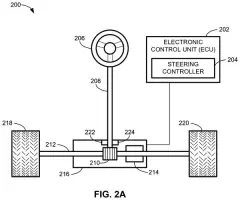
More in Automotive
All 432 Automotive patents →
Nvidia
Nvidia Files Patent for Cars That Guess Which Turn You Plan to Take
Qualcomm
Qualcomm Patents a Steering Torque System That Signals When Autopilot Is Active
BMW
BMW Patents a Self-Learning Steering Limit That Adapts to Each Car
Mercedes-Benz
No comments yet