
BMW
BMW · Automotive · Filed Jun 4, 2025 · USPTO published Nov 19, 2026 · This week's release
BMW Patents a Self-Learning Steering Limit That Adapts to Each Car
Every BMW that rolls off the line has its automated steering capped well below what the actual hardware can do, because one conservative limit has to work for every car in the model run. This patent describes a system that watches you steer manually and gradually raises that cap to match your specific vehicle.
- Publication number
- US 2026/0365165 A1(US20260365165A1)
- Applicant
- Bayerische Motoren Werke Aktiengesellschaft
- Filed · Published
- Jun 4, 2025 · Nov 19, 2026
- Inventors
- Andreas BOESL, Michael STROEBEL
- Status when we published
- Examiner raised objections; the company can respond
- Document
- 14 claims
- US classification
- 701/41
- Examiner
- CHEUNG, CALVIN K (Art Unit 3669)
- Parent application
- National Stage Entry of PCT/EP2023/083206 (filed Nov 27, 2023)(PCTEP2023083206)
How BMW's per-car steering calibration actually works
You're parking in a tight spot, and your BMW's automated parking mode keeps swinging wide, forcing an extra move you know you could skip if you just took the wheel yourself. The frustrating part: your car probably could steer tighter. The software just doesn't know that yet.
The problem is a factory-floor compromise. BMW sets one universal steering limit for every car in a model line, conservative enough to work even for the unit with the stiffest tolerances off the assembly line. Your particular car almost certainly has more range than that number suggests, but the automated system never gets to use it.
This patent describes software that observes how far you actually turn the steering wheel during ordinary manual driving. If your real-world steering angle is bigger than the stored limit, the system updates the limit for your car specifically, then verifies the new figure actually works during the next automated maneuver before saving it. Over time, the car's automated parking and maneuvering features get to use the full capability of your hardware.
determine a manual steering angle of a steering system of the vehicle effectuated during manual lateral control of the vehicle …
Translation: The car watches how you turn the steering wheel when you drive manually.
How the system learns and verifies a wider steering range
At the core, the system has two jobs: measure how far the driver turns the wheel during normal manual driving, and use that measurement to update the steering ceiling the automated system is allowed to reach.
The filing describes a few ways that update can happen:
- Direct copy: if the manual steering angle exceeds the stored limit, the system immediately saves the larger value as the new ceiling.
- Step-by-step approach: the stored value is raised by a small delta (the filing gives 0.1 degrees as an example) each time a larger manual angle is observed, then the car checks whether that incremented value actually works during an automated run before committing it to memory.
- Trajectory-linked calibration: when you manually drive a route that the car records as a reference (say, pulling into your driveway), the peak steering angle from that specific route is stored alongside it, so the automated replay of the same route can use the full angle you used.
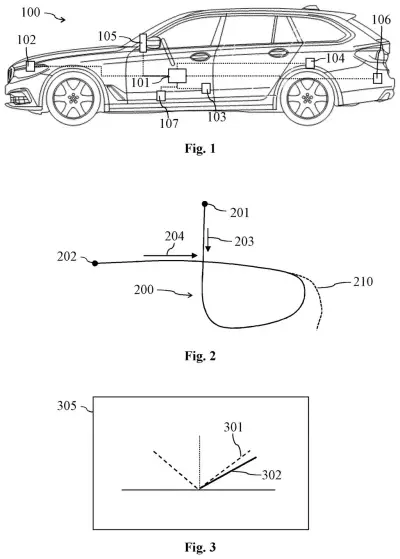
A second capability covers driver assistance during manual maneuvers. Using the learned steering ceiling, the system calculates the tightest curve the car can physically achieve and can display that trajectory on a screen, overlaid on the camera feed, so you can see exactly how sharp a turn is possible before you commit.
The filing also notes the system can apply an optional offset, keeping the automated limit a few degrees below the measured manual peak, as a comfort buffer.
… determine, on the basis of the determined manual steering angle, a maximum steering angle which can be set by the steering actuator of the vehicle in the automated lateral control of the vehicle …
Translation: It uses your personal driving habits to set a custom limit for how far the computer is allowed to turn the wheels.
What tighter auto-parking means for BMW drivers
For anyone who regularly uses automated parking or a "reverse along the route you just drove" feature, a tighter usable steering angle means fewer three-point turns become five-point turns. The gap between what you can do and what the car will do in auto mode narrows toward zero over time, without any trip to a dealer.
The application is currently under patent office examination, with an initial rejection issued in October 2026, which is a routine step and not a sign the filing is in trouble. If the approach makes it into production, the most direct path would be a software update to BMW's existing parking and maneuvering assist systems, since the patent relies entirely on reading existing steering sensors and writing back to a stored parameter, with no new hardware required.
BMW's sixth filing in our BMW coverage since November adds to a run that includes a stopping-point light system and an eye-check lane-change system.
Source: US 2026/0365165 A1 at the USPTO (PDF). Full patent text and figures are in the official publication.
Get our take in your Top Stories
Liked this breakdown? Add Patentlyze as a preferred source on Google, and our plain-English take shows up more often in your Top Stories the next time BMW patent news breaks.
Add Patentlyze on Google
One click.
There are more where this came from
We read the new patents from Big Tech, carmakers and more and send you the ones worth knowing. Plain English, free, every week.
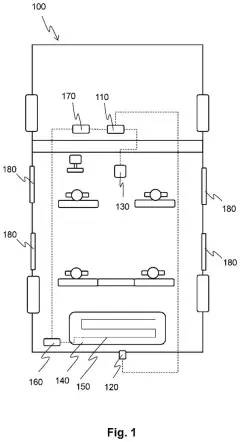
The drawings · 2 sheets
2 drawing sheets from US 2026/0365165 A1 · click any drawing to enlarge


More from BMW
All 6 BMW patents →
More in Automotive
All 432 Automotive patents →
Nvidia
Nvidia Patents a Voting System That Double-Checks Where a Self-Driving Car Thinks It Is
Hyundai & Kia
Kia Patents a Car Seat That Cleans Up Its Own Spills
Nvidia
Nvidia Files Patent for Building the Driving Test a Self-Driving Car Must Pass
Qualcomm
No comments yet