
Ford
Ford · Automotive · Filed May 15, 2025 · USPTO published Nov 19, 2026 · This week's release
Ford Files Patent for Self-Driving Steering That Lets You Nudge the Wheel Without a Fight
Ford's patent filing goes after the tug-of-war between you and a car that steers itself. Quick corrections get through easily, and slow drifting gets a gentle push back toward the planned path.
- Publication number
- US 2026/0365226 A1(US20260365226A1)
- Applicant
- Ford Global Technologies, LLC
- Filed · Published
- May 15, 2025 · Nov 19, 2026
- Inventors
- Ashrit Das, Anand Pradip Naik
- Status when we published
- Examiner raised objections; the company can respond
- Document
- 20 claims
- US classification
- 701/41
- Examiner
- MARC, MCDIEUNEL (Art Unit 3656)
What Ford's nudge-friendly steering actually does
Ever nudged the wheel to dodge a pothole while your car was steering itself, and felt it yank the wheel back? That tug-of-war is the problem Ford is working on here.
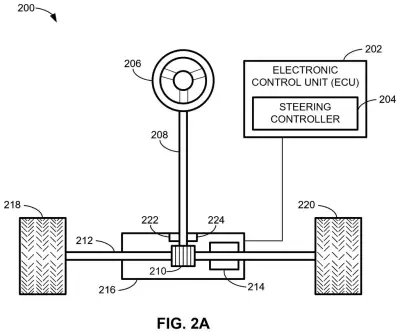
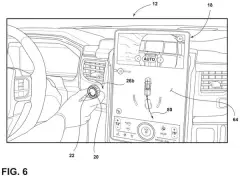
Ford's patent describes a steering computer that pays attention to how you push on the wheel and adjusts how much the car's own plan counts. A quick, deliberate push, like swerving around an obstacle or weaving through cones, gets more say, so the wheel moves with you and doesn't push back. A slow, steady push, like leaning toward one side of the lane, gets gentle resistance that guides the car back toward its path.
The goal is to let you steer a little without the system quitting on you. Push hard enough and the car still hands you full control, but smaller nudges stay blended in with the car's own steering.
… condition the PF angle request to obtain a conditioned PF angle request based on the torque input; determine a final angle request based on the conditioned PF angle request; and convert the final angle request to a torque request to be used to adjust the steering angle via the steering motor.
Translation: The system updates its automated steering plan based on any physical force the driver applies to the wheel.
How Ford separates a quick swerve from a slow drift
In this design, the car's path follower (the part that plans how to steer along the road using cameras and maps) produces an angle request, which is the steering wheel angle it wants. Ford's addition is to condition that request, meaning adjust it, based on the torque (twisting force) a sensor feels from your hands on the wheel. The adjusted angle is then turned into a motor torque that moves the steering.
The conditioning works in steps:
- A band pass filter (a filter that keeps only a middle range of signal speeds) passes torque changes between roughly 0.5 and 2.5 times per second in the example. That screens out a slow constant lean and fast electrical noise.
- Tiny signals below a threshold (0.1 in the example) are set to zero.
- What remains is added up over time with a built-in leak, so the total drains back toward zero when you let go.
- That total becomes a weight between 0 and 1. The result is the weight times your current wheel angle, plus (1 minus the weight) times the path follower's angle.
A weight near 1 means the wheel goes where you put it. Near 0, the car's plan wins and the wheel resists.
The filing also describes a virtual boost curve, which turns your push into an angle and blends it in. It has less influence as speed rises, and in the example its share is capped at 0.85, so your input never fully replaces the car's plan.
Methods and apparatus to adjust a steering angle of a vehicle in a self-driving mode are described herein. An example vehicle disclosed herein includes a torque sensor operatively coupled to a steering wheel, the torque sensor to sense a torque input to the steering wheel by a driver …
Translation: This patent covers technology that lets a driver nudge the steering wheel while the car is driving itself.
What this means for hands-on driver assist
If you drive a car with hands-on lane centering, you know the awkward moment when you need to steer around something and the system either fights you or gives up entirely. This filing describes a way to keep driver assist running while a quick correction still feels natural, and to give a firm, helpful push back when you drift slowly off center. You would notice it as a wheel that feels less stubborn during dodges.
The filing does not name a Ford model, and the patent office's first review rejected the claims as filed, which is routine and usually followed by amendments. It also covers steer-by-wire setups, where no mechanical link joins the wheel to the tires. In those cars the steering feel is produced entirely by software and a motor, so how the wheel responds is a design choice.
Ford's fifth patent application we've tracked since November in our Ford coverage follows filings like the leaning steering wheel and smoother handoff steering.
Source: US 2026/0365226 A1 at the USPTO (PDF). Full patent text and figures are in the official publication.
Get our take in your Top Stories
Liked this breakdown? Add Patentlyze as a preferred source on Google, and our plain-English take shows up more often in your Top Stories the next time Ford patent news breaks.
Add Patentlyze on Google
One click.
There are more where this came from
We read the new patents from Big Tech, carmakers and more and send you the ones worth knowing. Plain English, free, every week.
The drawings · 22 sheets
22 drawing sheets from US 2026/0365226 A1 · click any drawing to enlarge


Show the other 14 sheets


More from Ford
All 8 Ford patents →
More in Automotive
All 432 Automotive patents →
BMW
BMW Patents a Self-Learning Steering Limit That Adapts to Each Car
Qualcomm
Qualcomm Patents a Self-Driving AI That Learns How Much Room It Has to Move
Nvidia
Nvidia Files Patent for Self-Driving Cars That Can Tell When Their Sensors Are Blocked
Aurora
No comments yet