
Ford
Ford · Automotive · Filed May 16, 2025 · USPTO published Nov 19, 2026 · This week's release
Ford Patents a System to Move a Vehicle by Voice Using a Detachable Tray
Ford has been granted a patent for a system that turns a truck's built-in clipboard into a remote control, letting a driver outside the vehicle move it short distances by voice without touching a phone or joystick.
- Publication number
- US 2026/0367623 A1(US20260367623A1)
- Applicant
- Ford Global Technologies, LLC
- Filed · Published
- May 16, 2025 · Nov 19, 2026
- Inventors
- Stuart C. Salter, Jeff Robert Seaman, Jenna Rogers, Julie Koltys, Sidhaant Rath, John Robert Van Wiemeersch
- Status when we published
- Granted
- Document
- 20 claims
- US classification
- 701/2
- Examiner
- REFAI, RAMSEY (Art Unit 3664)
How Ford's clipboard-as-remote-control actually works
You're laying fence posts along the edge of a field and your truck needs to creep forward every few minutes. Getting in, moving it six inches, getting back out, repeat. It eats time and breaks your rhythm.
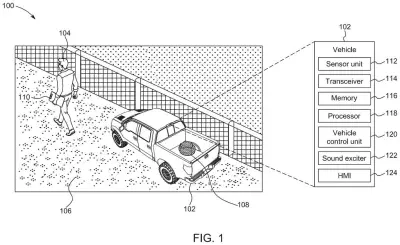
Ford's granted patent describes a fix built into the vehicle itself. The center console's removable clipboard contains a small wireless tag. When you pull the clipboard out and carry it with you, the truck can confirm it's nearby (within about 15 feet) and enter a remote-control mode. From there, you give voice commands: "Move forward six inches," "Back up to the clipboard," or even "Follow me" as you walk the fence line.
Before the truck moves, it reads your command back and asks you to confirm. While it moves, its radar and cameras watch for anything in the path. If you stop giving commands for about a minute, the mode shuts off automatically. No app, no extra device: just the clipboard that was already in your console.
… determine that the removable work surface is within a predefined distance range of the vehicle based on the signals obtained from the wireless tag …
Translation: The car checks if the tray is close enough using a wireless signal.
How the wireless tag and voice commands chain together
The patent covers a system with two main parts: a removable work surface (a clipboard that lives in the vehicle's center console lid) fitted with a wireless tag, and a processor that ties that tag to the vehicle's movement controls.
The wireless tag is either a Bluetooth Low Energy (BLE) tag or an Ultra-Wideband (UWB) tag. BLE operates in the 2.4 GHz band; UWB covers 3.1 to 10.6 GHz and is better at precise distance measurement. The vehicle measures signal strength (a value called RSSI, or Received Signal Strength Indicator) from the tag to confirm the clipboard is within roughly 15 feet before it will activate remote-control mode.
Once active, the system accepts voice commands and processes them through several safety checks:
- The vehicle reads the command back aloud and waits for verbal confirmation before moving.
- Radar, lidar, and cameras scan the intended path for obstacles; if something is there, the move is blocked.
- If no new command arrives within a set window (the filing mentions one minute), the mode turns itself off.
Beyond simple nudging, the filing describes two richer modes. In follow mode, the truck uses triangulation from multiple onboard transceivers to track the clipboard's real-time position and trail the user at a fixed distance. In park-to-clipboard mode, the user places the clipboard at the desired stopping point and says something like "Back up within two feet of the clipboard"; the truck navigates to that spot on its own.
What this means for truck owners doing outdoor work
For people who regularly use a truck as a work platform, climbing in and out repeatedly is a real friction point. A system like this, if it reaches production, could make short repositioning tasks feel more like operating a piece of powered equipment than driving a vehicle. The park-to-clipboard feature in particular addresses a common need: backing a bed precisely to a gate, a hay bale, or a loading dock without a spotter.
It is worth being clear: this is already a granted patent, not a pending application, though the final granted claims may read a little differently from the published application described here. Ford has the intellectual property locked in. Whether this appears in a production vehicle, and when, is a separate question entirely.
Ford's second patent application in our Ford coverage since November follows the camera AI mislabeling fix we've tracked.
Source: US 2026/0367623 A1 at the USPTO (PDF). Full patent text and figures are in the official publication.
Get our take in your Top Stories
Liked this breakdown? Add Patentlyze as a preferred source on Google, and our plain-English take shows up more often in your Top Stories the next time Ford patent news breaks.
Add Patentlyze on Google
One click.
There are more where this came from
We read the new patents from Big Tech, carmakers and more and send you the ones worth knowing. Plain English, free, every week.
The drawings · 7 sheets
7 drawing sheets from US 2026/0367623 A1 · click any drawing to enlarge


More from Ford
All 8 Ford patents →
More in Automotive
All 432 Automotive patents →
BMW
BMW Patents a See-Through Control Where Buttons Appear to Float in the Air
Mercedes-Benz
Mercedes-Benz Files Patent for Keeping Water Out of a Motor Inside the Wheel
Ferrari
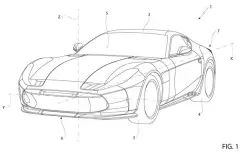
Ferrari Files Patent for Side Wings That Also Help Cool the Radiators
Ferrari
No comments yet