
GM
GM · Automotive · Filed May 18, 2025 · USPTO published Nov 19, 2026 · This week's release
GM Files Patent for Car Echo Cancellation That Keeps Your Voice When Both Callers Talk
Anyone who has talked over someone on a hands-free car call knows the choppy, clipped audio that follows. A new GM patent application goes after that moment, when both people speak at once.
- Publication number
- US 2026/0369261 A1(US20260369261A1)
- Applicant
- GM Global Technology Operations LLC
- Filed · Published
- May 18, 2025 · Nov 19, 2026
- Inventors
- Amos Schreibman, Elior Hadad, Moshe Tzur
- Status when we published
- Waiting for an examiner
- Document
- 20 claims
- US classification
- 381/66
- Examiner
- JEREZ LORA, WILLIAM A (Art Unit 2695)
What GM's echo-canceling filter actually does
Imagine you're driving and on a hands-free call. The other person's voice comes out of your car speakers, and your microphone picks it up and sends it back to them as an echo. Your phone or car has to cancel that echo, and it usually does fine until you both talk at the same time.
That's where things go wrong. The echo canceler can mistake your voice for echo, so it clips your words or its settings drift off. GM's filing describes a way to check which direction the sound is coming from. If it comes from where the driver or a passenger sits, the system treats it as a real person talking.
The system keeps a running confidence score for whether only the other caller is speaking. When it's confident, the filter learns quickly. When someone in the car starts talking, it eases off so your voice survives.
How the filter works out who is talking
The filing covers an adaptive filter, a piece of software that keeps adjusting itself to predict the echo and subtract it from what the microphone hears. After the filter's weights (its current guess at the echo path) are applied, whatever echo remains is called the residual echo.
Next, the system measures directivity, meaning how strongly the leftover sound points toward where a person in the car is sitting. It does this with an acoustic transfer function vector (a stored description of how sound travels from a seat to the microphones), which can come from a beamformer (a way of focusing microphones on one direction) or from a tuning step done ahead of time. It compares the energy coming from those directions to everything else.
From that comparison it builds a directivity confidence measure, a number between 0 and 1. Near 1 means only the far-end caller is talking. Near 0 means someone nearby is speaking.
The confidence score then sets the filter's forgetting factor, a setting for how fast the filter drops old information and learns new. The filing says it can:
- Learn fully when the confidence is high
- Freeze learning when double talk (both sides talking) is likely
- Average the filter's weights across iterations to limit drift
- Update a running mean and standard deviation of directivity during far-end-only stretches
Why this matters for GM's in-car voice calls
If you take calls or give voice commands in the car, you may notice choppy or muffled speech when the other person interrupts. A filter that protects your voice during those overlaps could make hands-free calls sound more natural and make voice assistants less likely to miss a command spoken over music or a caller.
The filing says the same approach could go into phones, headsets, earphones and speaker systems, though it is described using a vehicle as the main example. It is aimed at both person-to-person calls and voice-to-machine speech recognition.
GM's second patent application we've tracked since November builds on our GM coverage that began with a cold-battery warming idea.
Source: US 2026/0369261 A1 at the USPTO (PDF). Full patent text and figures are in the official publication.
Get our take in your Top Stories
Liked this breakdown? Add Patentlyze as a preferred source on Google, and our plain-English take shows up more often in your Top Stories the next time GM patent news breaks.
Add Patentlyze on Google
One click.
There are more where this came from
We read the new patents from Big Tech, carmakers and more and send you the ones worth knowing. Plain English, free, every week.
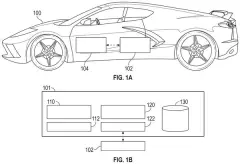
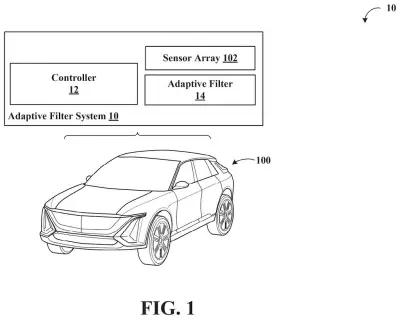
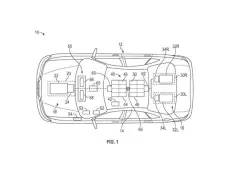
The drawings · 5 sheets
5 drawing sheets from US 2026/0369261 A1 · click any drawing to enlarge


More from GM
All 10 GM patents →
More in Automotive
All 432 Automotive patents →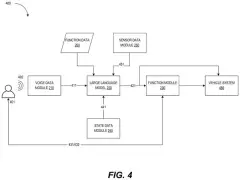
Volkswagen
Volkswagen Files Patent for a Car That Understands 'I Feel Hot'
BMW
BMW Files Patent for a Car That Stops Where You Can See the Light
Google
Google Files Patent for Car Screens That Adapt to Weather, Battery and Crashes
Samsung
No comments yet