
BMW
BMW · Automotive · Filed May 18, 2026 · USPTO published Nov 19, 2026 · This week's release
BMW Files Patent for a Car That Stops Where You Can See the Light
BMW has filed a patent for a car that picks its own stopping spot at a red light so the driver can actually see the signal change. It is a small fix for a very familiar annoyance: the honk from behind when you did not notice green.
- Publication number
- US 2026/0365172 A1(US20260365172A1)
- Applicant
- Bayerische Motoren Werke Aktiengesellschaft
- Filed · Published
- May 18, 2026 · Nov 19, 2026
- Inventors
- Wolfgang SPIESSL
- Status when we published
- Waiting for an examiner
- Document
- 10 claims
- US classification
- 701/25
What BMW's red-light parking spot idea does
Ever sat at a red light behind a truck or under a tall signal you could barely see, then missed the green because your view was blocked? The honk from the car behind you is the usual reminder.
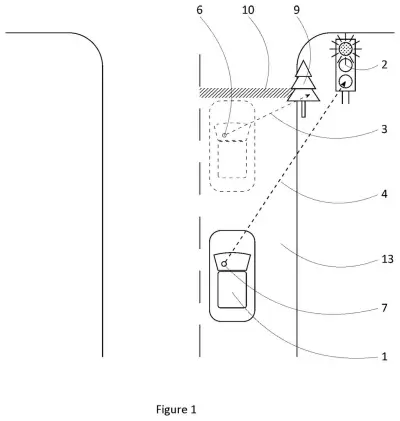
BMW's patent tackles that. When your car is first in line, it checks whether your view of the traffic light is blocked by something, like a sun visor, the rearview mirror, or a dirty patch of windshield. If the spot right at the stop line gives you a bad view, the car looks for a nearby spot where your head would have a clear line to the light.
Then it stops there, ideally as close to the line as that clear view allows. The goal is simple: you notice the green right away, nobody behind you gets impatient, and traffic keeps moving.
… detecting an obstacle blocking the first line of sight; detecting a second line of sight directed toward the traffic signal installation from a second position within the stopping area, the second line of sight being clear of the obstacle; …
Translation: The car finds a spot where the driver can actually see the traffic light past whatever is blocking the view.
How BMW's car finds a spot with a clear view
The patent describes a driver assistance method that works out where a car should stop at a red light. The car first detects the traffic signal, its stop line, and the stopping area next to it (the stretch of road where a car can sensibly halt). It does this with cameras, ultrasonic sensors, radar, or by matching against a map database.
Next it checks two imagined viewpoints. From the first position (say, right at the line), is the driver's line of sight to the light blocked by an obstacle? From a second position a bit farther back, is the line of sight clear? If the light shows red and nothing else is in the stopping area, the car stops so that the driver's head position matches that second, clear spot.
The filing also describes several variations:
- Choosing the clear spot closest to the stop line, so another car can't squeeze in front.
- Tracking the driver's eye position and flagging obstacles inside the car, such as a sun visor you could simply fold up.
- Using the light's other display, such as one hung over the road, or switching to another lane on your navigation route.
- Shifting sideways within a wide lane, and using V2X (the car talking to traffic infrastructure) or stored signal timing to plan ahead.
The car can steer itself into the spot, or guide you there with lights, sounds, or a display.
Finally, the motor vehicle is stopped in the stopping area, the second position corresponding to a head position of the driver.
Translation: The vehicle then stops right where the driver has a clear line of sight to the light.
Why BMW's patent targets the slow start at green
The practical payoff is a smoother, less stressful stop at intersections. If you drive a car with this feature, you would notice it mostly by what doesn't happen: no missed green, no horn behind you, no awkward half-second of realizing everyone else saw the light before you did.
For BMW, it fits the broader trend of driver assistance that handles small comfort problems, not just crashes. It relies on sensors modern cars already carry, plus a way to estimate where your head sits. That head tracking is the piece that would make or break it in real traffic. As with any patent application, there is no sign here of a product or a launch date.
BMW's fifth filing we've tracked since November in our BMW coverage follows patents like the eye-check lane system and floating air buttons.
Source: US 2026/0365172 A1 at the USPTO (PDF). Full patent text and figures are in the official publication.
Get our take in your Top Stories
Liked this breakdown? Add Patentlyze as a preferred source on Google, and our plain-English take shows up more often in your Top Stories the next time BMW patent news breaks.
Add Patentlyze on Google
One click.
There are more where this came from
We read the new patents from Big Tech, carmakers and more and send you the ones worth knowing. Plain English, free, every week.
The drawings · 5 sheets
5 drawing sheets from US 2026/0365172 A1 · click any drawing to enlarge


More from BMW
All 6 BMW patents →
More in Automotive
All 432 Automotive patents →
Nvidia
Nvidia Files Patent for Counting Each Object Once When Several Car Cameras See It
Volkswagen
Volkswagen Files Patent for a Car That Understands 'I Feel Hot'
Sony
Sony Patents In-Car Scents That Match the Burger Ads You Drive Past
Honda
No comments yet