
GM
GM · Automotive · Filed May 14, 2025 · USPTO published Nov 19, 2026 · This week's release
GM Patents a Suspension That Preps Your Car to Swerve Around a Stopped Truck
Most crash tech works on the brakes and the steering. GM's patent hands part of the job to the springs and shock absorbers at each wheel, tuning them for a swerve or lifting the nose to soften a hit that can't be dodged.
- Publication number
- US 2026/0365162 A1(US20260365162A1)
- Applicant
- GM GLOBAL TECHNOLOGY OPERATIONS LLC
- Filed · Published
- May 14, 2025 · Nov 19, 2026
- Inventors
- Devon Hall, Brian K. Saylor
- Status when we published
- Approved; patent expected soon
- Document
- 20 claims
- US classification
- 701/37
- Examiner
- JIN, GEORGE C. (Art Unit 3747)
What GM's crash-prep suspension actually does
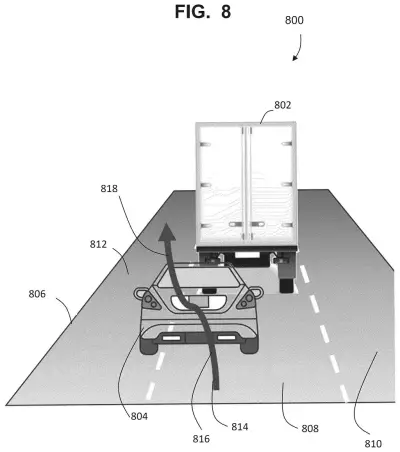
A sedan is closing fast on the back of a stopped truck, and the lanes on both sides are empty. The driver has very little time to react.
You already know the usual answers: brake hard or yank the wheel. GM's patent adds another one. Your car's suspension, the springs and shock absorbers at each wheel, gets involved too. In this design the suspension is powered, so it can push and stiffen on command instead of only reacting to bumps.
When the car's sensors spot the truck, it works out whether you can stop or swerve in time. If so, it tightens up the right wheels to keep the car flat and gripping the road as you turn. If a crash can't be avoided, it raises the nose so your bumper meets the truck at a better height instead of diving underneath it.
… increasing a left front spring force, increasing a left front jounce damping force, increasing a right front rebound damping force, increasing a left rear jounce damping force, increasing a right rear rebound damping force, and increasing a roll stiffness …
Translation: The car stiffens specific corners of its suspension to help it swerve cleanly to the right.
How the suspension picks swerve, stop or lift
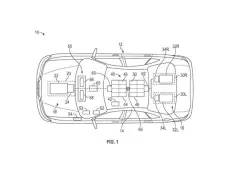
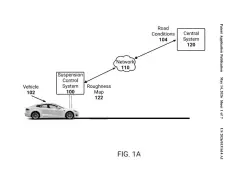
The system watches the road ahead with cameras, radar and similar sensors, checking every 10 to 100 milliseconds. It measures the distance to a barrier (a stopped truck, a guard rail) and how long until the car reaches it. The car needs an active suspension: at each wheel, a motor or hydraulic actuator (a part that pushes or pulls on command) adds force on its own instead of only reacting to the road.
The filing uses two sets of speed and distance thresholds. The first set decides when contact is unavoidable. A second, larger set decides whether stopping or turning can still avoid it.
For avoidable cases, claim 1 spells out the recipe. If the driver is steering one way, the car makes these changes for a swerve in that direction:
- Stiffen the springs and damping on the wheels that will carry the extra weight.
- Stiffen the opposite-side rebound damping (how fast a wheel drops back down).
- Raise roll stiffness (resistance to the body leaning).
If the wheel is straight, it raises roll stiffness, shifts tire lateral load transfer distribution (how cornering weight is split between front and rear tires) to control yaw (twisting of the car), and adds damping, all before the evasive turn.
When contact can't be avoided, other claims have the front end raised toward the barrier's height. One example in the description lifts the front with about five kilonewtons of force.
… determining at least one active suspension command to change a condition of at least one of the active suspensions and determined to at least one of: avoid contact between the vehicle and the barrier, reduce an amount of contact between the vehicle and the barrier, or change a location on the vehicle that will contact the barrier …
Translation: The system adjusts the suspension either to miss the obstacle entirely or to minimize the severity of a crash.
Why a stiffer suspension could matter in a crash
The target here is the ugly crash where one car runs into the back of a truck or a guard rail. The description says heavy braking can push the nose down, letting the car slide under the barrier. That can send crash forces toward the A pillar (the roof post beside the windshield) and the firewall, the wall between engine and cabin. Raising the nose is meant to keep the hit in the part of the car built to absorb it. It would also give you better grip when you try to swerve.
The patent office has approved this application, and once GM pays the final fee it should be issued as a granted patent. The filing lists sedans, SUVs and trucks, but any car using it would need a powered suspension at each wheel.
GM's ninth filing in our GM coverage since November follows patents like fog detection ahead and leaking shock absorbers among the nine applications we've tracked.
Source: US 2026/0365162 A1 at the USPTO (PDF). Full patent text and figures are in the official publication.
Get our take in your Top Stories
Liked this breakdown? Add Patentlyze as a preferred source on Google, and our plain-English take shows up more often in your Top Stories the next time GM patent news breaks.
Add Patentlyze on Google
One click.
There are more where this came from
We read the new patents from Big Tech, carmakers and more and send you the ones worth knowing. Plain English, free, every week.
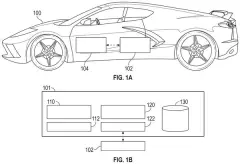
The drawings · 8 sheets
8 drawing sheets from US 2026/0365162 A1 · click any drawing to enlarge


More from GM
All 10 GM patents →
More in Automotive
All 432 Automotive patents →
Ferrari
Ferrari Patents a Suspension That Tilts the Front Wheels Without a Bulky Extra Arm
Amazon
New Patent Monitors Robotaxi Suspension Health Without Extra Sensors
Tesla
Tesla Patents Air Suspension Valves That Ease Your Car Up Instead of Jolting It
Tesla
No comments yet