
Google
Google · AR / VR · Filed May 15, 2026 · USPTO published Nov 19, 2026 · This week's release
Google Files Patent for 3D Scenes That Sharpen as You Walk Closer
Google's patent application describes a way to draw a 3D room in fine detail only near you, and in rough detail far away, so a phone can handle scenes that would otherwise be too big to load.
- Publication number
- US 2026/0369002 A1(US20260369002A1)
- Applicant
- GOOGLE LLC
- Filed · Published
- May 15, 2026 · Nov 19, 2026
- Inventors
- Marie-Julie Rakotosaona, Fabian Manhardt, Michael Niemeyer, Christina Nektaria Tsalicoglou, Federico Tombari, Jonáš Kulhánek, Songyou Peng
- Status when we published
- Waiting for an examiner
- Document
- 20 claims
- US classification
- 345/419
- Parent application
- Claims priority from a provisional application 63807371 (filed May 16, 2025)
What Google's distance-based 3D detail does
A realistic 3D copy of a room can be built from millions of tiny, see-through colored blobs. That is more than the memory in a phone or a headset can hold and draw at once, so big scenes can lag or simply refuse to load.
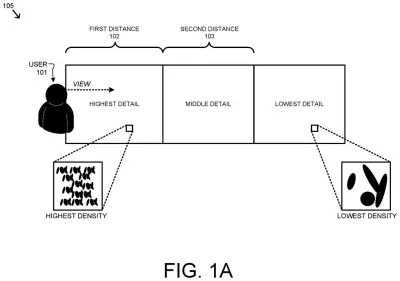
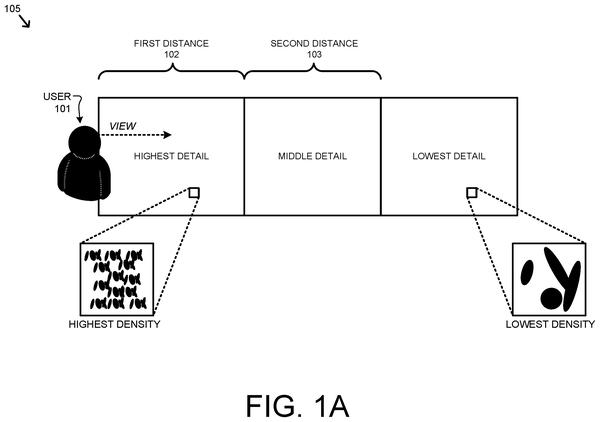
Google's patent application splits the scene into chunks and keeps several versions of each one. The chunk right in front of you gets the full-detail version, so you can see the texture of a painting or the carving on a statue. Chunks across the room get a trimmed version with fewer blobs, since you couldn't make out fine detail from that far anyway.
As you walk, the system swaps versions and fades the extra detail in gradually. A distant fireplace sharpens as you approach instead of suddenly popping into place.
determining a first set of shapes for a first region associated with a capture location in a three-dimensional scene, the first set of shapes having a first density …
Translation: Calculating the initial level of detail needed near the user viewpoint.
How Google trims shapes in faraway parts of a room
The claims cover a simple core: choose a set of shapes with a high density for the region around a capture location (the viewpoint an image is drawn from), choose a less dense set for a region outside it, then render an image from both. The shapes can be Gaussians, which are soft, semi-transparent colored points in 3D space.
The description says these sets are made ahead of time. The system estimates where the source photos were taken, places a dense cloud of Gaussians, and divides the scene into chunks using K-means clustering (a standard way to group nearby points). A smoothing filter based on Nyquist's theorem (a rule about the smallest detail a screen's pixels can show) flags shapes too small to matter at a distance, and importance pruning removes them.
When you move, the device picks a version of each chunk by distance and blends the shapes onto the screen, a step called splatting. An opacity blending step fades extra detail in from 0% to 100% as the camera approaches, so nothing pops into view. The filing describes two or three levels per chunk, and says more can be used.
A second set of shapes may be determined for a second region outside of the first region, the second set of shapes having a second density.
Translation: Setting a different level of detail for parts of the scene further away.
Why phones and headsets could show bigger 3D spaces
If you've ever walked through a 3D map or a virtual room on a phone and watched it stutter or pop into place, this is the problem Google is going after. Spending detail close to you and saving it far away could let a phone or a headset show bigger, more realistic spaces without running out of memory.
The filing lists gaming, interactive maps and extended reality as uses of 3D scene generation, and names smartphones and wearables as the target devices. Because the trimmed versions are made ahead of time, your device doesn't have to do heavy math on every frame. It is a patent application, so nothing here says when, or whether, you would see it in a product.
That makes this Google's third filing we've tracked in the GPU rendering race since August, following their work on smooth 3D scenes on phones and animating characters without hardware limits.
Source: US 2026/0369002 A1 at the USPTO (PDF). Full patent text and figures are in the official publication.
Get our take in your Top Stories
Liked this breakdown? Add Patentlyze as a preferred source on Google, and our plain-English take shows up more often in your Top Stories the next time Google patent news breaks.
Add Patentlyze on Google
One click.
There are more where this came from
We read every patent application Big Tech publishes and send you the ones worth knowing. Plain English, free, every week.
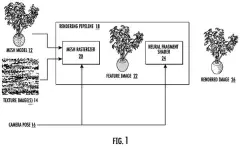
The drawings · 8 sheets
8 drawing sheets from US 2026/0369002 A1 · click any drawing to enlarge


More from Google
All 1,127 Google patents →
More in AR / VR
All 713 AR / VR patents →
Microsoft
Microsoft Files Patent for Teaching AI to Sharpen Blurry Game Graphics
Apple
Apple Patents a Triangle-Based Method to Build Sharper, Faster 3D Images
Samsung
Samsung Patents Technology That Colors 3D Images by Tracking How Light Hits Each Tiny Cube of Space
AMD
No comments yet