
Google
Google · AR / VR · Filed May 8, 2025 · USPTO published Nov 12, 2026 · This week's release
Google Files Patent for Tilting VR Scenes to Hide Jagged Edges
VR screens sit so close to your eyes that nearly straight lines look like shimmering staircases. Google's fix is to draw the scene tilted 45 degrees, then spin it back before you ever see it.
- Publication number
- US 2026/0360090 A1(US20260360090A1)
- Applicant
- GOOGLE LLC
- Filed · Published
- May 8, 2025 · Nov 12, 2026
- Inventors
- Philip George Nichols Lamoureux, Tim Kunwoo Kwak, Hendrik Wagenaar
- Status when we published
- Examiner raised objections; the company can respond
- Document
- 20 claims
- US classification
- 345/611
- Examiner
- PUNTIER, CHRIS ALEJANDRO (Art Unit 2616)
What Google's tilted-camera VR trick does
Ever notice how a diagonal line on a low-resolution screen looks like a staircase? VR headsets run into a version of this even with sharp screens, because the display sits only about 5 to 8 centimeters from your eyes, so each pixel looks large.
The worst offenders are lines that are only a few degrees off perfectly horizontal or vertical, like the edges of a virtual table. As your head moves, the jagged steps crawl and shimmer. Lines at 45 degrees look much cleaner.
Google's patent application has the headset pretend your head is tilted 45 degrees while the app draws the scene, then rotates the finished picture back just before it reaches your eyes. Your head never turns; only the numbers describing it change.
… modifying, based on the first orientation, the first image to produce a second image of the object; and displaying the second image of the object.
Translation: The system shifts the picture slightly before showing it to you.
How the image gets tilted, then rotated back
The headset first reads its sensors (gyroscopes and accelerometers, the same kinds of motion chips found in a phone) to work out which way your head is pointed. Drawing a frame takes about 50 milliseconds, so it predicts where your head will be at display time, in some versions with a trained neural network (a program that learned from lots of recorded head movements).
Then it adds 45 degrees to that predicted angle. The altered angle goes to the app, such as a game or video, which draws the scene from a virtual camera set at the tilted angle. In that tilted view, lines that were nearly horizontal or vertical become near-diagonal, where the pixel steps are smallest.
When the picture comes back, the headset checks your head position again, about 5 milliseconds before display, and corrects the image in three ways:
- It rotates the image back by 45 degrees.
- It pans (slides) the image to match any late head movement.
- It adds a small extra rotation for the same reason.
The filing also describes variations: alternating plus 30 and minus 30 degrees on successive frames, skipping the trick for scenes full of diagonal lines, and rotating one half of the display relative to the other.
… this modification of the head orientation does not involve the user actually modifying their head pose but rather modifying the data representing the orientation.
Translation: The software tricks your viewpoint behind the scenes without making you move your actual head.
What this means for Google's headset graphics
If you wear a VR or XR headset, the payoff is a calmer picture: fewer crawling, shimmering edges on things like table corners and text. Google says the usual fixes cost too much for a headset's small processor. Drawing the scene at four times the pixels and shrinking it back is too heavy, and re-sampling only the edges does not help lines in text or graphics.
This approach, Google says, adds virtually no load, so it could suit headsets where computing power is scarce. The filing does not name a product, and the examiner's first review rejected the claims as filed, which is routine at this stage and usually followed by amendments.
Google's 50th filing we've tracked since May in the AR glasses race builds on earlier applications like finding misplaced objects and landmark and sound navigation.
Source: US 2026/0360090 A1 at the USPTO (PDF). Full patent text and figures are in the official publication.
Get our take in your Top Stories
Liked this breakdown? Add Patentlyze as a preferred source on Google, and our plain-English take shows up more often in your Top Stories the next time Google patent news breaks.
Add Patentlyze on Google
One click.
There are more where this came from
We read every patent application Big Tech publishes and send you the ones worth knowing. Plain English, free, every week.
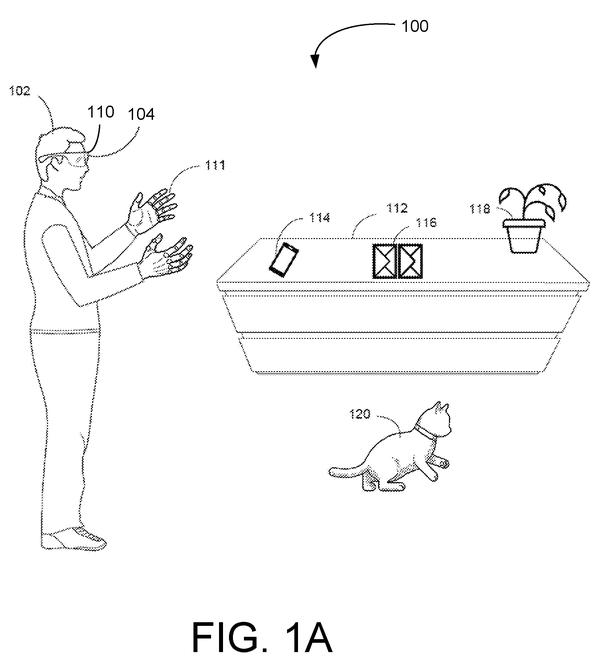
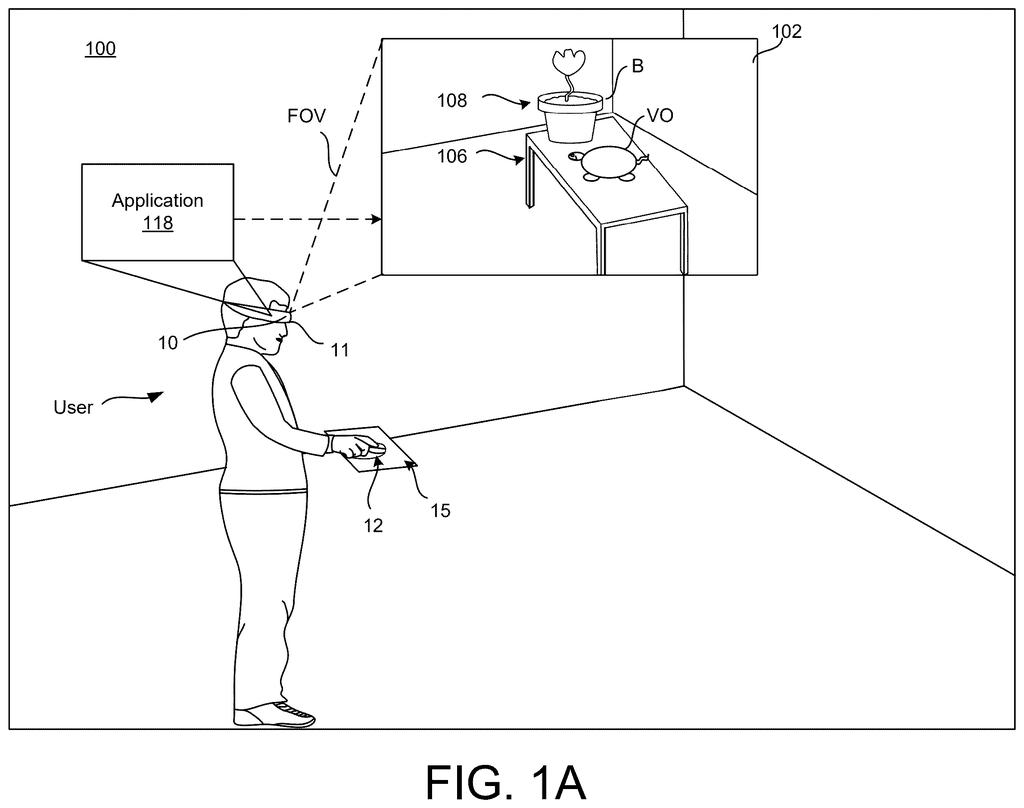
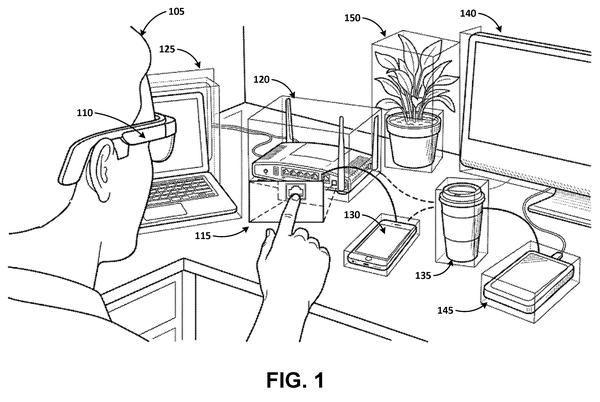
The drawings · 11 sheets
11 drawing sheets from US 2026/0360090 A1 · click any drawing to enlarge


Show the other 3 sheets


More from Google
All 1,079 Google patents →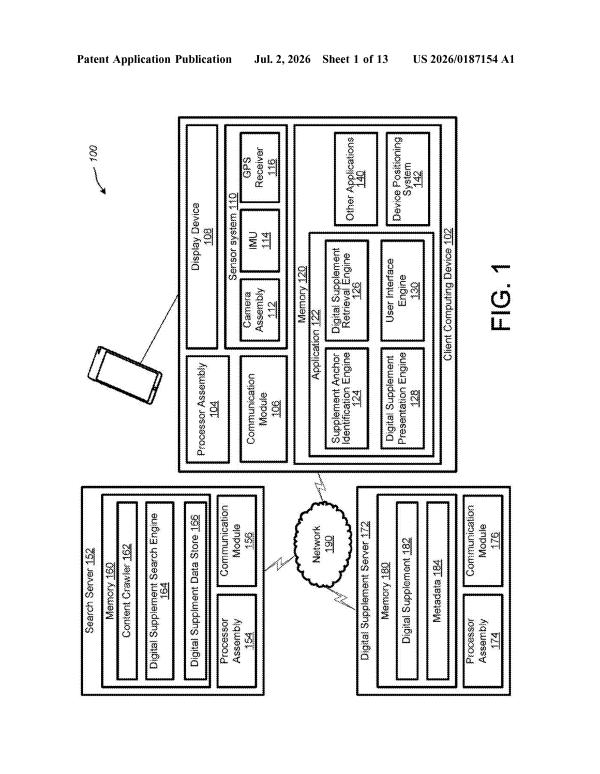
More in AR / VR
All 690 AR / VR patents →
Meta
Meta Patents a Headset Menu Bar That Detaches From Your Floating Screens
IBM
IBM Patents a Virtual World Built From Your Shopping and Social Media History
Apple
Apple Files Patent for Tagging the Flaws in 360 Video So Added Objects Blend In
Meta
No comments yet