
Google
Google · AR / VR · Filed Feb 27, 2026 · USPTO published Nov 12, 2026 · This week's release
Google Patents a Wrist Buzz That Tells You When You're Writing on Thin Air
Google has filed a patent application to give floating AR notepads a missing feature: the feeling of touching something. A buzz on your wrist tells you your pinch has reached the page.
- Publication number
- US 2026/0360092 A1(US20260360092A1)
- Applicant
- GOOGLE LLC
- Filed · Published
- Feb 27, 2026 · Nov 12, 2026
- Inventors
- Stiven Guillaume Francois Morvan, Yodahe Alemu, Dongeek Shin
- Status when we published
- Waiting for an examiner
- Document
- 20 claims
- US classification
- 345/633
- Parent application
- National Stage Entry of PCT/US2023/076554 (filed Oct 11, 2023)(PCTUS2023076554)
What Google's air-writing wrist buzz does
Every time you write with a pen, the desk pushes back against your hand, and that tiny bump tells you the tip has touched the page. Now take a notepad that floats in the air in front of your smartglasses. Nothing pushes back, so you can't tell whether you're touching it.
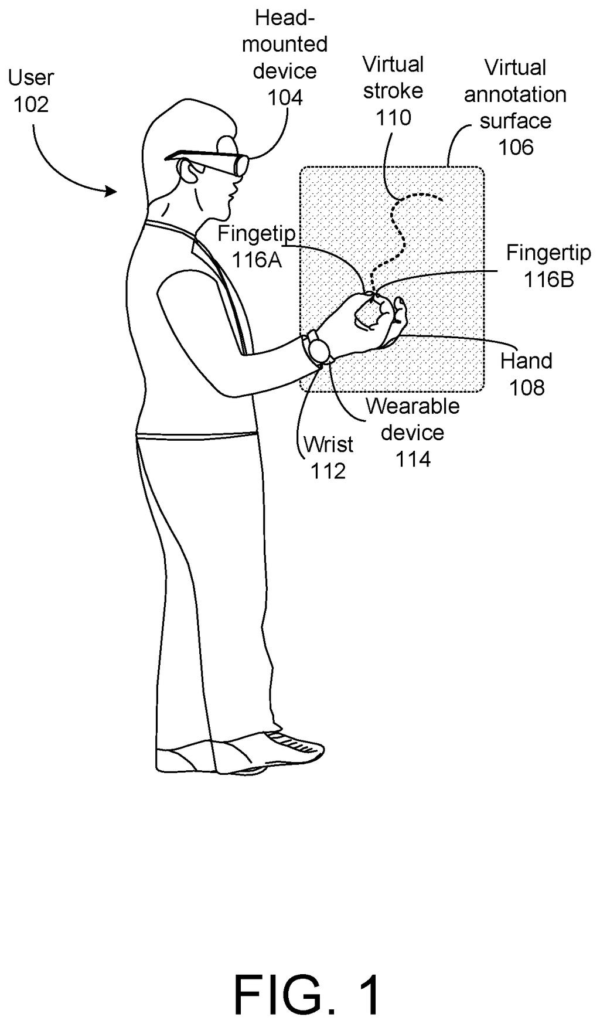
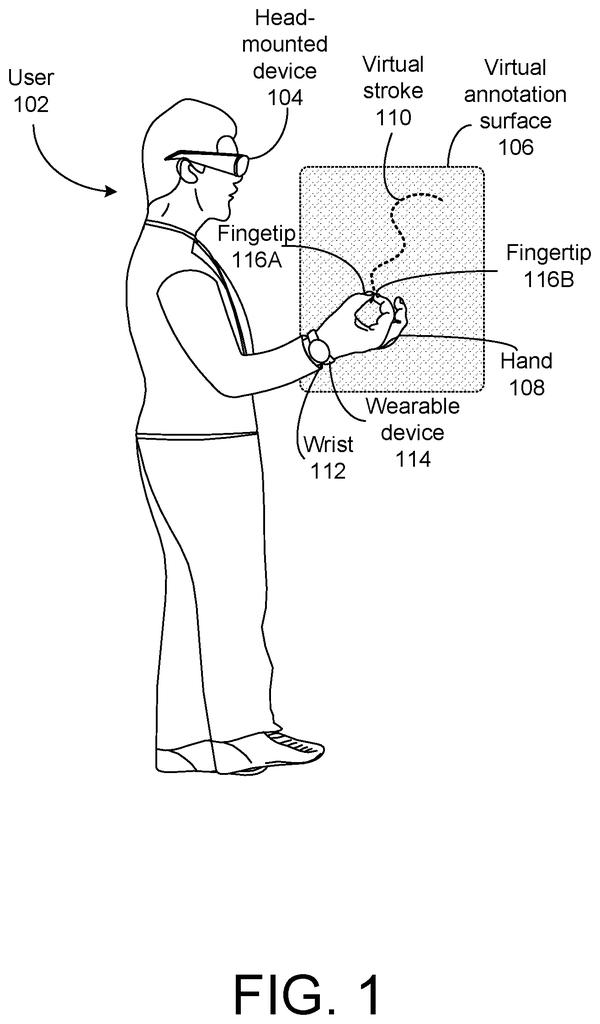
Google's patent application describes a fix. Cameras on the glasses watch your hand. When you pinch your fingers together and the pinch reaches the floating page, a watch, ring or band on your wrist vibrates, a little buzz that stands in for the feel of paper.
Before you get there, a circle on the page shrinks as your fingers close in, and it disappears once you're close enough. Push through the page and it covers the part of your hand that has gone past it. Then you just move your hand and a line appears.
determining that a user is writing on a virtual annotation surface based on a portion of a hand of the user being within a threshold distance of the virtual annotation surface and the hand forming a predetermined gesture …
Translation: The system detects when your hand gets close enough to make a specific sign in the empty air.
How glasses and a watch spot a pinch on air
The core idea is a two-part test. The computing device (usually smartglasses with cameras) decides you are writing when part of your hand, such as the fingertips, is within a set distance of the virtual page and your hand is making a preset gesture. The filing's examples of gestures are a pinch or a tap, and its example distances are one centimeter, half a centimeter or a quarter of a centimeter.
To spot the gesture, the system finds hand landmarks (points like finger joints and fingertips) in the camera images and compares them to a stored gesture library. A neural network (software trained on many examples) can do the recognizing. A tap can also be picked up from a wearable's motion sensor as two quick, opposite jolts in acceleration.
Once both conditions hold, the device tells a wearable, such as a wrist band, watch or ring, to vibrate. If your hand then moves while staying in range, which accelerometer readings or camera images can confirm, the glasses draw a virtual stroke that follows it: letters, numbers or sketches.
The filing also describes extra cues for when you are not yet in range:
- A shape on the page that shrinks as your fingers approach and vanishes inside the threshold.
- The page covering the part of your hand that has gone past it.
- Sound or a different type of vibration instead of a visual cue.
… based on determining that the user is writing on the virtual annotation surface, providing haptic feedback to the user.
Translation: Once the system realizes you are writing on nothing, it vibrates your wrist.
Why writing on thin air needs a buzz
If you ever use AR glasses for notes or sketches, this decides whether writing in the air feels usable. Without a surface to press on, it is hard to know where the page is, so strokes start late or get lost. A buzz tells you when you have touched down. It also means the notepad can float anywhere within reach, with no desk or wall needed.
The filing builds this on gear you may already wear, since a watch or ring can do the buzzing. It names no product, and nothing in it says one is coming. It does show Google working through the small details that make hand-only controls for glasses feel natural.
Google's 56th filing we've tracked since May in our smart glasses display work watchlist builds on the fold-wake fix and the light-switching contrast work, continuing to refine how these glasses show images.
Source: US 2026/0360092 A1 at the USPTO (PDF). Full patent text and figures are in the official publication.
Get our take in your Top Stories
Liked this breakdown? Add Patentlyze as a preferred source on Google, and our plain-English take shows up more often in your Top Stories the next time Google patent news breaks.
Add Patentlyze on Google
One click.
There are more where this came from
We read every patent application Big Tech publishes and send you the ones worth knowing. Plain English, free, every week.
The drawings · 8 sheets
8 drawing sheets from US 2026/0360092 A1 · click any drawing to enlarge


More from Google
All 1,079 Google patents →
More in AR / VR
All 690 AR / VR patents →
Google
Google Files Patent to Stop Smart Glasses Displays From Wasting Light
Google
Google Files Patent to Make Smart Glasses Displays Look Evenly Bright
Google
Google Files Patent for AR Glasses That Warn You Before a Coffee Cup Meets Your Hard Drive
Google
No comments yet