
Google
Google · AI / ML · Filed May 15, 2025 · USPTO published Nov 19, 2026 · This week's release
Google Files Patent for AI Podcasts That Show You Links to Buy What They Mention
Google's new patent application describes an AI-generated podcast that can put a tappable link, a signup button or a shopping cart in front of you for whatever the hosts just mentioned.
- Publication number
- US 2026/0368249 A1(US20260368249A1)
- Applicant
- Google LLC
- Filed · Published
- May 15, 2025 · Nov 19, 2026
- Inventors
- Antonino Gulli, Vladimir Vuskovic
- Status when we published
- Waiting for an examiner
- Document
- 20 claims
- US classification
- 715/716
What Google's clickable AI podcast links do
A podcast host gushes about a pair of noise-canceling headphones while you stand at the sink, hands covered in soap. By the time you could grab your phone, the brand name is long gone. Google's new patent application tries to fix that.
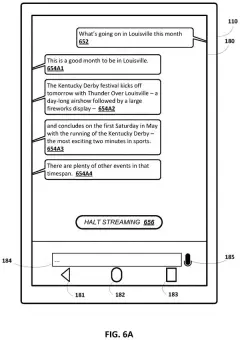
It targets AI-generated podcasts, where software writes the script and a synthetic voice reads it. Ahead of time, the system reads the source material and prepares a menu of possible actions, such as a product link, a webinar signup or a book recommendation. When you ask for an episode, it picks the action that fits you and shows it as a button inside the player.
Tap the button and the action runs. Other options in the filing include texting a local plumber or filling a shopping cart with the exact chair the hosts were raving about.
… generating data comprising instructions that are executable by one or more processors to cause the one or more processors to perform operations comprising providing an interactive user interface element for display associated with the first action …
Translation: The system creates clickable buttons that appear alongside the audio.
How the podcast picks which link to show you
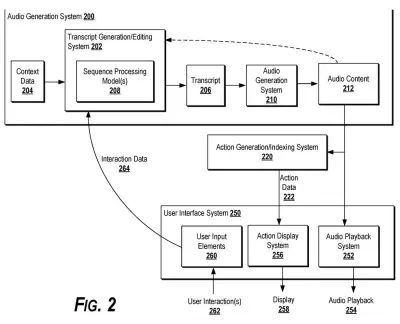
The claims cover a pipeline with two halves. First, a machine-learned model (an AI trained on large amounts of text) takes a corpus of context data, which the filing says can be transcripts, notes or research, and writes an initial transcript describing its topics. That transcript is then turned into audio, such as an AI-generated podcast.
Second, the system reads the source material or the transcript and generates at least two candidate actions. It then indexes the transcript and the actions, meaning it stores them for fast lookup. The filing says this prep work can happen offline, so less has to be computed when you press play, which cuts waiting.
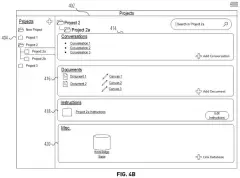
When a request for the audio arrives through the audio interface, the system picks one action based on the request and context data. The description gives device type as an example, so two different devices could get different actions. It then generates instructions for a button shown as part of the player. When you select it, by tap or voice command, the system starts the action.
Actions named in the dependent claims include:
- A web link, or launching a separate app
- Registering for an event or webinar
- A book recommendation or a link to an online course platform
- A phone call or text to a service provider
- Filling a shopping cart
- Generating a content item that works in third-party content
The system generates candidate actions, such as URL links or registration options, processes the transcript, and indexes the candidate actions.
Translation: It automatically finds relevant web links and sign-up options based on what is said.
Why podcasts could become a shopping surface
If this ever ships, a podcast you can only listen to would become one you can act on. Hear about a webinar and sign up in one tap. Hear about a book and see where to buy it. The filing even says the system could check whether you're driving, sitting or walking, and what screen you have, before deciding how to show a button.
The business angle is plain too. The filing describes unique links that tie traffic back to a provider and a third-party content provider, with click metrics tracked. It also describes sorting mentions by commercial intent or informational intent. Put together, an AI podcast could double as a storefront, which would matter to advertisers and to anyone deciding how much to trust what they hear.
That makes this Google's 100th filing we've tracked in AI assistant & agent coverage since May, a count that includes applications like ads inside AI answers and speeding up chatbots.
Source: US 2026/0368249 A1 at the USPTO (PDF). Full patent text and figures are in the official publication.
Get our take in your Top Stories
Liked this breakdown? Add Patentlyze as a preferred source on Google, and our plain-English take shows up more often in your Top Stories the next time Google patent news breaks.
Add Patentlyze on Google
One click.
There are more where this came from
We read every patent application Big Tech publishes and send you the ones worth knowing. Plain English, free, every week.
The drawings · 15 sheets
15 drawing sheets from US 2026/0368249 A1 · click any drawing to enlarge


Show the other 7 sheets


More from Google
All 1,127 Google patents →
More in AI assistant & agent
All 436 AI assistant & agent patents →
Amazon
Amazon Files Patent for a Fact-Check on the Links AI Chatbots Cite
Microsoft
Microsoft Patents AI Web Browsing System That Links Apps Without Custom API Agreements
Salesforce
Salesforce Files Patent to Let AI Agents Show Their Work Before They Finish a Job
OpenAI
No comments yet