
Google
Google · AI / ML · Filed Oct 22, 2024 · USPTO published Aug 20, 2026 · Aug 20 release
Google Patents a Method to Align Ad Landing Pages With Search Query Intent
When you search for something specific and click an ad, you usually expect to land somewhere relevant. Google is now patenting a way to teach AI to automatically measure exactly how far off that landing page is from what you actually searched for.
- Publication number
- US 2026/0244940 A1(US20260244940A1)
- Applicant
- Google LLC
- Filed · Published
- Oct 22, 2024 · Aug 20, 2026
- Inventors
- Kaung Mon Khin, Chaitanya Gajanan Gokhale, Yi Sun, Kelvin Gu, Vijay Sainath Thadkal
- Status when we published
- Waiting for an examiner
- Document
- 19 claims
- US classification
- 706/25
- Parent application
- National Stage Entry of PCT/US2023/030476 (filed Aug 17, 2023)(PCTUS2023030476)
How Google's AI judges if an ad actually fits your search
Imagine you search for "red running shoes size 10" and click an ad that takes you to a generic shoe store homepage. That mismatch is frustrating, and it probably hurts the ad's performance too. Google's patent describes a system for automatically measuring how bad that kind of mismatch is, at scale, across millions of ads.
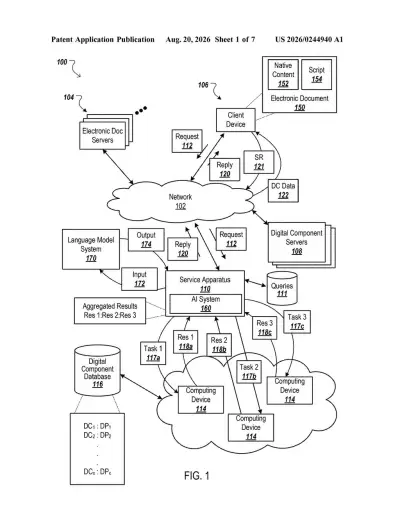
The system works in two stages. First, a large AI model (the kind powering tools like Gemini) acts as a "teacher," carefully scoring how well an advertiser's landing page matches a search query. That teacher then trains a leaner, faster "student" AI that can do the same job without needing to run the heavy-duty model every single time.
The end result is a scoring system that can tell Google's ad platform, in plain terms, how specifically relevant a landing page is to a particular search. Advertisers whose pages are a poor fit would presumably be penalized in how their ads rank or what they pay.
generating, by a large language model trained to determine a label probability, a plurality of label probabilities, each label probability generated for a particular label in a set of labels and generated by a separate inference call of the large language model; …
Translation: The system uses an artificial intelligence model to score the content using multiple distinct checks.
How the teacher-student scoring pipeline works
The patent describes what Google calls a specificity drift measurement: a numerical score that captures how far a query's intent drifts from the content of the advertiser's landing page. The challenge is doing this at the scale Google operates, where billions of query-ad pairs exist.
Here is the pipeline the patent lays out:
- Step 1 (LLM as referee): For a given search query and a candidate landing page, Google pulls the top-ranked search results for that query. A large language model then compares each of those result pages against the landing page, generating a probability score for several relevance labels (think of these as grades: highly relevant, somewhat relevant, off-topic). This produces a document-to-document score.
- Step 2 (Aggregate to a query score): Those individual page comparisons are averaged or combined into a single query-to-document score, which captures the overall specificity gap between the query and the landing page.
- Step 3 (Teach a smaller model): All those scored examples become training data for a teacher model. That teacher model learns to assign specificity scores without needing the top search results as a reference, making it much faster at inference time (meaning: when it actually has to score live ads).
- Step 4 (Student model): The teacher then trains a lighter student model, which is blended with other training signals to predict overall ad performance for a given landing page.
The key insight is that the expensive LLM is only used to generate training labels, not at serving time. The final deployed model is small and fast enough to run in a live ad system.
The student model is ensemble trained, using the student model specificity training set and at least one other student model training set does not quantify the query-to-landing page specificity drift, to predict a performance of a query for a landing page.
Translation: A faster model is trained using this data to predict how well an ad matches a search.
What this means for Google's ad quality systems
For advertisers, this kind of scoring system can directly affect where your ad appears and how much you pay per click. If Google can quantify landing page relevance with greater precision, it can reward advertisers whose pages genuinely match user intent and push down those running generic or loosely related landing pages. That pressure has real financial consequences for ad budgets across every industry that runs Google Search ads.
For everyday users, the theory is that ads become less annoying over time because the system filters out the bait-and-switch pages that send you somewhere irrelevant. Whether the scoring translates cleanly into better user experience depends on how much weight Google gives it in its broader ad auction, but the patent signals a serious engineering investment in that direction. Ad-quality scoring is one of the more active areas among the interesting tech patents filed by the major platforms right now, and this one is unusually specific about the methodology Google is building toward.
Google's 597th filing among the patents we've tracked since May includes earlier work like the privacy-first cloud AI and self-correcting phone cameras, all part of our Google coverage.
Source: US 2026/0244940 A1 at the USPTO (PDF). Full patent text and figures are in the official publication.
Get our take in your Top Stories
Liked this breakdown? Add Patentlyze as a preferred source on Google, and our plain-English take shows up more often in your Top Stories the next time Google patent news breaks.
Add Patentlyze on Google
One click.
There are more where this came from
We read the new patents from Big Tech, carmakers and more and send you the ones worth knowing. Plain English, free, every week.
The drawings · 7 sheets
7 drawing sheets from US 2026/0244940 A1 · click any drawing to enlarge


More from Google
All 1,127 Google patents →
More in AI / ML
All 2,745 AI / ML patents →
IBM
IBM Patents AI System That Translates Legacy Business Code Automatically
Microsoft
Microsoft Patents an AI That Focuses Only on the Parts of a Document That Matter
Microsoft
Microsoft Patents an AI That Writes the Code Behind Your Data Charts
IBM