
Google
Google · AI / ML · Filed Nov 25, 2025 · USPTO published Nov 19, 2026 · This week's release
Google Patents AI That Processes Unedited Photo Data Straight From Camera Hardware
Your phone's camera doesn't record a finished color photo. It records a mosaic of red, green and blue dots, and AI usually waits for software to convert that into a normal picture first. A new Google filing teaches the AI to skip that step.
- Publication number
- US 2026/0370961 A1(US20260370961A1)
- Applicant
- Google LLC
- Filed · Published
- Nov 25, 2025 · Nov 19, 2026
- Inventors
- Alex Joseph Bewley, David Bryan D'Ambrosio, Navdeep Jaitly
- Status when we published
- Waiting for an examiner
- Document
- 23 claims
- US classification
- 348/223.1
- Examiner
- PETERSON, CHRISTOPHER K (Art Unit 2637)
- Parent application
- National Stage Entry of PCT/US2024/030788 (filed May 23, 2024)(PCTUS2024030788)
What Google's raw-camera-data AI actually does
A robot returns a serve in table tennis, tracking a small orange ball that crosses the table in a blink. Every millisecond the camera software spends preparing the picture is a millisecond the robot can't spend reacting.
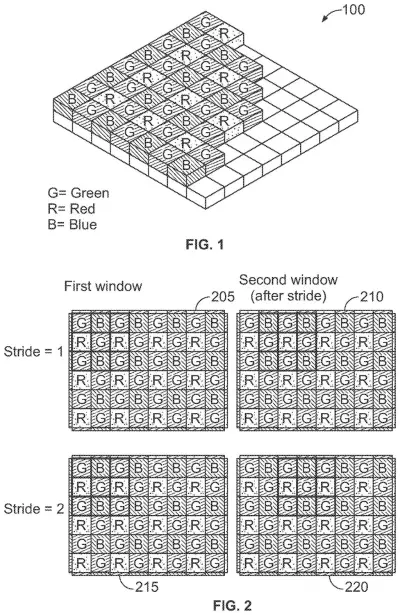
Most camera sensors don't record a finished color photo. Each tiny light sensor sits under a red, green or blue filter, arranged in a repeating tile pattern, and software normally converts that into a regular color image before an AI looks at it. Google's filing describes teaching the AI to read the mosaic directly, by making its first look at the image step across the pattern in a way that always lines up with it.
In the filing's robot example, skipping the conversion avoids about 1 millisecond of delay per camera and cuts the data being moved around by two-thirds.
… converting each image of the plurality of images to a respective image comprising image data arranged in a color filter array, and wherein the color filter array corresponds to an arrangement of color filters on a grid of photosensors corresponding to a camera sensor; …
Translation: The system rearranges regular photos to mimic the raw pixel layout of an actual camera sensor.
How the AI's first step lines up with the sensor
The patent covers training a convolutional neural network (an image-recognition AI that slides a small window across a picture and scores what it sees) to work on raw sensor data. The twist is in the first layer. A sensor's color filter array, such as the common 2×2 Bayer pattern, repeats, so a pixel's color depends on its position. A window that moves one pixel at a time ends up applying the same learned weights to red pixels in one spot and green pixels in the next, which muddies the color information.
The fix is to align the window's stride (how many pixels it jumps between steps) with the pattern: 2 for Bayer, 4 for a Quad Bayer sensor, or a multiple of those. Then each weight always sees the same color.
Training works like this:
- Start with ordinary color (RGB) images.
- An extra conversion layer re-renders each one as mosaic data, as a real sensor would capture it.
- Train the network with the aligned stride.
- Remove the conversion layer afterward, so the network reads raw sensor output directly.
Cropping during training must also land on multiples of the pattern, so colors keep their positions. The filing says training can happen on the camera device or on a separate computer.
… aligning a stride of an input receptive field of the input layer to match an input grid stride for the color filter array, the stride of the input receptive field corresponds to a number of pixel shifts over the color filter array …
Translation: The artificial intelligence matches its scanning pattern directly to the physical pixel grid of the camera.
Why skipping color conversion saves time
The practical win is speed and efficiency. If an AI can read what the sensor captured without waiting for a color conversion, a camera-equipped device does less work per frame. In the filing's ping-pong robot, that meant about 1 millisecond saved per camera (roughly 15% of the time between images) and two-thirds less data sent from camera to computer to chip.
The filing lists many places this could apply: object detection on a phone, robot vision, driving systems, security cameras, satellite images and webcam effects in video calls. It also describes privacy-minded setups where processing sits right next to the sensor, so only high-level findings leave the device instead of full images. Those are examples from the filing, and no product is named.
This is the 61st Google filing in Enterprise AI we've tracked since May, following one on video from a single photo and one on browsing history as a podcast.
Source: US 2026/0370961 A1 at the USPTO (PDF). Full patent text and figures are in the official publication.
Get our take in your Top Stories
Liked this breakdown? Add Patentlyze as a preferred source on Google, and our plain-English take shows up more often in your Top Stories the next time Google patent news breaks.
Add Patentlyze on Google
One click.
There are more where this came from
We read every patent application Big Tech publishes and send you the ones worth knowing. Plain English, free, every week.
The drawings · 10 sheets
10 drawing sheets from US 2026/0370961 A1 · click any drawing to enlarge


Show the other 2 sheets


More from Google
All 1,127 Google patents →
More in AI / ML
All 2,738 AI / ML patents →
Adobe
Adobe Patents a System That Builds Slide Decks Straight From Analytics Data
Qualcomm
Qualcomm Patents a Way to Teach One AI Encoder to See Through Every Camera at Once
IBM
IBM Patents an AI System That Scores Data Quality Across Mixed Sources
Samsung
No comments yet