
Google
Google · AI / ML · Filed Jul 17, 2026 · USPTO published Nov 12, 2026 · This week's release
Google Files Patent for a Spreadsheet-Style Tool That Teaches AI by Example
A few rows of examples in a table could be enough to customize an AI model, according to a new Google patent application.
- Publication number
- US 2026/0359023 A1(US20260359023A1)
- Applicant
- Google LLC
- Filed · Published
- Jul 17, 2026 · Nov 12, 2026
- Inventors
- Mr. Andy Coenen, Mr. Ludovic Peran, Mr. Michael Terry, Mr. Aaron Donsbach
- Status when we published
- Waiting for an examiner
- Document
- 20 claims
- US classification
- 717/105
- Parent application
- Continuation of 18/604,444 (filed Mar 13, 2024)(18604444)
What Google's example-table AI builder does
Every time you ask an AI chatbot to rewrite something and it gets the format wrong, you end up typing the same correction again and again. Building an AI tool that gets it right the first time currently takes coding skills and weeks of work, according to Google's filing.
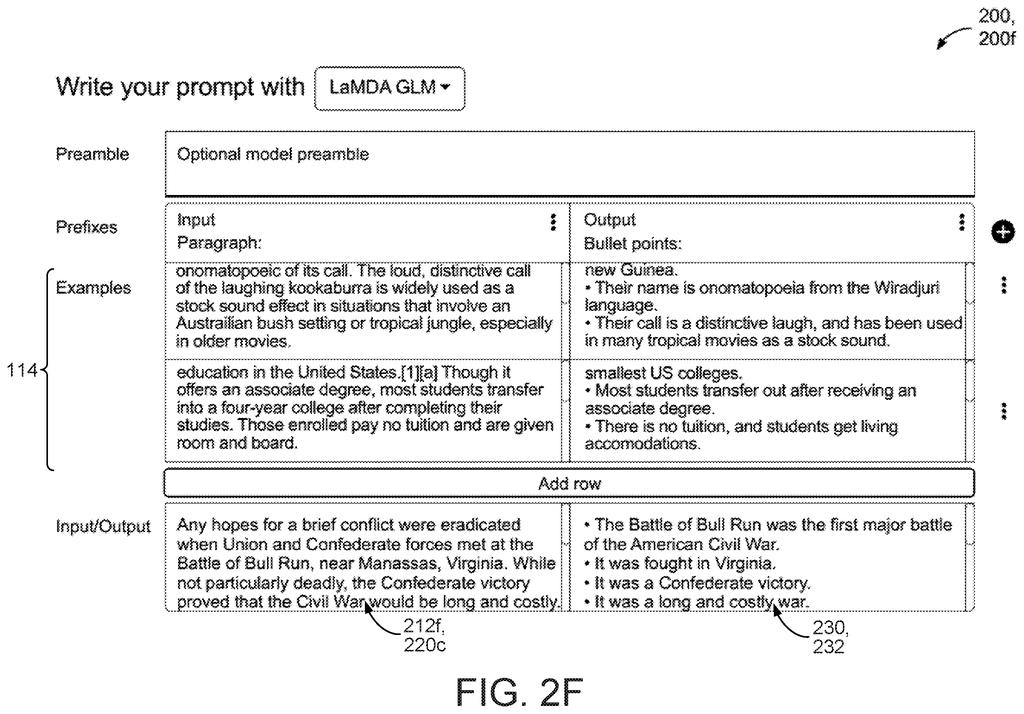
This patent describes a web form that cuts that down. You pick one of several existing AI models from a drop-down menu, write a short note about the job, and fill in a table. Each row holds an example input and the answer you want back. The filing mentions three to five rows as a typical amount.
Press run, and the system adjusts the model to match your examples. You can type in a fresh test and see what comes out, fix your examples, and try again. When you're happy, it hands you ready-made code so an app can use your custom model. Google says the whole process takes minutes instead of weeks.
a model selection input element allowing selection of a pre-trained machine learning (ML) model from a plurality of different ML models; a preamble text input field for capturing text identifying instructions for the selected pre-trained ML model; and one or more user input fields representing a corresponding training sample …
Translation: The tool lets users pick an AI model, write instructions for it, and provide training examples.
How the form turns examples into a working model
The patent covers a web tool (what developers call an integrated development environment, a workspace for building software) for customizing an existing AI model. When you start, your browser receives a structured prompt, a form with specific boxes to fill in.
The form has three main parts:
- A model picker: a drop-down menu for choosing a pre-trained model (an AI model that has already learned from a huge pile of text).
- A preamble box: where you write instructions for the model.
- A table of examples: each row has one box for a sample input and one for the ground-truth output (the exact answer you want). A button adds more rows.
When you submit, the system adjusts the model using your instructions and examples. The claims mention one-shot or few-shot learning (teaching a model from one or a handful of examples). You can then type a test input, read the output in the same window, fix or add examples, and go again. Rows can also be filled from a spreadsheet or CSV file.
Finally, the system generates code that calls an API (a doorway that lets other software talk to the model), so the tuned model can run inside an app.
… each user input field representing a corresponding training sample and including a first corresponding text input field for capturing input text to be provided to an ML model, and a second corresponding text input field for capturing ground-truth output text.
Translation: Users supply matching pairs of input text and correct output text to train the AI.
Why Google's form could open AI building to non-coders
The practical pitch is speed and access. The filing says current AI development takes machine learning skills, coding skills and weeks of work, and that this tool lets people build a model in minutes. If that holds up, a person who knows their own subject, such as a teacher or a customer support lead, could build a custom text tool without hiring an engineer.
For Google, a tool like this would sit on top of its AI models and give developers an easy on-ramp. The description lists a model picker, so people could choose among several models. The patent says nothing about pricing or release, and it describes a method, not a product.
Google's 57th filing we've tracked in AI training & infrastructure since May follows work like blending models to resist tricks and training AI on fake photo flaws.
Source: US 2026/0359023 A1 at the USPTO (PDF). Full patent text and figures are in the official publication.
Get our take in your Top Stories
Liked this breakdown? Add Patentlyze as a preferred source on Google, and our plain-English take shows up more often in your Top Stories the next time Google patent news breaks.
Add Patentlyze on Google
One click.
There are more where this came from
We read every patent application Big Tech publishes and send you the ones worth knowing. Plain English, free, every week.
The drawings · 10 sheets
10 drawing sheets from US 2026/0359023 A1 · click any drawing to enlarge


Show the other 2 sheets


More from Google
All 1,079 Google patents →
More in AI training & infrastructure
All 316 AI training & infrastructure patents →
Qualcomm
Qualcomm Patents an AI That Blends Any Image's Style With Any Other's Content
OpenAI
OpenAI Files Patent for Keeping Thousands of Custom AI Models Ready to Answer
OpenAI
OpenAI Files Patent for Letting Customers Teach Its AI With Their Own Pictures
Qualcomm
No comments yet