
Google
Google · Cell phone · Filed Oct 21, 2025 · USPTO published Nov 12, 2026 · This week's release
Google Files Patent for a Foldable Screen Hinge Built Around Magnets
The hinge is the part of a foldable phone that wears out first, and Google has filed a patent that puts magnets inside it. The pull of those magnets changes as the screen folds, so the hinge feels different at each angle.
- Publication number
- US 2026/0362616 A1(US20260362616A1)
- Applicant
- Google LLC
- Filed · Published
- Oct 21, 2025 · Nov 12, 2026
- Inventors
- Shih Wei Hsiang, Kuan-hsu Chen
- Status when we published
- Waiting for an examiner
- Document
- 14 claims
- US classification
- 361/807
- Parent application
- National Stage Entry of PCT/US2023/022400 (filed May 16, 2023)(PCTUS2023022400)
What Google's magnetic foldable hinge does
Ever noticed how a foldable phone can feel a little loose or gritty after a year of opening and closing it? A hinge is packed with gears, springs and tiny parts, and dust and wear can leave it stiff, wobbly or out of line.
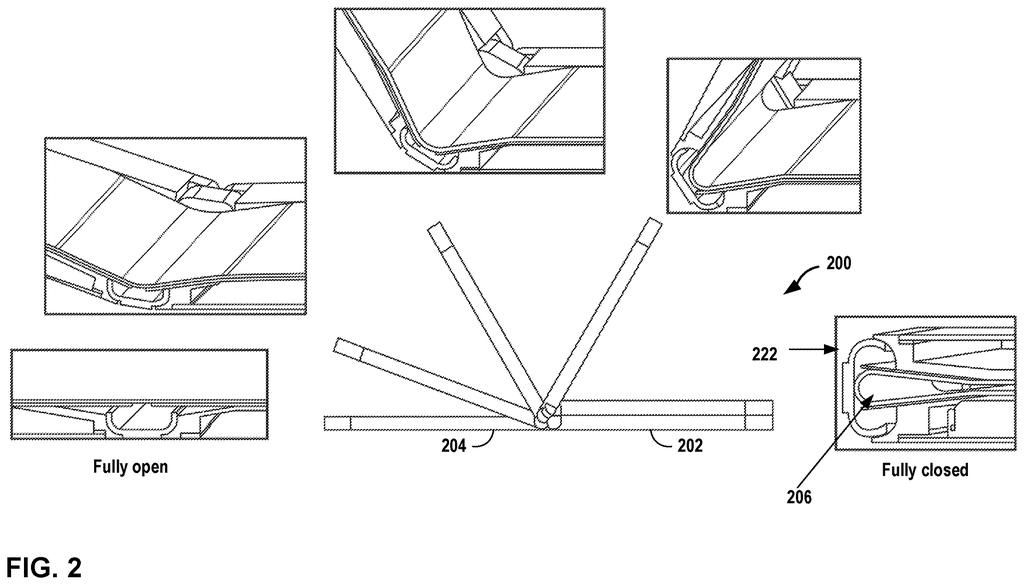
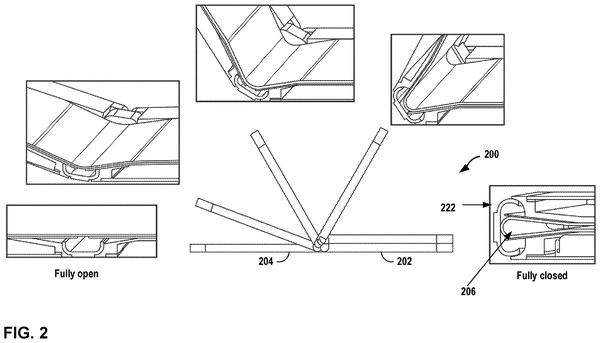
Google's filing adds magnets to the hinge. Each half of the device has a magnet inside, and a matching magnet sits at the end of a small arm attached to the hinge. The two face each other with opposite poles, so they pull together and give the fold a gentle resistance.
That pull changes as you move the screen, so the hinge can feel different at each angle. The company says the goal is a device that opens and closes fully, smoothly and securely, and that lines up properly every time. The screen is one continuous display that spans both halves.
… a first arm assembly comprising: a first proximal end rotatably connected to the hinge assembly about the first hinge axis; and a first distal end on which the first magnetic element is positioned …
Translation: A moving arm holds one of the magnets near the hinge.
How the magnets pull as the screen folds
The device in the claims has a continuous display (one screen that runs across the fold), a hinge, and two halves that swing open and shut. The hinge has two gears that mesh together, so both halves move in sync. Each half is attached to the hinge on a gear axis (the line it rotates around).
The magnet part works like this. A small arm is attached to the hinge on a separate hinge axis, and a magnet sits at the far end of that arm. A second magnet, with the opposite pole, sits inside the nearby half of the device. Because the gear axis and the hinge axis are not in the same place, the gap between the two magnets changes as the angle changes. Magnetic pull grows as magnets get closer, so the resistance does not rise in a straight line.
The filing gives example numbers. The magnets add a twisting force of about 50 newton-millimeters when the device is fully open. That rises to about 65 near 120 degrees and falls to about 20 when it is closed.
The filing also describes optional extras:
- Hinge plates with slots that the arm slides in, to guide the motion
- Supporting plates under the screen, held down by spring-loaded pins
- Extra gears to keep both halves in step
- OLED or micro LED screens
The hinge sits inside the housing, which helps keep out dust.
The first assembly includes a second magnetic element having an opposite pole to the first magnetic element.
Translation: A second matching magnet sits nearby with the opposite magnetic pole.
What magnet hinges mean for foldable phones
If you have used a foldable phone, you know the hinge is the part people worry about. Google's own filing says hinges are complex and expensive, and that dust and daily use can make them stiff, loose or misaligned, which can even damage the screen. Magnets that help the device settle open and shut, and that the company says take little damage over time, are aimed at exactly those complaints.
The filing lists foldable phones, tablets, e-readers and gaming devices as examples, and it names no specific product. For now it shows how Google thinks about the feel of opening and closing a big-screen device that still fits in a pocket. Whether it ever reaches a shipping device is unknown, but the hinge is where foldables are won or lost.
Google's third filing we've tracked since July in the foldable phone race follows their earlier applications on the auto-snap hinge and the frame-hidden antenna.
Source: US 2026/0362616 A1 at the USPTO (PDF). Full patent text and figures are in the official publication.
Get our take in your Top Stories
Liked this breakdown? Add Patentlyze as a preferred source on Google, and our plain-English take shows up more often in your Top Stories the next time Google patent news breaks.
Add Patentlyze on Google
One click.
There are more where this came from
We read every patent application Big Tech publishes and send you the ones worth knowing. Plain English, free, every week.
The drawings · 7 sheets
7 drawing sheets from US 2026/0362616 A1 · click any drawing to enlarge


More from Google
All 1,079 Google patents →
More in Cell phone
All 485 Cell phone patents →
Samsung
Samsung Files Patent for Foldable Screens That Put Less Touch Wiring at the Crease
Samsung
Samsung Patents a Rubber Edge Guard for Phones That Fold Three Times
Samsung
Samsung Patents a Glass-and-Plastic Cover for Foldable Phone Screens
Samsung
No comments yet