
Google
Google · AI / ML · Filed Dec 30, 2025 · USPTO published Nov 19, 2026 · This week's release
Google Files Patent for Picking Ads While an AI Answer Is Still Being Written
Ask an AI chatbot to compare leather pants, and this Google patent application describes choosing the matching ad before the answer has even finished writing itself. The goal is to add extra content without making you wait.
- Publication number
- US 2026/0368222 A1(US20260368222A1)
- Applicant
- Google LLC
- Filed · Published
- Dec 30, 2025 · Nov 19, 2026
- Inventors
- Raghavendra Rao Donamukkala, Laukik Chitnis, Alpa Jain, Timothy Benjamin Whalin, Abhishek Aggarwal, Jennifer Veneranda Cordova, Max Moroz
- Status when we published
- Waiting for an examiner
- Document
- 20 claims
- US classification
- 707/748
- Examiner
- BOWEN, RICHARD L (Art Unit 2165)
- Parent application
- Claims priority from a provisional application 63805419 (filed May 14, 2025)
What Google's mid-answer ad matching does
A shopper asks an AI chatbot to compare leather pants from a favorite clothing brand. The answer streams onto the screen. If an ad for those same pants gets added only after the answer is done, you wait a little longer. That delay is the problem Google is trying to remove.
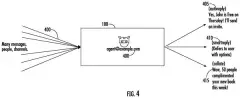
In this patent application, the AI doesn't wait to finish before looking for something to show you. While it works, it writes a short shorthand version of your question, such as 'compare men's leather pants fashion brand.' A second AI model reads that shorthand and picks matching content. The filing says that content can be an advertisement, a post, a review or a short video.
The result is that the extra content can appear at nearly the same moment as the answer. Google also describes how to decide where it sits on the screen and how to mark it as separate from the answer.
… determining, by the one or more processors, digital content relevant to the query based on the intermediate data as the AI model is generating a response to the query …
Translation: Ads are selected while the chatbot is still figuring out its answer.
How the shorthand phrase finds matching content
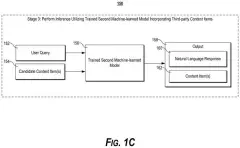
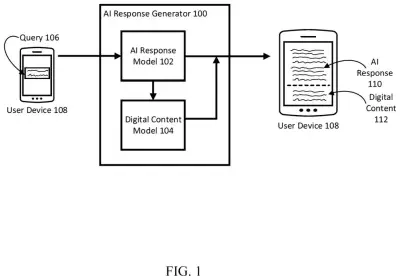
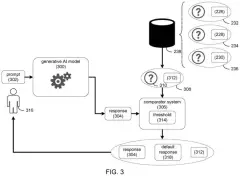
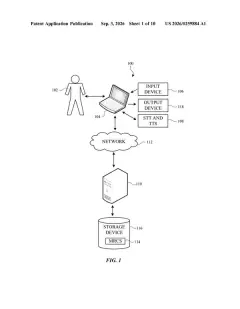
The patent describes two AI models working side by side. One writes the answer to your question. The other, a digital content model, finds something relevant to show with it. Claim 1 covers receiving intermediate data (half-finished information the first model produces along the way) and using it to pick content while the answer is still being generated.
The main kind of intermediate data is a proxy phrase: a short, machine-written stand-in for what you meant. It can drop or reorder words. The filing's example turns 'I would like to compare similar leather pants for men from Fashion Brand' into 'compare men's leather pants fashion brand.' Phrases can be saved next to the original question and reused later. The first model also scores whether a phrase says enough, and only sends it along once the score passes a threshold.
The second model then compares candidate content to the phrase. It can turn both into embeddings (lists of numbers that capture meaning) and check how close they are. It can also use similarity thresholds, ranking or weighting.
Once content is chosen, the filing describes a few more steps:
- A short header is written for the content, capped at a set number of tokens (small chunks of text), and cut or rewritten if too long.
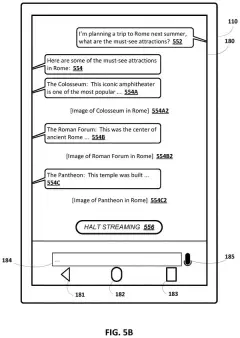
- A short answer puts the content at the bottom, a medium one at the top, and a long one inside the answer or at the side.
- A dashed line or a 'sponsored' label can separate it from the answer.
An AI model for generating the response generates proxy phrases that another AI model for determining the relevant digital content utilizes.
Translation: One AI writes temporary phrases so a second AI can pick out matching ads.
What this means for ads inside AI answers
If you use AI chatbots, the practical takeaway is that ads and other extras could show up alongside answers without adding the wait that tacking them on afterward would cause. You might not notice anything slower, even when the answer carries a commercial suggestion. The filing says this works within milliseconds of the answer appearing.
The filing also frames this as a business issue. Chat-style answers have no list of links, so content owners have no obvious place to reach you. This design gives them one, and lists advertisements as an example. The filing names no product, so it only shows the problem Google is trying to solve.
That makes this Google's 101st filing we've tracked in AI assistant & agent coverage since May, a topic that already includes patents for ads inside AI answers and shoppable AI podcasts.
Source: US 2026/0368222 A1 at the USPTO (PDF). Full patent text and figures are in the official publication.
Get our take in your Top Stories
Liked this breakdown? Add Patentlyze as a preferred source on Google, and our plain-English take shows up more often in your Top Stories the next time Google patent news breaks.
Add Patentlyze on Google
One click.
There are more where this came from
We read every patent application Big Tech publishes and send you the ones worth knowing. Plain English, free, every week.
The drawings · 9 sheets
9 drawing sheets from US 2026/0368222 A1 · click any drawing to enlarge


Show the other 1 sheets

More from Google
All 1,127 Google patents →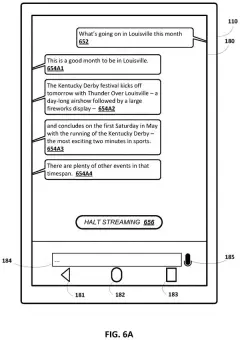
More in AI assistant & agent
All 436 AI assistant & agent patents →
Microsoft
Microsoft Files Patent to Train AI on One Great Answer and a Few Bad Ones
IBM
IBM Files Patent for an AI Referee That Picks the Best Chatbot Answer
Microsoft
Microsoft Files Patent for an AI-Made Answer Key That Catches Chatbot Mistakes
Microsoft
No comments yet