
Samsung Patents a Way for AI to Turn Your Chat History Into Generated Images
Most AI image generators require you to type a precise description. Samsung is filing patents around a system that reads your conversation and writes that description for you.
What Samsung's conversation-to-image AI actually does
Ever tried to describe a mental image to an AI and gotten something completely wrong back? That gap between what you mean and what the AI understands is a real friction point, and it's what Samsung is working on here.
The idea is that instead of asking you to write a detailed prompt like "a cozy cabin in winter at dusk, watercolor style," the AI reads your back-and-forth conversation and figures out what image you probably want. It pulls context from the whole exchange, not just your last message, and turns that into the specific kind of description an image generator needs to do a good job.
In practice, a separate AI model sits between your chat and the image generator. You talk naturally, it translates, and the image generator gets a well-formed prompt it can actually use. Samsung trained this middle-layer model on lots of real pairs of conversations and the prompts that matched them.
receiving a dialogue; obtaining a prompt corresponding to the dialogue by inputting the dialogue to a prompt generative model; and obtaining an image based on the prompt …
Translation: The system reads your chat and uses an AI model to turn it into an image generation prompt.
How the prompt model reads dialogue to build image instructions
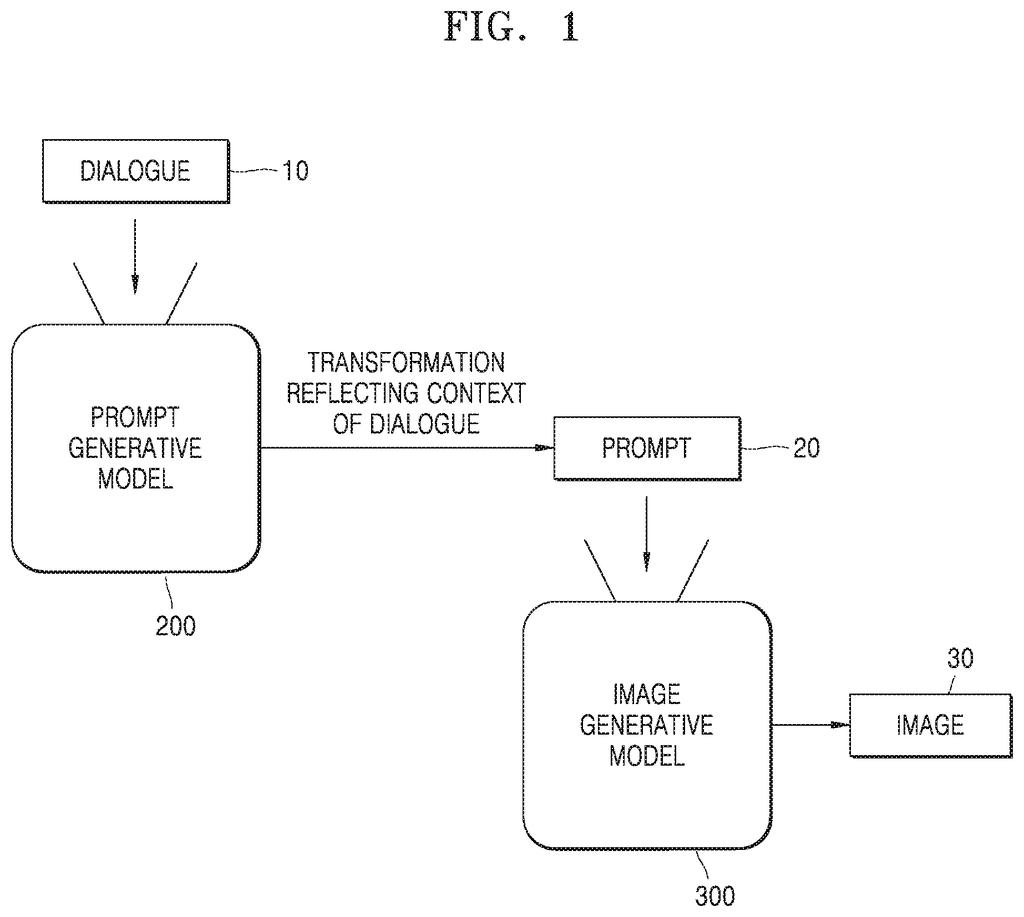
The system has two distinct AI components working in sequence. First, a prompt generative model takes in a dialogue (a multi-turn conversation, not just a single sentence) and produces a written prompt. Second, a standard image generative model takes that prompt and produces the final image.
The key design choice is how the prompt model is trained. Samsung trained it on dialogue-prompt pairs, meaning real examples where a conversation was matched to a well-crafted image prompt. That training teaches the model to pick up on context spread across a whole conversation, not just the most recent message. If you said "something warm" three messages ago and "like the picture we talked about" just now, the model tries to hold all of that together.
The prompt it outputs is described as a description based on the context of the dialogue, which means it goes beyond keyword extraction. It's meant to produce a coherent, descriptive sentence or paragraph that an image generator can act on.
- User holds a natural conversation
- Prompt generative model reads the full dialogue and outputs a structured image description
- Image generative model produces the final image from that description
… the prompt comprises a description based on a context of the dialogue, and wherein the prompt generative model may be trained based on a plurality of dialogue-prompt pairs.
Translation: The AI creates prompts from conversation context using training data made of matched chats and prompts.
What this means for AI image tools on Samsung devices
The friction of writing good AI image prompts is a real barrier for most people. Prompt engineering, the practice of carefully wording instructions to get better AI outputs, is its own skill set that most users don't have and don't want to learn. A system that reads what you actually said, in normal conversation, and handles that translation step in the background would make AI image generation far more accessible.
For Samsung, this fits naturally into a device like a phone or tablet where conversations happen constantly, whether in a messaging app, a voice assistant, or a built-in AI chat interface. Samsung's track record in on-device AI patents suggests the company is thinking about where these models run, though this filing doesn't specify on-device versus cloud processing.
Samsung's 37th filing in the AI image and video patents we've tracked since May joins earlier work like one that grades its own edits and one that captions stored photos.
The concept is straightforward and the problem it solves is real: writing good image prompts is hard, and most people won't bother. A model that bridges natural conversation and structured prompt writing is a useful idea.
The ship path is short in theory. The core components, a language model and an image generator, already exist as off-the-shelf building blocks. The specific contribution here is the middle-layer model trained on dialogue-prompt pairs, which means Samsung would need a solid dataset of those pairs and a model tuned on them. That's tractable engineering work, not a research moonshot.
What the patent doesn't tell you is how well this actually works in practice, or how the system handles vague or contradictory conversation history. A filing describes the architecture; the hard part is the training data quality and whether the prompt model's outputs are consistently better than what a user would type themselves.
There are more where this came from
We read every patent application Big Tech publishes and send you the ones worth knowing. Plain English, free, every week.
The drawings
12 drawing sheets from US 2026/0301245 A1 · click any drawing to enlarge


Want this weekly breakdown for a company we don't cover? Patentlyze Pro →
Be the first to weigh in