
Google
Google · AI / ML · Filed Jul 17, 2026 · USPTO published Nov 12, 2026 · This week's release
Google Files Patent for Fixing Group Photos by Borrowing Faces From Other Shots
Google's patent describes a way to fix a group photo by borrowing a better face, or a whole head, from another frame in the same burst. The twist is that it decides which kind of swap will look more natural.
- Publication number
- US 2026/0360049 A1(US20260360049A1)
- Applicant
- Google LLC
- Filed · Published
- Jul 17, 2026 · Nov 12, 2026
- Inventors
- Jay TENENBAUM, Assaf ZOMET, Barel LEVY, Yaron BRODSKY, Shiran ZADA, Yael Pritch KNAAN, Ariel EPHRAT, Inbar MOSSERI, Avram GOLBERT
- Status when we published
- Waiting for an examiner
- Document
- 20 claims
- US classification
- 345/629
- Parent application
- Continuation of 18/906,015 (filed Oct 3, 2024)(18906015)
What Google's group-photo face swap actually does
The more people you squeeze into a group photo, the better the odds that somebody blinked, looked away, or got caught mid-sentence. Retaking the shot again and again only works until everyone's patience runs out.
This Google patent describes a way to fix the one good photo you have by borrowing from the others you took. You pick the best overall shot, then choose a better face for each person from the rest. The software swaps in a whole head or just the eyes and mouth, depending on which will look more natural.
The filing says earlier tools of this type left visible seams or leftover pixels from the original. Google's approach tries to hide those, so the final picture looks like it was taken in one moment.
… determining to use a face editor based on a difference between a first angle of a target head of the subject in the target image and a second angle of a source head of the subject in the source image …
Translation: The system decides to fix a face when someone is looking the wrong way in a photo.
How Google picks between a face or head swap
The patent covers a photo tool with two kinds of editors. You start with a target photo (the shot you like best overall) and one or more source photos (other frames, often from a burst) where a person looks better. The claims center on the face editor, which gets used when the head angle in the target and source photos is close enough to match.
The face editor moves only things like eyes and mouths. It straightens the face to a standard pose, turns the face into a list of numbers that describes it (a latent-space vector), and copies the eye and mouth numbers from the source into the target. Then it redraws the face and tilts it back to its original pose. The filing leaves the nose alone, since a nose from a differently tilted head can look out of place.
When the angles differ more, the filing describes a head editor that replaces the whole head, hair included. It fills the neck and shoulders with a blend computed from both photos and repaints any background the old head uncovered. It skips this when heads are crowded together or one is blocked, which it can spot by comparing color histograms (a count of the colors in each picture).
For phones, the filing also describes a lightweight on-device model. It warps a dense face mesh (a grid of points mapped over the face) from the source onto the target, and a larger offline model cleans up artifacts and helps train the phone version.
Why your next group photo could need fewer retakes
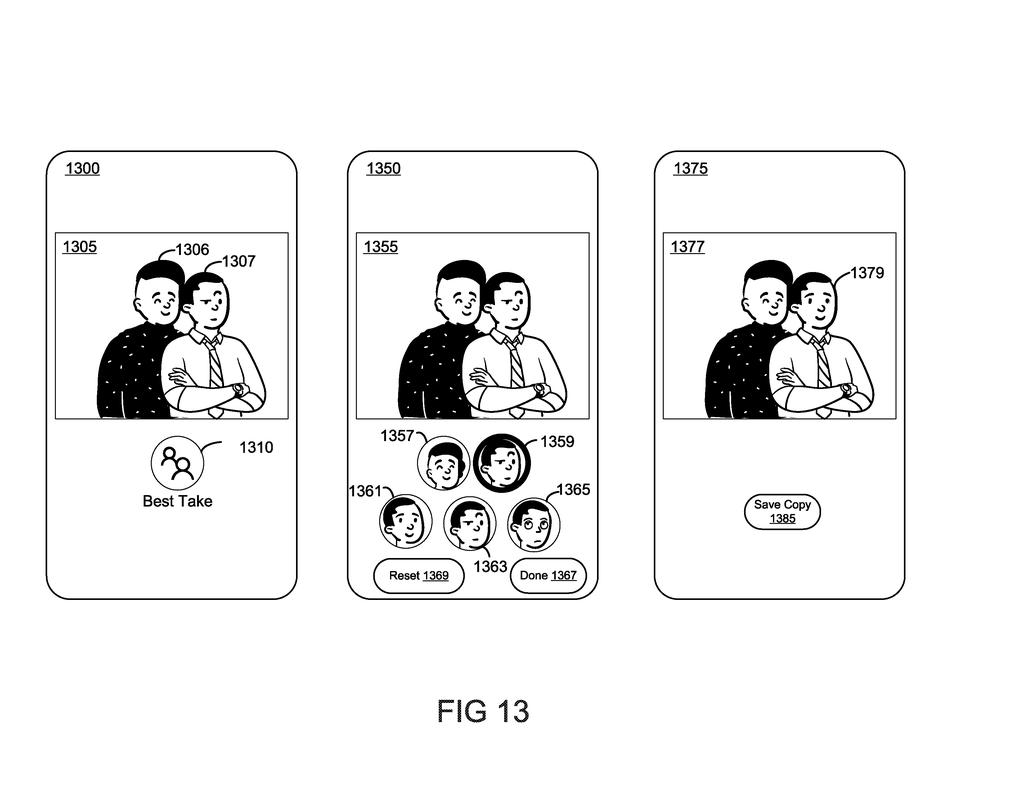
If you've taken a group photo, you know the routine: shoot a dozen frames and hope. A tool like this would let you pick one frame and fix the person who blinked, using another frame from the same burst. The filing's mock-up even shows a Best Take button, with a choice of faces for each person in the shot.
For Google, the interesting part is the plan to run it on the phone itself. The filing says processing can happen on your device or on a server depending on your settings, and edits only go ahead with your permission. The real test is whether results look natural in hard cases like hats, crowded heads and big pose changes.
Google's 83rd filing we've tracked since May builds on video grown from one photo and erasing text from photos in our AI photo editing watchlist.
Source: US 2026/0360049 A1 at the USPTO (PDF). Full patent text and figures are in the official publication.
Get our take in your Top Stories
Liked this breakdown? Add Patentlyze as a preferred source on Google, and our plain-English take shows up more often in your Top Stories the next time Google patent news breaks.
Add Patentlyze on Google
One click.
There are more where this came from
We read every patent application Big Tech publishes and send you the ones worth knowing. Plain English, free, every week.
The drawings · 13 sheets
13 drawing sheets from US 2026/0360049 A1 · click any drawing to enlarge


Show the other 5 sheets


More from Google
All 1,079 Google patents →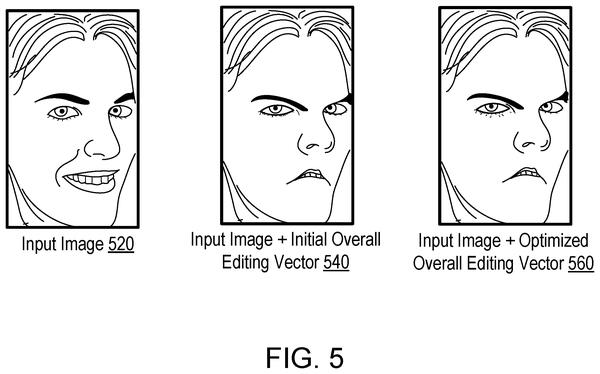
More in AI vision
All 339 AI vision patents →
Nvidia
Nvidia Files Patent to Keep AI-Altered Faces From Looking Pasted Onto Video
Samsung
Samsung Files Patent to Undo the Stretched Faces in Close-Up Selfies
Qualcomm
Qualcomm Files Patent for Training AI to Erase Objects From Photos Cleanly
Samsung
No comments yet