
Google
Google · Software · Filed May 16, 2025 · USPTO published Nov 19, 2026 · This week's release
Google Patents Product Photos That Start Spinning in Sync as You Scroll
Scroll past a row of shoe ads and each one could start turning on its own, all at the same speed and facing the same way. Google's filing also says the spin can be built from as few as three ordinary photos.
- Publication number
- US 2026/0368981 A1(US20260368981A1)
- Applicant
- GOOGLE LLC
- Filed · Published
- May 16, 2025 · Nov 19, 2026
- Inventors
- Valdrin KOSHI
- Status when we published
- Examiner raised objections; the company can respond
- Document
- 20 claims
- US classification
- 345/473
- Examiner
- MAZUMDER, SAPTARSHI (Art Unit 2612)
What Google's spinning-shoe ad patent does
Imagine you're scrolling a shopping page for sneakers. Four ads sit in a column, and each shoe is frozen in a different pose, so comparing them means tapping and dragging each one to turn it around.
Google's filing describes a page that does the turning for you. Once a product photo is fully on your screen, it swaps itself for a short spinning view, and every shoe turns at the same speed and faces the same direction at the same moment. When a photo scrolls away, the spinning version is thrown out so your browser isn't bogged down.
The spinning view is built from just a handful of pictures, as few as three from a merchant, flipped through like a flipbook.
… automatically loading and animating a first set of generated 360-degree videos of the 360-degree generated videos in place of the static images in the first set of instances.
Translation: The site swaps still photos for spinning videos once items scroll into view.
How the spin gets built from three photos
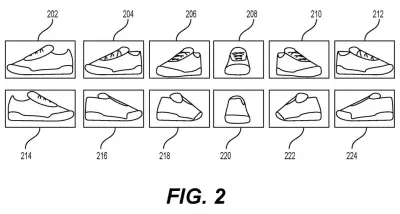
The method starts with what a merchant already has: a 3D model of a product, or as few as three ordinary photos. From those, the system generates a set of still pictures showing the object turned a little further each time. One example is 12 pictures, each rotated 30 degrees around the vertical axis (the line running top to bottom through the object). Flipped through quickly, they act as a 360-degree video. The filing says generative AI could fill in the missing views.
On the webpage, each product first appears as a plain still image. When the page detects that a set of those images has reached a set position in the viewport (the part of the page visible on your screen), it loads the spinning versions and swaps them in. The filing describes a few details:
- Sync: every video starts on the same frame, and an anchor point such as the middle of the screen can be tied to a specific frame, like a front view of the shoe, so products line up as you scroll.
- Skipping: the system estimates how long an item will stay on screen. If too few frames could play in that time, it keeps the still image.
- Cleanup: videos are discarded once they leave the screen.
The filing puts a set of about 24 images at roughly 200 to 300 kilobytes, compared with 3 or 4 megabytes for a full 3D model.
… such that the objects are oriented in the same rotational position at all points of rotation and the rotational speed is the same for all of the objects.
Translation: All the product images spin in perfect synchronization at the exact same speed.
What this means for Google's shopping ads
If you shop on your phone, this targets a small annoyance: product photos that sit still until you tap and drag them. A page that shows every shoe turning together, with no effort from you, makes side-by-side comparison easier. The filing also says only the items on screen get the heavier spinning treatment, which keeps busy pages from bogging down.
For merchants and advertisers, the draw is a richer ad built from very little, since three photos can become a rotating view. The examiner's first review rejected the claims as filed, which is routine at this stage and usually followed by amendments, so the final scope may change.
That makes this Google's 1095th filing in our Google coverage since May, adding to work like AI building 3D from photos and scenes sharpening as you approach.
Source: US 2026/0368981 A1 at the USPTO (PDF). Full patent text and figures are in the official publication.
Get our take in your Top Stories
Liked this breakdown? Add Patentlyze as a preferred source on Google, and our plain-English take shows up more often in your Top Stories the next time Google patent news breaks.
Add Patentlyze on Google
One click.
There are more where this came from
We read every patent application Big Tech publishes and send you the ones worth knowing. Plain English, free, every week.
The drawings · 6 sheets
6 drawing sheets from US 2026/0368981 A1 · click any drawing to enlarge


More from Google
All 1,127 Google patents →
More in Software
All 814 Software patents →
Samsung
Samsung Patents a Live Screen Translator That Updates as You Scroll
Salesforce
Salesforce Patents a System That Keeps Product Info in Sync Across Every Platform
Amazon
Amazon Patents a System That Translates Product Listing Images Without Breaking the Layout
Samsung
No comments yet