
Google
Google · AI / ML · Filed Jul 24, 2026 · USPTO published Nov 19, 2026 · This week's release
Google Files Patent for Training Photo-Recognition AI by Scoring Its Own Guesses
Most image AI learns by copying labeled examples. Google's patent adds a second round where the AI makes its own answers and gets graded on them, like a student moving from practice problems to the real test.
- Publication number
- US 2026/0369047 A1(US20260369047A1)
- Applicant
- Google LLC
- Filed · Published
- Jul 24, 2026 · Nov 19, 2026
- Inventors
- Alexander Kolesnikov, Xiaohua Zhai, André Susano Pinto, Yuge Shi, Lucas Klaus Beyer
- Status when we published
- Waiting for an examiner
- Document
- 20 claims
- US classification
- 382/157
- Parent application
- Continuation of 18/438,317 (filed Feb 9, 2024)(18438317)
How Google trains image AI on its own guesses
A photo app looks at a crowded street and tries to outline every car, bike and person. Some outlines are tight. Others miss a pedestrian entirely. When the AI behind the app is first trained, it only learns to copy the correct answers it is shown, so it is never graded on how good its own outlines turn out.
Google's patent adds a second round of training. After the AI studies pictures with correct answers, it starts making its own guesses. Each guess gets a quality score, and the AI is nudged toward whatever scored higher. The score can be nearly anything that fits the job, even a rating typed in by a person looking at the results.
Google says the approach paid off in its examples. An image model working on smaller pictures beat a rival method that used bigger ones at labeling every pixel in an image.
… determining a first task reward value for the first predicted output for the computer vision task, wherein the first task reward value measures a task-specific quality of the first predicted output …
Translation: The system calculates a score to measure how well the AI's image description matches the expected result.
How the score steers the model's next guess
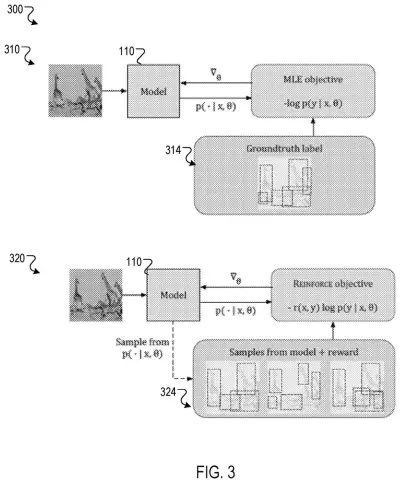
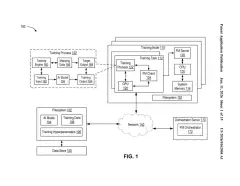
The network has an encoder (reads the picture) and a decoder (writes the answer). The answer is a string of tokens, small pieces from a fixed vocabulary, like words in a sentence. For object detection, some tokens give a box's coordinates and others name the object inside.
Training runs in two stages. First comes maximum likelihood pre-training, where the network learns to give high probability to known correct answers for labeled images. The claimed fine-tuning stage then has the network answer images itself and computes a task reward, a number for how good that answer is. Reinforcement learning (training by trial and score) then multiplies the reward by how likely the network found that answer and updates the network.
To cut noise, the filing subtracts a baseline, such as the score of a second answer for the same image, so only better-than-usual answers get reinforced. Since the reward never feeds back through the math, it can be a hard-to-calculate metric or a person's rating.
Example rewards include:
- Object detection: recall, or an approximate mean average precision (a standard accuracy score).
- Segmentation: a score derived from Panoptic Quality, rewarding matched objects and penalizing extras.
- Colorization: a reward favoring vivid, varied color over gray.
… the neural network is fine-tuned using task rewards and through reinforcement learning …
Translation: The AI improves its photo recognition by learning from its own scored guesses over time.
Why Google's smaller-image results stand out
You would never see this directly, but you could see it in results. The filing says the technique can run inside a robot or car's perception system, a camera monitoring system or a phone, or behind a web service that analyzes images on request. Scoring answers during training means the model is tuned to the job it will actually do once it is in use.
Google also reports numbers. In its object-detection example, the fine-tuned model beat a published baseline that used larger images, even though the pre-trained version had not. For panoptic segmentation (labeling what and which object every pixel belongs to), 512 by 512 images beat a method working on 1280 by 1280. Smaller inputs usually mean less work per image, though the filing gives no cost figures.
That makes this Google's 53rd filing we've tracked in AI vision since May, a run that includes fixing group photos with borrowed faces and radar gestures that self-correct.
Source: US 2026/0369047 A1 at the USPTO (PDF). Full patent text and figures are in the official publication.
Get our take in your Top Stories
Liked this breakdown? Add Patentlyze as a preferred source on Google, and our plain-English take shows up more often in your Top Stories the next time Google patent news breaks.
Add Patentlyze on Google
One click.
There are more where this came from
We read every patent application Big Tech publishes and send you the ones worth knowing. Plain English, free, every week.
The drawings · 4 sheets
4 drawing sheets from US 2026/0369047 A1 · click any drawing to enlarge


More from Google
All 1,127 Google patents →
More in AI vision
All 351 AI vision patents →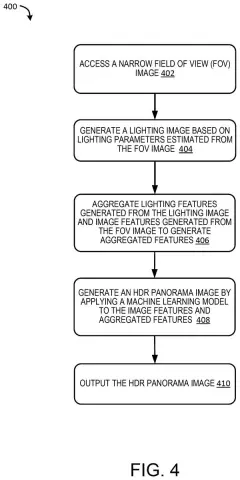
Adobe
Adobe Patents AI That Guesses the Whole Room's Lighting From One Photo
Nvidia
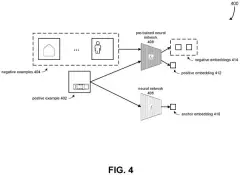
Nvidia Patents a Method to Train AI Systems on Multiple Image Types at Once
Nvidia
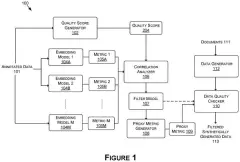
Nvidia Patents a System That Screens AI Training Data for Quality Before It Causes Problems
Nvidia
No comments yet