Google
Google · AI / ML · Filed Mar 26, 2026 · USPTO published Aug 27, 2026 · Aug 27 release
Google Patents Technology That Sends Each Learning Task to Its Most Qualified AI Specialist
Training an AI model from scratch is expensive and slow. Google's new patent describes a way to skip most of that work by directing each new task to a pre-trained specialist, rather than forcing a single generalist model to handle everything.
- Publication number
- US 2026/0252974 A1(US20260252974A1)
- Applicant
- Google LLC
- Filed · Published
- Mar 26, 2026 · Aug 27, 2026
- Inventors
- Carlos Riquelme Ruiz, André Susano Pinto, Joan Puigcerver, Basil Mustafa, Neil Matthew Tinmouth Houlsby, Sylvain Gelly, Cedric Benjamin Renggli, Daniel Martin Keysers
- Status when we published
- Waiting for an examiner
- Document
- 21 claims
- US classification
- 706/12
- Parent application
- Continuation of 18/008,293 (filed Dec 5, 2022)(18008293)
How Google's expert-routing approach cuts AI training costs
Today, when a company wants to teach an AI a new skill, it typically starts with one large general-purpose model and tries to fine-tune it for the job. The problem is that a single general model doesn't know everything about every domain equally well, so you often need enormous amounts of training data and computing power to get decent results.
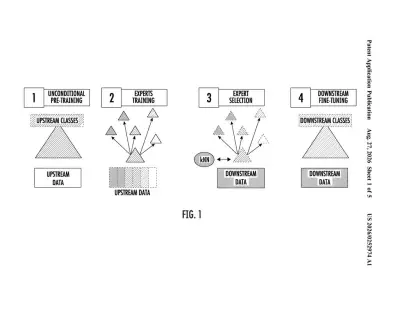
Google's patent describes a different approach. Instead of one generalist, you have a collection of expert models, each pre-trained on different kinds of data. When a new task arrives, a routing system figures out which expert (or combination of experts) is the best starting point. The new task then learns from those specialists rather than from a blank slate.
The result, according to the filing, is that you can teach AI new skills using fewer examples and less computing power than conventional approaches require. That's a meaningful cost difference when training large AI systems runs into millions of dollars.
… the present disclosure is directed to systems and methods that provide a simple, scalable, yet effective strategy to perform transfer learning with a mixture of experts (MoE). In particular, the transfer of pre-trained representations can improve sample efficiency and reduce computational requirements for new tasks.
Translation: Google is using a team of specialized AI models to learn new skills faster while using less computing power.
How the mixture-of-experts transfer strategy works
The patent covers a transfer learning system built around a mixture of experts (MoE) architecture. Transfer learning means taking a model already trained on a large dataset and adapting it to a new, specific task instead of starting from zero. A mixture of experts means the system contains multiple specialized sub-models (the "experts"), each strong in different areas.
The core idea is that generic pre-trained representations, the internal patterns a model has already learned, are usually a one-size-fits-all starting point. They work, but they're not optimized for any particular family of downstream tasks. Google's approach replaces that single starting point with a routing mechanism (a layer that decides which expert to activate) so that each new task gets transferred knowledge from the most relevant specialist.
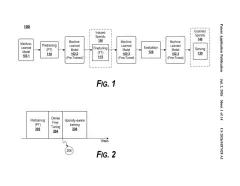
- Pre-trained expert models each hold representations tuned to different data distributions.
- A router evaluates the incoming task and selects which expert or experts should contribute their learned patterns.
- The selected expert representations are then fine-tuned on the new task, requiring fewer labeled examples than a from-scratch approach.
The filing emphasizes that the strategy is intentionally simple to implement, not a complex multi-stage pipeline, which is part of why it claims gains in both sample efficiency (needing less training data) and computational cost.
What this means for cheaper, faster AI development
The practical stakes here are about who can afford to build AI. Fine-tuning large models is the standard way companies add new capabilities to AI products, and it's expensive. If routing tasks to the right specialist genuinely cuts the data and compute required, smaller teams and tighter budgets can ship AI features that previously needed warehouse-scale infrastructure.
For Google specifically, this kind of architecture fits naturally into products that already handle wildly different query types, from image search to document understanding to language translation. A routing system that matches each task to a relevant expert is a plausible backbone for that variety. AI training efficiency is one of the more actively filed areas in plain-English patent summaries, and Google's expert-routing angle adds a structurally distinct option to an already crowded field of fine-tuning approaches.
This is the 14th Google filing we've tracked since May in our AI models in teams watchlist, following a patent on cutting multi-task AI costs and one on AI learning from errors.
Source: US 2026/0252974 A1 at the USPTO (PDF). Full patent text and figures are in the official publication.
Get our take in your Top Stories
Liked this breakdown? Add Patentlyze as a preferred source on Google, and our plain-English take shows up more often in your Top Stories the next time Google patent news breaks.
Add Patentlyze on Google
One click.
There are more where this came from
We read the new patents from Big Tech, carmakers and more and send you the ones worth knowing. Plain English, free, every week.
The drawings · 5 sheets
5 drawing sheets from US 2026/0252974 A1 · click any drawing to enlarge


More from Google
All 1,127 Google patents →
More in AI training & infrastructure
All 324 AI training & infrastructure patents →
IBM
IBM Patent Describes AI That Writes and Self-Grades Its Own Synthetic Data Code
Microsoft
Microsoft Patents a System That Uses AI to Build Training Data for Other AIs
Microsoft
Microsoft Patents AI Training That Splits Historical Data Across Multiple Workers Simultaneously
Adobe