
Honda
Honda · Automotive · Filed May 16, 2025 · USPTO published Nov 19, 2026 · This week's release
Honda Files Patent for Parked Cars That Light Up Gaps Big Enough for Your Car
Honda has filed for a way to turn parked cars into parking attendants: they light up the open gap beside them, then switch on a second light only when your car actually fits.
- Publication number
- US 2026/0369164 A1(US20260369164A1)
- Applicant
- American Honda Motor Co., Inc.
- Filed · Published
- May 16, 2025 · Nov 19, 2026
- Inventors
- JAEBUM CHOI, HYEONWOO KIM, ESTELLE GREER DYNAK STRADER, JENNIFER HWA-YUN WANG
- Status when we published
- Approved; patent expected soon
- Document
- 20 claims
- US classification
- 340/932.2
- Examiner
- AZIZ, ADNAN (Art Unit 2685)
What Honda's glowing parking-gap patent does
You're circling a packed lot, squinting at every gap between parked cars and wondering whether your SUV will actually fit. Half the time you creep in, realize it's too tight, and back out with a line of cars behind you.
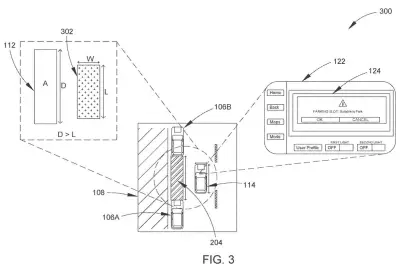
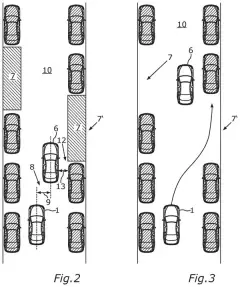
Honda's patent filing tries to take the guesswork out of that moment. The parked cars themselves measure the empty space between them. When your car rolls in slowly, it signals that it's hunting for a spot and shares how long it is. The parked cars shine a light on the open gap, and if the space is long enough for you, a second light marks it as a fit.
Your car's screen then shows an image of that spot. Once you park, the lights switch off, so the lot isn't left glowing.
… determine, based on the received first information, that a first parking slot is available between the first vehicle and the second vehicle; …
Translation: The system figures out where a gap exists between two already parked cars.
How parked cars measure a gap and signal you
The system starts with cars that are already parked. Sensors and cameras on each one (the filing lists LiDAR, ultrasonic, infrared, laser and radar sensors) measure the distance between neighboring cars. If that gap is wider than a set value, such as 10 feet in the filing's example, the system treats it as an open slot.
A car arriving at the lot sends its own details, including its length. It counts as a parking candidate when it meets conditions such as driving 10 to 20 km/h (roughly 6 to 12 mph) and being within 10 to 20 feet of the parked cars.
From there, the steps run like this:
- First light: the parked cars' electronic control units (ECUs, the small computers that run a car's lights and other functions) switch on a light to show an open gap.
- Fit check: the system compares the gap with the arriving car's length. It can also compare floor area (length times width) or use the car's model, type or cargo size.
- Second light: if the gap fits, the parked cars switch on a second light over that slot, and the details travel to the arriving car over vehicle-to-vehicle, vehicle-to-infrastructure or vehicle-to-anything wireless links.
- Screen: the arriving car displays an image of the suitable slot.
The lights turn off when the car parks, after a timer (10 to 15 minutes in the example), or when the driver taps an off option. With several open gaps, the driver can pick one, or the system can choose using a saved user profile.
The system determines whether an available parking slot is suitable to park the third vehicle based on determined the length and the distance and controls emission of a second light from the first vehicle and the second vehicle.
Translation: Parked cars shine lights on the space once they verify your car will actually fit.
What this means for tight lots and street parking
If this ever reaches real cars, you would notice it in the oldest parking headache: gaps that look big enough and aren't. The lights do the judging from outside, and your screen confirms it, which could save time in tight lots and on crowded streets. Because the parked cars do the work, the lot needs no sensors or signs of its own, a cost the filing says holds older systems back.
The patent office has approved this application and Honda has paid the fee to have it issued, so it should become a granted patent soon. The filing names no product or timeline. It covers a system, a method and a stored-software version of the same idea.
Honda's second filing we've tracked since November follows our Honda coverage that began with a partly charged battery-swap station.
Source: US 2026/0369164 A1 at the USPTO (PDF). Full patent text and figures are in the official publication.
Get our take in your Top Stories
Liked this breakdown? Add Patentlyze as a preferred source on Google, and our plain-English take shows up more often in your Top Stories the next time Honda patent news breaks.
Add Patentlyze on Google
One click.
There are more where this came from
We read the new patents from Big Tech, carmakers and more and send you the ones worth knowing. Plain English, free, every week.
The drawings · 13 sheets
13 drawing sheets from US 2026/0369164 A1 · click any drawing to enlarge


Show the other 5 sheets


More from Honda
All 8 Honda patents →
More in Automotive
All 432 Automotive patents →
Amazon
Amazon Patent Teaches Robotaxis How to Navigate Around Double-Parked Cars
Toyota
Toyota Files Patent to Cut the Wait When You Summon Your Parked Car
Qualcomm
Qualcomm Patents a Self-Driving Vision System That Spends Less Effort on Parked Cars
BMW
No comments yet