
BMW
BMW · Automotive · Filed Jun 13, 2025 · USPTO published Nov 19, 2026 · This week's release
BMW Files Patent for Cars That Split the Street to Hunt Parking
Hunting for a parking spot is usually a solo chore, but BMW describes cars that split up the work: the one in front checks one side of the street, and the one behind checks the other.
- Publication number
- US 2026/0369166 A1(US20260369166A1)
- Applicant
- Bayerische Motoren Werke Aktiengesellschaft
- Filed · Published
- Jun 13, 2025 · Nov 19, 2026
- Inventors
- Michael STROEBEL, Maria SZATKOWSKA-ZIAJA
- Status when we published
- Waiting for an examiner
- Document
- 10 claims
- US classification
- 340/932.2
- Examiner
- WU, ZHEN Y (Art Unit 2685)
- Parent application
- National Stage Entry of PCT/EP2023/081642 (filed Nov 13, 2023)(PCTEP2023081642)
What BMW's team-up parking search actually does
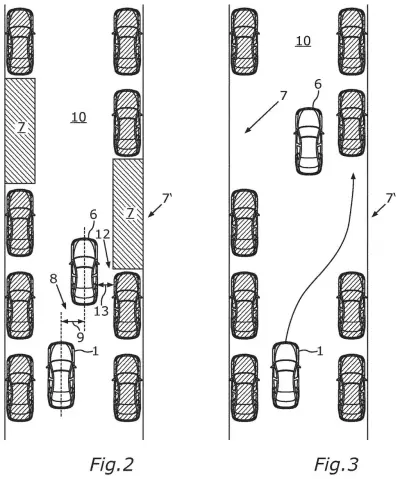
A car creeps down a narrow one-way street lined with parked cars on both sides. Its sensors can only see the side it hugs, so a free space across the way goes unnoticed.
BMW's patent application tackles this by having the car in front share what it spotted over a direct car-to-car wireless link. Your car also notices where that lead car is sitting in the lane, say close to the right curb. It then shifts to the other side of the lane so its own sensors cover the left.
Put together, the two cars can see both sides of the street, and your car can then steer itself forward into the best open space it was told about.
… receiving parking space data from a vehicle in front in the environment of the ego vehicle, wherein the parking space data describe potential parking spaces in front of the ego vehicle in the direction of travel …
Translation: The car gets tips about open spots from the vehicle driving ahead of it.
How the car behind picks a side of the lane
The filing covers a method for a car's parking assistant (the software that can steer the car into a space) during a partly automated hunt for parking. The car, called the "ego vehicle" in the patent, uses its own sensors, such as radar, lidar, ultrasonic sensors or cameras, to map its surroundings.
At the same time it receives parking space data from a vehicle ahead. That data describes potential spaces in front of the car in the direction of travel, using details like position, width, depth and angle. Sending a few numbers instead of a whole sensor map keeps the message small.
The key step is that the car's own sensors also tell it the lead vehicle's relative position, for example how far it sits from the edge of the lane. From that, the car picks a driving strategy, such as offset positioning (driving slightly off to one side of the lane), so its sensors cover the side the lead car is likely missing.
- The data can travel by direct car-to-car messaging, after the following car sends a parking space search request.
- That request can ask the lead car to hug a certain side of the lane.
- The description also mentions the lead car weaving in a wavy line to check both sides.
… a driving strategy is determined for the ego vehicle for the at least partially automated search for parking spaces, according to which the environment data will be recorded in the future …
Translation: The car adjusts how it looks for spaces based on where the lead car is positioned.
Why BMW cares about narrow one-way streets
If you have ever circled a crowded block or a supermarket lot, the appeal is plain: two cars sharing the scouting could find an open space sooner and with less fuss. It would also help most on tight one-way streets and in lots with parking on both sides, where one car cannot reliably see everything.
There is a catch the filing admits: the idea works better the more cars take part. It suggests a shared industry standard, or a version limited to one maker's cars or a single fleet. Either way, it points to parking becoming a team effort between connected vehicles rather than a task each car does alone.
BMW's second filing we've tracked since November follows our BMW coverage that began with automatic fog-clearing cameras.
Source: US 2026/0369166 A1 at the USPTO (PDF). Full patent text and figures are in the official publication.
Get our take in your Top Stories
Liked this breakdown? Add Patentlyze as a preferred source on Google, and our plain-English take shows up more often in your Top Stories the next time BMW patent news breaks.
Add Patentlyze on Google
One click.
There are more where this came from
We read the new patents from Big Tech, carmakers and more and send you the ones worth knowing. Plain English, free, every week.
The drawings · 2 sheets
2 drawing sheets from US 2026/0369166 A1 · click any drawing to enlarge


More from BMW
All 6 BMW patents →
More in Automotive
All 432 Automotive patents →
Nvidia
Nvidia Files Patent to Help Self-Driving Cars Find the Edges of a Parking Spot
Sony
Sony Patents Tech That Previews Your Parking Spot Using Nearby Cars' 3D Shape
Mobileye (Intel)
Mobileye Patents a Camera-Only System That Picks the Perfect Parking Entry Point
Amazon
No comments yet