
Honda
Honda · Automotive · Filed Mar 24, 2026 · USPTO published Nov 19, 2026 · This week's release
A New Honda Patent Teaches Cars Where to Stop Without Mapped Stop Lines
Most ordinary maps know where an intersection is but not where the stop line is painted. Honda's patent application fills that gap with a simple formula based on lane counts and corner size.
- Publication number
- US 2026/0365169 A1(US20260365169A1)
- Applicant
- HONDA MOTOR CO., LTD.
- Filed · Published
- Mar 24, 2026 · Nov 19, 2026
- Inventors
- Ryogo MATSUMOTO, Tomokazu MITSUI, Yuki KIZUMI
- Status when we published
- Waiting for an examiner
- Document
- 10 claims
- US classification
- 701/70
What Honda's stop-position estimate actually does
Imagine you're driving toward a T-junction on a quiet road. Your car's driver-assist system knows an intersection is ahead, but its map has never recorded where the white stop line is painted. So where should the car start slowing, and where should it stop?
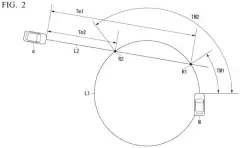
Honda's patent application answers with simple math. The car takes the intersection's spot on the map, counts the lanes on the road crossing ahead, and backs up from the intersection by enough distance to clear those lanes, plus extra room for the rounded corner. With the example numbers in the filing (4-meter lanes and a 5-meter corner allowance), a two-lane crossing road works out to about 9 meters short of the intersection.
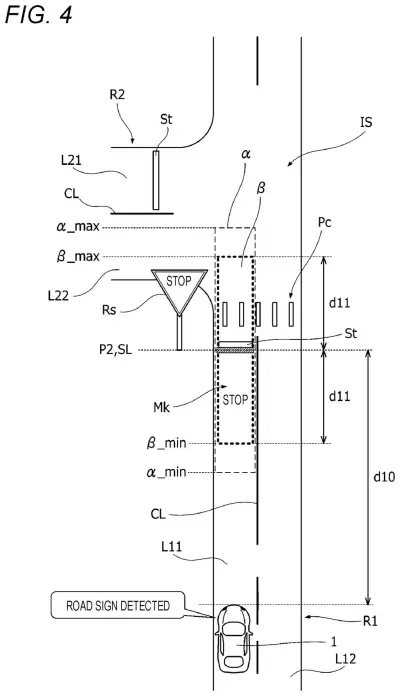
As the car gets closer, its cameras and sensors pick up a warning sign, then a stop sign, then paint on the road, and each one sharpens the guess. Once the car actually sees the stop line, it uses that instead.
… estimates, as the stop position, a position located at a distance from the intersection on a vehicle side of the intersection, the distance being a sum of a first adjustment distance according to a number of lanes of the crossing road and a predetermined second adjustment distance corresponding to a corner cut of the intersection.
Translation: The car calculates where to stop by combining the width of the crossing road with the angle of the street corner.
How Honda's car narrows its stop-point guess
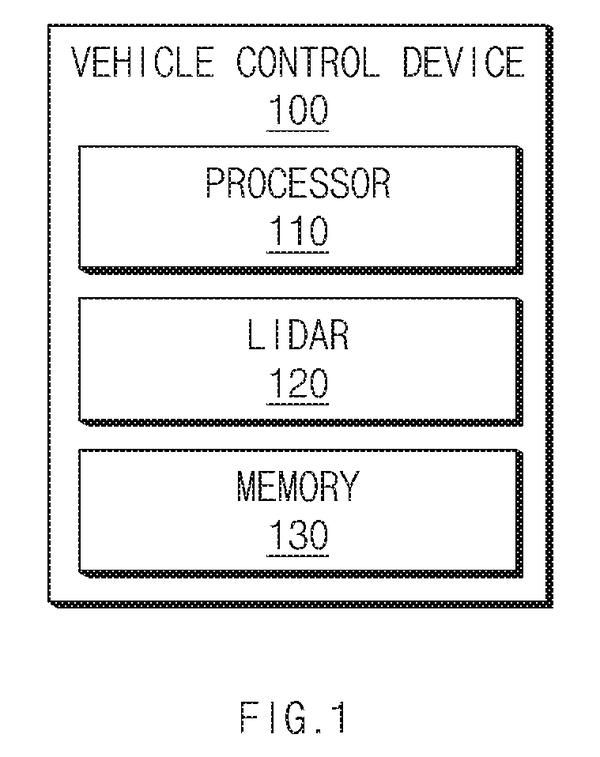
The core of the filing is a processor (the car's onboard computer) that works from standard-definition map data. That kind of map records where an intersection sits and how many lanes each connecting road has, but general maps often leave out the stop line itself.
Starting from the intersection's map position, the processor backs up toward the car by the sum of two distances:
- First distance: grows with the number of lanes on the crossing road. The example is half the lane count times a 4-meter lane width.
- Second distance: a preset allowance for the intersection's rounded corner, 5 meters in the example (it can also be zero).
The dependent claims add sensor-based refinements. An advance warning sign places the stop spot ahead of the sign by a distance matched to the road's speed limit. A stop sign inside a window around that spot (10 meters either side, in the example) takes over, and the closest sign wins if several show up. Painted "Stop" text or a crosswalk then shrinks the window further, and the midpoint becomes the stop position.
A detected stop line overrides everything, and the other estimating can stop, which saves computing. The result can feed gentle slowing or a driver alert.
What this means for driver assist on basic maps
If you drive a car with automatic slowing or stop alerts, the practical gain is reach. A system that needs stop lines in its map only works where the map has them. Honda's approach would let a car on a basic navigation map still guess a sensible stopping spot at a junction, then correct itself as it sees signs and paint.
The filing says the estimate could trigger gentle slowing so the car avoids a sudden hard brake, or simply warn the driver. It describes a left-hand-traffic setup like Japan's and says the geometry can be mirrored for right-hand roads like those in the US. It is a small building block for driver assistance, and the filing names no product.
Honda's seventh filing we've tracked since November in our Honda coverage follows patents like the turn-risk driver assist and the energy-reuse cooling system.
Source: US 2026/0365169 A1 at the USPTO (PDF). Full patent text and figures are in the official publication.
Get our take in your Top Stories
Liked this breakdown? Add Patentlyze as a preferred source on Google, and our plain-English take shows up more often in your Top Stories the next time Honda patent news breaks.
Add Patentlyze on Google
One click.
There are more where this came from
We read the new patents from Big Tech, carmakers and more and send you the ones worth knowing. Plain English, free, every week.
The drawings · 12 sheets
12 drawing sheets from US 2026/0365169 A1 · click any drawing to enlarge


Show the other 4 sheets


More from Honda
All 8 Honda patents →
More in Automotive
All 432 Automotive patents →
Waymo (Google)
Waymo Files Patent for Cars That Find Their Own Stop Spot Without a Painted Line
Qualcomm
Qualcomm Files Patent to Let Cars Pinpoint Each Other Using Painted Lane Lines
Amazon
Amazon Unit Zoox Files Patent for Maps That Draw Their Own Lane Lines
Google
No comments yet