
Honda
Honda · Energy · Filed Jun 26, 2025 · USPTO published Nov 19, 2026 · This week's release
Honda Patents a Battery-Swap Station That Keeps Spare Batteries Partly Charged
Honda has filed a patent for a battery swap station that deliberately leaves many of its spare batteries short of full. The idea is to cut battery wear without making drivers wait.
- Publication number
- US 2026/0370013 A1(US20260370013A1)
- Applicant
- Honda Motor Co., Ltd.
- Filed · Published
- Jun 26, 2025 · Nov 19, 2026
- Inventors
- Steffen Limmer, Tobias Rodemann
- Status when we published
- Waiting for an examiner
- Document
- 13 claims
- US classification
- 320/137
- Parent application
- National Stage Entry of PCT/EP2023/087816 (filed Dec 27, 2023)(PCTEP2023087816)
What Honda's battery-swap charging patent does
Ever wonder why a battery that sits at 100% for days tends to age faster than one kept a bit lower? It's a real effect, and it's a headache for a battery swap station, where drivers trade a drained EV battery for a charged one and the station's owner pays for every worn-out pack.
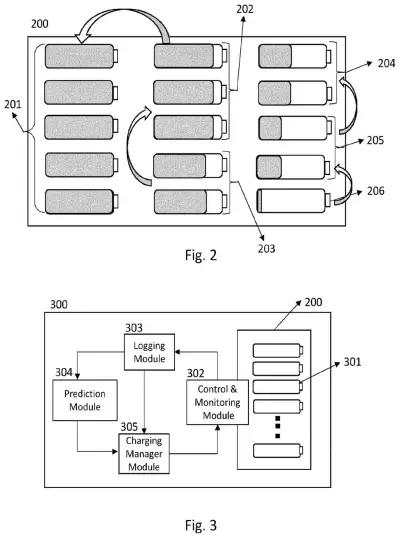
The usual approach is to keep plenty of extra full batteries on hand in case a rush shows up. Honda's patent filing takes another route. The station predicts how many full batteries it will need, adds a modest cushion, and keeps other batteries parked at something like 90% or 70%.
If the full ones run low, the 90% batteries get topped off in a short time, and the 70% ones move up to refill that 90% group. You still get a quick swap, but fewer batteries spend their days sitting at full charge.
predicting a required quantity of fully charged batteries and adding a safety margin to determine an initial number of fully charged batteries at a given time …
Translation: The system figures out how many full batteries are needed and adds a safety buffer.
How Honda's swap station stages its batteries
The patent covers a way to control charging at a battery swapping station, where an EV driver hands in a drained battery and takes a charged one. A prediction tool estimates how many fully charged batteries the station will need at a given time, then adds a safety margin (a cushion of extra batteries) to get a starting number.
Instead of charging that whole cushion to 100%, the station charges only the starting number to full. Other batteries are held at one or more pre-charge levels, meaning a lower state of charge (the percentage of the battery that is filled). The filing gives 95%, 90% or 85% as examples for the first level, and one example setup with a 90% group and a 70% group.
The station also sets a threshold, a minimum count of full batteries, and keeps comparing the real count against it. When the count drops below the threshold, batteries from the first pre-charge level get charged to full. The filing describes a chain of levels:
- Batteries from the second level refill the first level.
- Batteries from the third level refill the second, and so on down the line.
- The threshold can be set by an operator or calculated from historical data, and the prediction and cushion can be refreshed on a schedule.
The prediction, logging and charging-manager pieces can sit inside the station or run as a cloud service. A logging module records each battery's charge level and serial number over time.
charging multiple batteries to a full charge level to provide the initial number of fully charged batteries, and multiple batteries to at least a first pre-charge level, the first pre-charge level being a lower state of charge than the fully charged level …
Translation: Some batteries are fully charged while others are kept partially charged to save energy.
Why Honda's patent targets battery wear costs
For you as a driver, the benefit would be indirect. In a swap network, the operator owns the batteries, and the filing says wear on those batteries makes up a large share of running costs. If a station can serve the same number of customers with fewer batteries sitting full, that could mean lower costs and less waste, though the patent does not say anything about prices.
The approach also works as a way to hold service quality steady. The filing points out that operators tend to pick a big cushion of full batteries to avoid turning customers away, and that this leads to extra wear. A layered stock of partly charged batteries lets a station keep a smaller cushion and still react quickly to a surge of swaps.
Source: US 2026/0370013 A1 at the USPTO (PDF). Full patent text and figures are in the official publication.
Get our take in your Top Stories
Liked this breakdown? Add Patentlyze as a preferred source on Google, and our plain-English take shows up more often in your Top Stories the next time Honda patent news breaks.
Add Patentlyze on Google
One click.
There are more where this came from
We read the new patents from Big Tech, carmakers and more and send you the ones worth knowing. Plain English, free, every week.
The drawings · 2 sheets
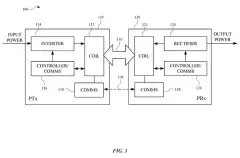
2 drawing sheets from US 2026/0370013 A1 · click any drawing to enlarge


More from Honda
All 8 Honda patents →
More in Energy
All 147 Energy patents →
Apple
Apple Files Patent for Letting Your Item Tracker Rest While You're Home
Apple
Apple Patents Earbuds That Trade Audio Speed for Battery Savings in Noisy Rooms
Samsung
Samsung Files Patent for an Add-On That Gives Older Phones Newer Bluetooth Audio
Apple
No comments yet