
Toyota
Toyota · Automotive · Filed Apr 30, 2026 · USPTO published Nov 19, 2026 · This week's release
Toyota Files Patent to Cut the Wait When You Summon Your Parked Car
Toyota wants your parked car to be ready to drive itself by the time you open the app. Its new patent uses the phone-as-car-key connection to wake the car's systems as you walk up.
- Publication number
- US 2026/0367624 A1(US20260367624A1)
- Applicant
- TOYOTA JIDOSHA KABUSHIKI KAISHA
- Filed · Published
- Apr 30, 2026 · Nov 19, 2026
- Inventors
- Tatsuya SUGANO, Takahiro YAMAMOTO, Chenyang WANG
- Status when we published
- Waiting for an examiner
- Document
- 4 claims
- US classification
- 701/2
What Toyota's wake-up-early parking patent does
Ever stood next to your car, phone in hand, watching a loading spinner? Remote parking features have a version of that problem. A parked car is mostly asleep, and two things have to wake up before it can move on its own: the connection to your phone and the computer that steers and brakes.
Toyota's patent describes a way to wake both at once. Your phone already talks to the car through a low-power key link that locks and unlocks the doors, and that link stays awake even when the car is off. The car uses it to notice you. When you open the remote-driving app and you are within a set distance, the car starts the second connection and powers up its driving computer together.
By the time you pick a route on your screen, the car is already ready.
… cause a control unit to execute remote travel control of causing the vehicle that is parked to travel to a predetermined target space in response to the travel instruction …
Translation: Instructs the parked car to drive itself to a specific spot when you summon it.
How the digital key link wakes the car
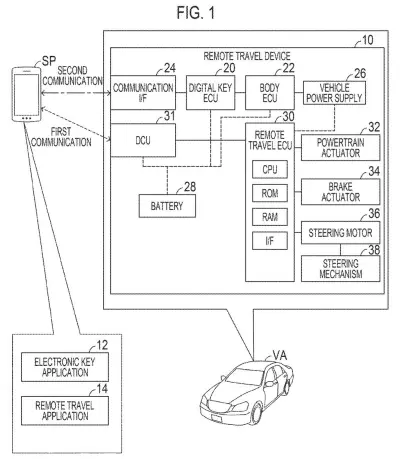
The filing covers a remote travel device: the hardware and software that let a parked car drive itself to a target spot, such as out of a parking space, while you control it from outside using your phone. Two wireless links are involved. The first communication carries the driving commands (the example given is Bluetooth). The second communication uses a different protocol (the example is Bluetooth Low Energy, or BLE, a power-sipping version) and handles the digital car key.
The problem, according to the filing, is timing. In an earlier design the first link and the driving computer woke up one after the other, so you waited twice: once for the connection, and again for the computer to boot.
Here is the new sequence:
- The car's digital key unit checks your phone's key ID, opens the second link, and measures how far away you are at regular intervals.
- You open the remote-driving app, which sends activation data.
- A body computer (the unit that controls the car's power) checks the activation condition: data received, and distance at or under a threshold.
- If both are true, it powers the communication unit for the first link and turns on the vehicle power supply, which wakes the driving computer (an ECU, or electronic control unit).
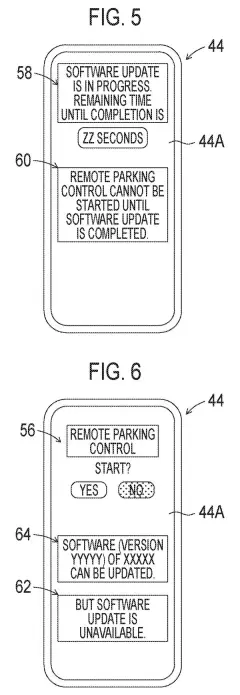
Once awake, the car uses its camera to find routes out of the space and sends them to your phone. You choose one, then keep a finger moving on the screen to keep the car going. If the commands stop, the car slows down. The filing also describes using either condition alone, and putting the key function in a separate key terminal.
… communicates, via second communication using a protocol different from a protocol of first communication, with an electronic key terminal that is carried by a portable terminal or a user and that is used to perform unlocking and locking of a door of a vehicle even when a vehicle power supply of the vehicle is in an off state …
Translation: Uses a backup wireless protocol to talk to your key fob even while the car is completely turned off.
Why this could shorten your remote pull-out wait
If you ever use a self-parking or summon-style feature, the wait before the car responds is the part you notice most. This patent attacks that wait directly by doing the two slow startup jobs at the same time instead of one after the other.
It also trims the steps for you. According to the filing, simply opening the remote-driving app is enough to set things in motion, with no extra button to press first. The design builds on the digital key your phone may already act as, so it leans on hardware a car with phone-based unlocking already has. It is a small, practical change, and the kind a driver would feel as a car that simply feels ready sooner.
Toyota's third filing we've tracked since November in our Toyota coverage follows patents on crowd simulations with AI and robots detecting task failures.
Source: US 2026/0367624 A1 at the USPTO (PDF). Full patent text and figures are in the official publication.
Get our take in your Top Stories
Liked this breakdown? Add Patentlyze as a preferred source on Google, and our plain-English take shows up more often in your Top Stories the next time Toyota patent news breaks.
Add Patentlyze on Google
One click.
There are more where this came from
We read the new patents from Big Tech, carmakers and more and send you the ones worth knowing. Plain English, free, every week.
The drawings · 5 sheets
5 drawing sheets from US 2026/0367624 A1 · click any drawing to enlarge


More from Toyota
All 16 Toyota patents →
More in Automotive
All 432 Automotive patents →
Honda
Honda Files Patent for Parked Cars That Light Up Gaps Big Enough for Your Car
Qualcomm
Qualcomm Patents a Self-Driving Vision System That Spends Less Effort on Parked Cars
Intel
Intel Patents a Way to Stream Every Car Screen to Remote Engineers at Once
Volkswagen
No comments yet